

On This Day in Science: March 13, 1781
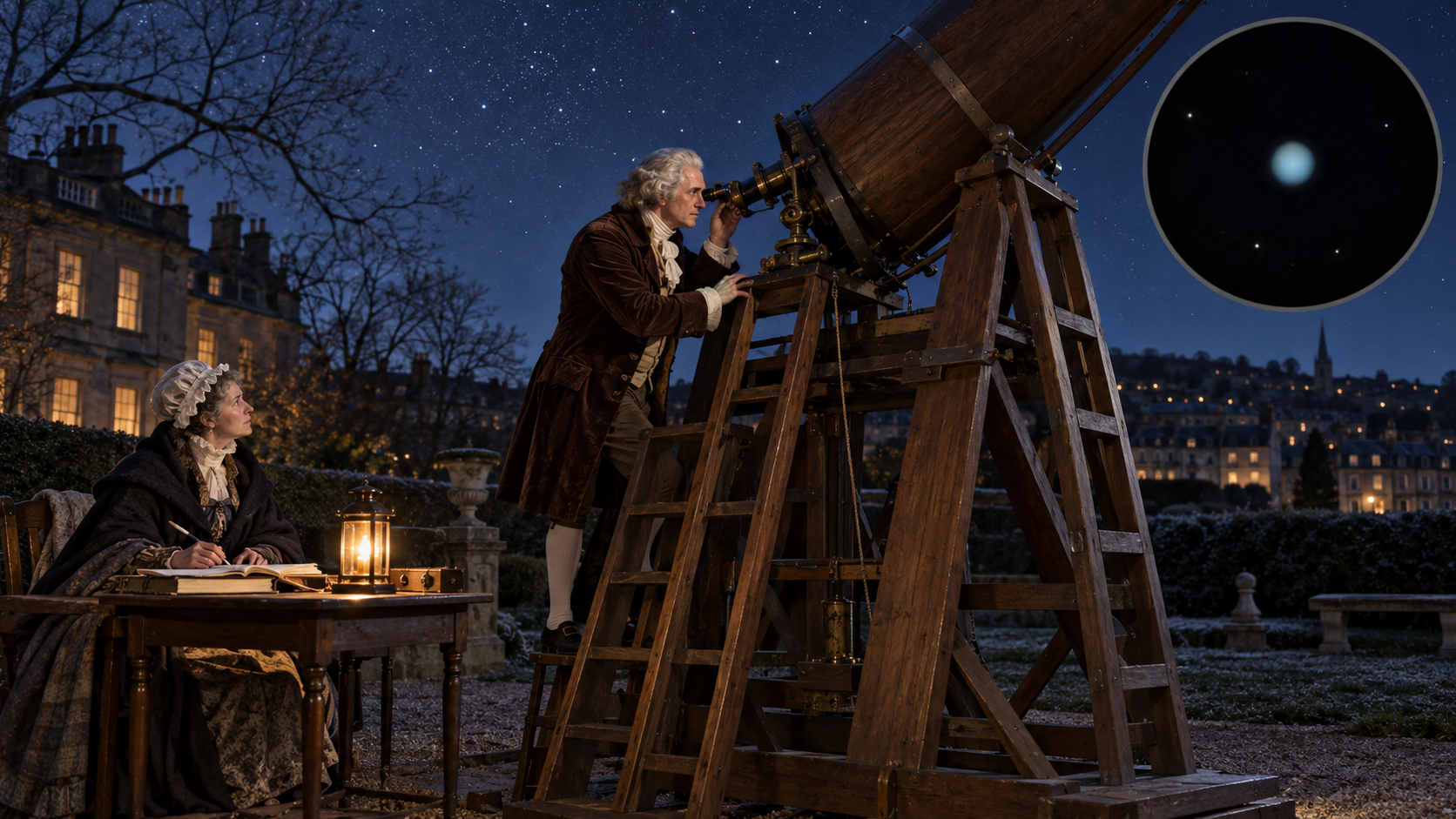
On March 13, 1781, William Herschel aimed a telescope from his garden in Bath, England, and noticed an object in Gemini that appeared different from ordinary stars. He first reported it as a comet because it seemed to show a disk and changed position against the background sky. Continued observations by Herschel and astronomers elsewhere established that the object followed a nearly circular path beyond Saturn. It was a planet, the first recognized in recorded history with a telescope.
Herschel was a musician and self-taught astronomer who built reflecting telescopes with mirrors he ground and polished himself. His systematic sweeps searched for double stars and other faint objects. Uranus was bright enough to have been recorded earlier as a star, but a single plotted position did not reveal its nature. Herschel’s attention to appearance and movement converted an old point of light into a new world.
The discovery nearly doubled the known scale of the planetary system. Astronomers calculated an orbit, examined older observations, debated a name, and searched for moons. Herschel discovered Titania and Oberon in 1787. The name Uranus, proposed in the mythological sequence of Saturn and Jupiter, became standard internationally, while the planet’s unusual axial tilt and ring-moon system emerged through later telescopes and Voyager 2.
Uranus also became a test of gravitational prediction. Irregularities in its calculated motion helped lead nineteenth-century astronomers toward Neptune, although refined masses and observations were essential. The March sighting matters because it expanded both the map and method of planetary science. Planets were no longer only the familiar wanderers known since antiquity; disciplined telescopic survey could reveal members of the Solar System that human eyes had failed to recognize. For science history, the episode is also a case study in how evidence moves from an observation or engineered test into a durable body of knowledge. Instruments supplied measurements, specialists debated interpretation, and later work refined what the first result could mean. Archives preserve the early record while new methods let researchers ask different questions of it. That continuing revision is not a weakness in the original achievement; it is the process through which a dated milestone remains scientifically useful. Seen across a longer timeline, the event also shows that scientific milestones are junctions rather than isolated beginnings. Earlier experiments, tools, and institutions made the work possible, while later teams tested its limits and carried the result into new settings. What survives is more than an anniversary fact: it is a traceable chain of evidence, correction, and application that allows one moment to remain relevant as knowledge and technology continue to change. The anniversary also highlights the difference between a first result and a finished understanding. A successful observation can settle one question while opening several harder ones, and even a failed objective can return measurements that reshape later designs. Preserved data, specimens, photographs, and hardware allow new generations to revisit the work with better tools. Science advances through that continuity, where a specific date marks progress without pretending that inquiry stopped there.
Herschel noticed an object that looked extended and shifted position among the stars.
He initially classified it as a comet before orbital work showed it was a planet.
Herschel built reflecting telescopes and conducted systematic sweeps of the night sky.
The find depended on instrument quality, patient comparison, and follow-up by other astronomers.
Uranus extended the known planetary realm far beyond Saturn.
Its later orbital study also contributed to the search that culminated in Neptune's discovery.
Explore more of "On This Day ..."
Discover more events from the same date across news, politics, technology, sports, and other fields. Each link highlights significant moments that shaped history on different fronts.