

On This Day in Science: March 14, 2016
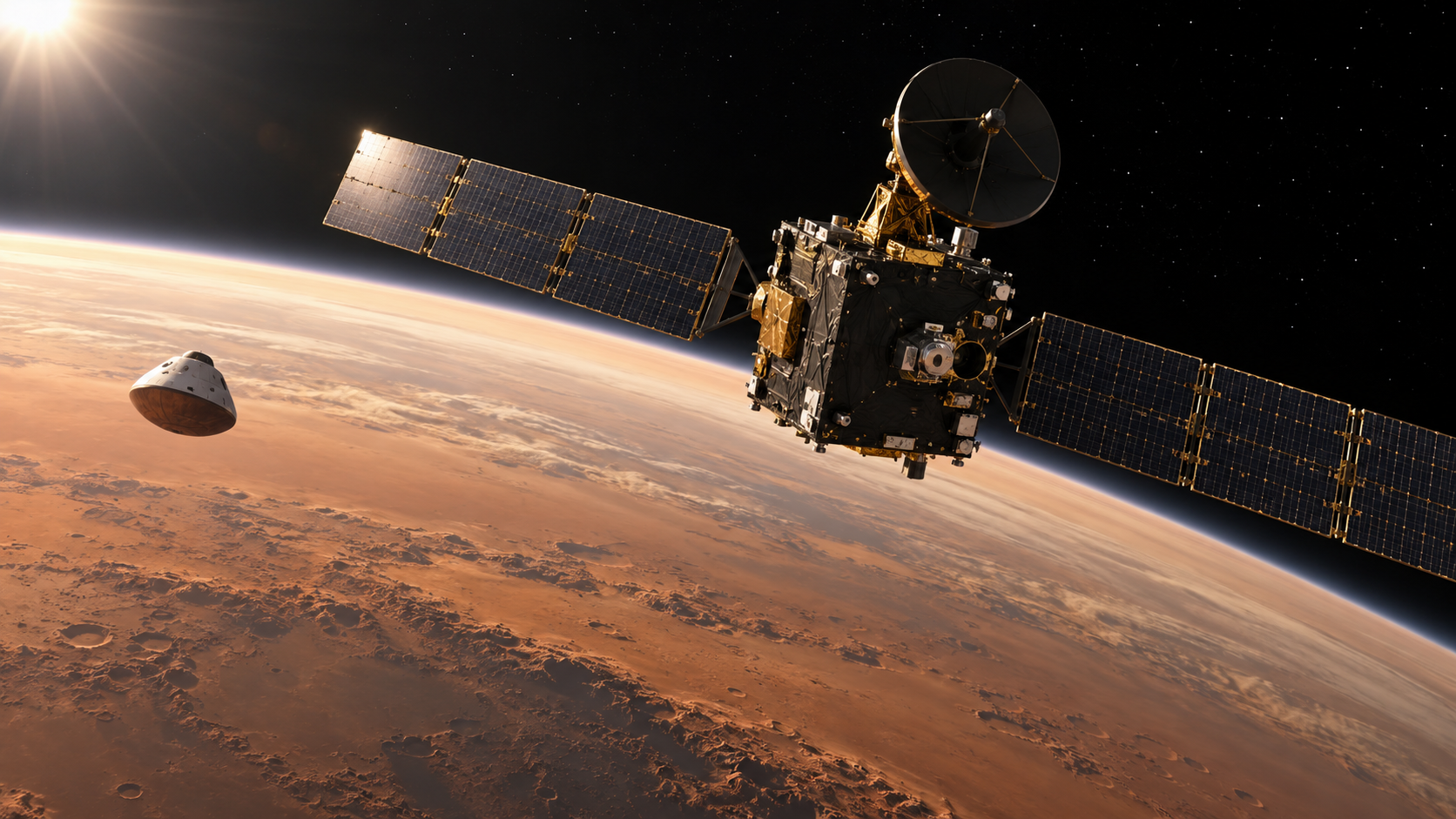
On March 14, 2016, the ExoMars Trace Gas Orbiter lifted off from Baikonur Cosmodrome with the Schiaparelli entry demonstrator attached. The joint European Space Agency and Roscosmos mission began a seven-month cruise to Mars. Its main orbiter was designed to measure gases present in tiny amounts, especially methane, whose possible sources include geological reactions and biological activity. The mission would also map water-related minerals and serve as a communications relay.
TGO entered orbit in October 2016 and spent more than a year using atmospheric drag to reshape its long initial path into a near-circular science orbit. From there, sensitive spectrometers observed sunlight passing through the atmosphere and measured gases by the wavelengths they absorbed. This occultation method can detect low concentrations and build vertical profiles, while cameras and neutron instruments connect atmospheric questions with surface geology and buried water.
Schiaparelli separated as planned but crashed during its landing attempt after a sequence of navigation and software problems. The loss still returned engineering data during entry and descent, which investigators used to identify the failure chain. TGO itself succeeded and became an important relay for surface missions. Its measurements placed stringent upper limits on global methane, complicating earlier reports and sharpening questions about when and where the gas may appear.
Trace gases are scientifically valuable because even a small concentration can reveal an active source or sink. Interpretation remains difficult: sunlight, dust, seasons, minerals, and chemical reactions all affect the Martian atmosphere. The launch began a mission built to replace isolated detections with repeatable global measurements. Its record shows how one project can contain both a failed landing and a productive long-term observatory, with each result demanding different lessons. Seen across a longer timeline, the event also shows that scientific milestones are junctions rather than isolated beginnings. Earlier experiments, tools, and institutions made the work possible, while later teams tested its limits and carried the result into new settings. What survives is more than an anniversary fact: it is a traceable chain of evidence, correction, and application that allows one moment to remain relevant as knowledge and technology continue to change. The anniversary also highlights the difference between a first result and a finished understanding. A successful observation can settle one question while opening several harder ones, and even a failed objective can return measurements that reshape later designs. Preserved data, specimens, photographs, and hardware allow new generations to revisit the work with better tools. Science advances through that continuity, where a specific date marks progress without pretending that inquiry stopped there. Its place on the calendar is therefore useful as an entry point, not an endpoint. The people involved worked with the instruments, assumptions, and social conditions of their time, and later research has both extended and corrected their conclusions. Reconstructing the event carefully means separating what was known that day from what became clear afterward. That distinction protects the history from myth while showing how cumulative evidence turns a memorable episode into lasting scientific knowledge.
TGO uses sensitive spectrometers to map methane and other minor components of the Martian atmosphere.
Their abundance and distribution may reveal active geological or chemical processes.
The spacecraft repeatedly skimmed the upper atmosphere to reduce and circularize its orbit.
Solar occultations then provided precise vertical profiles of atmospheric composition.
Schiaparelli was lost during descent, and its data helped investigators reconstruct the failure.
The orbiter continued successfully as a science platform and communications relay.
Explore more of "On This Day ..."
Discover more events from the same date across news, politics, technology, sports, and other fields. Each link highlights significant moments that shaped history on different fronts.