

On This Day in Science: March 19, 2008
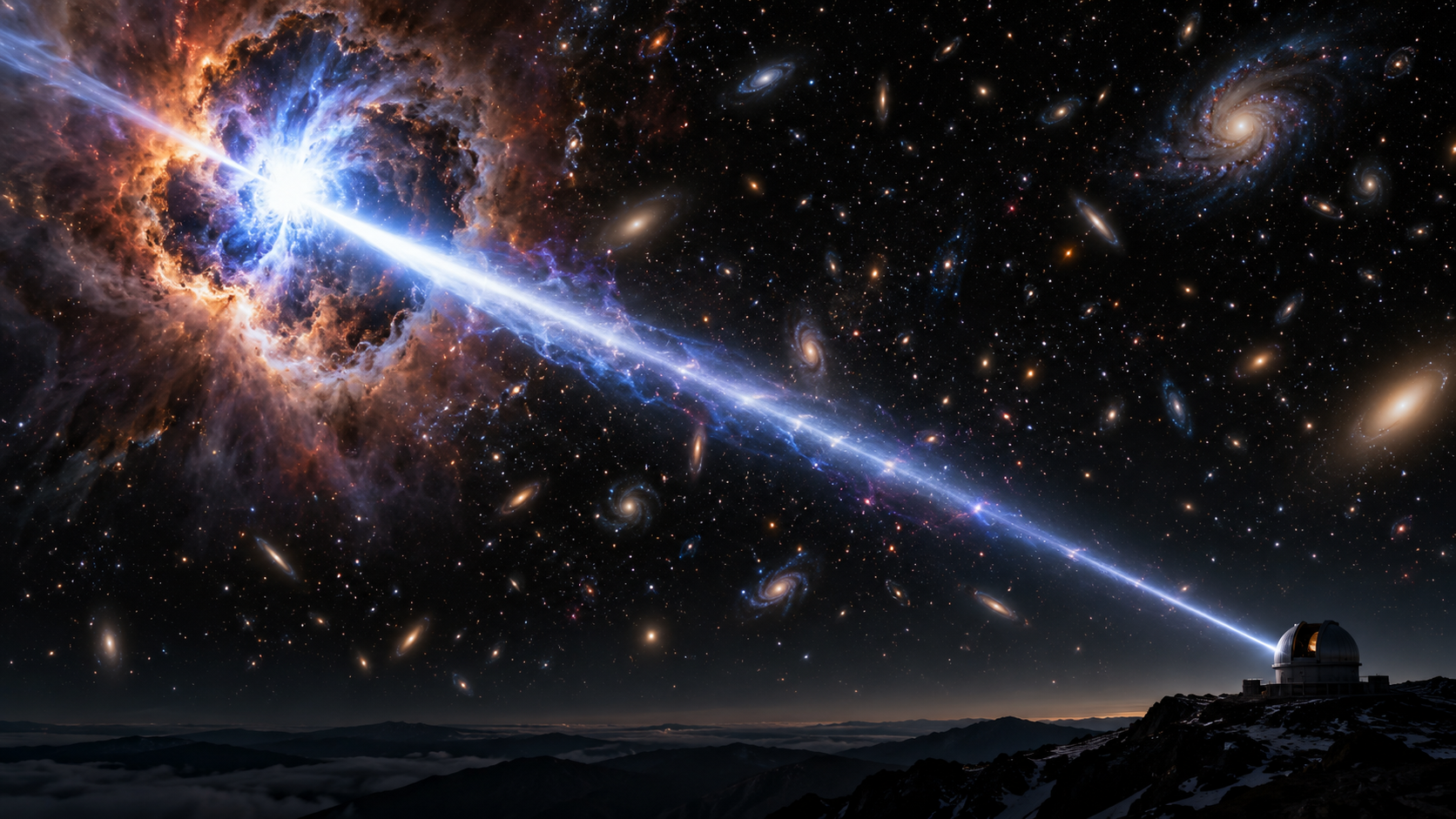
On March 19, 2008, NASA’s Swift satellite detected a gamma-ray burst later designated GRB 080319B. Telescopes on the ground responded within seconds and recorded an optical flash that briefly reached naked-eye brightness under dark skies. The source lay roughly 7.5 billion light-years away, making it the most distant object known to have been visible without optical aid. No one is confirmed to have noticed it directly during its short peak.
Long gamma-ray bursts are associated with the collapse of certain massive stars and the formation of compact objects, often black holes. Narrow jets traveling close to light speed can punch through the star and send intense radiation outward. If Earth lies near a jet’s direction, the event appears extraordinarily bright. GRB 080319B’s optical and gamma-ray emission challenged simple models because the visible flash was exceptionally powerful.
The burst occurred during a remarkable day when Swift detected several explosions within twenty-four hours. Robotic telescopes rapidly shifted to the coordinates, while larger observatories followed the afterglow as it faded. Comparing gamma rays, X-rays, ultraviolet, visible, infrared, and radio measurements allowed researchers to test whether different parts of the jet or separate radiation processes produced the light. Speed was essential because the brightest phase could not be repeated.
The event illustrated time-domain astronomy: instruments do not only map where objects are, but watch how the universe changes from second to second. Automated alerts connected spacecraft to observatories around the world, turning an unpredictable flash into coordinated evidence. Modern networks continue to improve that response, combining different wavelengths and messengers to reconstruct violent events that happened billions of years before their light reached Earth. The anniversary also highlights the difference between a first result and a finished understanding. A successful observation can settle one question while opening several harder ones, and even a failed objective can return measurements that reshape later designs. Preserved data, specimens, photographs, and hardware allow new generations to revisit the work with better tools. Science advances through that continuity, where a specific date marks progress without pretending that inquiry stopped there. Its place on the calendar is therefore useful as an entry point, not an endpoint. The people involved worked with the instruments, assumptions, and social conditions of their time, and later research has both extended and corrected their conclusions. Reconstructing the event carefully means separating what was known that day from what became clear afterward. That distinction protects the history from myth while showing how cumulative evidence turns a memorable episode into lasting scientific knowledge. For science history, the episode is also a case study in how evidence moves from an observation or engineered test into a durable body of knowledge. Instruments supplied measurements, specialists debated interpretation, and later work refined what the first result could mean. Archives preserve the early record while new methods let researchers ask different questions of it. That continuing revision is not a weakness in the original achievement; it is the process through which a dated milestone remains scientifically useful.
The optical counterpart briefly became bright enough for unaided vision despite its enormous distance.
The peak lasted too briefly for any confirmed casual observer to see it.
Long gamma-ray bursts are linked to massive stellar collapse and narrow relativistic outflows.
Alignment with the jet can make a distant event appear exceptionally intense.
Swift distributed rapid coordinates and ground telescopes began observing within seconds.
Multiwavelength follow-up tracked the fading afterglow and tested models of the jet.
Explore more of "On This Day ..."
Discover more events from the same date across news, politics, technology, sports, and other fields. Each link highlights significant moments that shaped history on different fronts.