

On This Day in Science: March 20, 1916
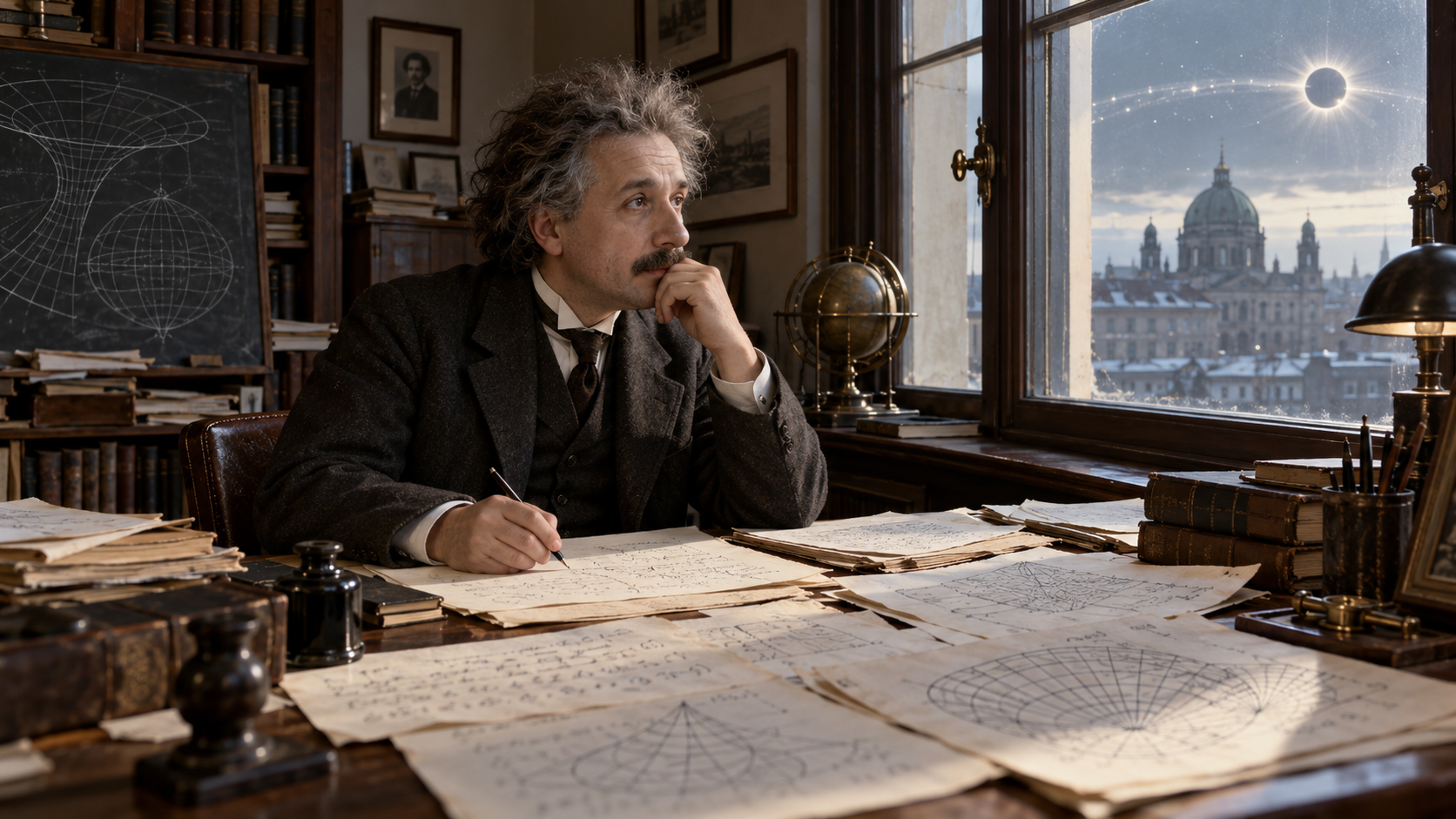
On March 20, 1916, Albert Einstein’s comprehensive paper “The Foundation of the General Theory of Relativity” was dated for publication in Annalen der Physik. It gathered the field equations he had completed the previous year into a systematic account of gravity. Instead of treating gravitation as an ordinary force acting across fixed space and time, the theory described matter and energy as shaping spacetime, while free objects followed the resulting geometry.
Einstein built on the equivalence between acceleration and a gravitational field. The mathematics required curved geometry and tensors capable of expressing laws in any coordinate system. The field equations linked the distribution of energy and momentum to spacetime curvature. In weak fields and at low speeds, the theory reproduced Newtonian gravity, preserving the older theory where it had been tested while predicting small departures under more demanding conditions.
One early success was explaining the unexplained advance of Mercury’s perihelion. General relativity also predicted that light would bend near a massive body and that clocks would run at different rates in different gravitational conditions. Eclipse observations in 1919 brought wide attention to light deflection. Later work revealed gravitational lenses, black holes, expanding-universe models, and gravitational waves—phenomena not available as direct evidence in 1916.
The paper did not make the theory final or easy. Solutions, experiments, and interpretation developed across generations, and quantum mechanics still resists a complete union with gravity. Yet the framework is practical as well as profound: satellite navigation must account for relativistic clock effects. The March document marks the point at which a new description of gravity became a coherent program that could be calculated, challenged, and extended. Its place on the calendar is therefore useful as an entry point, not an endpoint. The people involved worked with the instruments, assumptions, and social conditions of their time, and later research has both extended and corrected their conclusions. Reconstructing the event carefully means separating what was known that day from what became clear afterward. That distinction protects the history from myth while showing how cumulative evidence turns a memorable episode into lasting scientific knowledge. For science history, the episode is also a case study in how evidence moves from an observation or engineered test into a durable body of knowledge. Instruments supplied measurements, specialists debated interpretation, and later work refined what the first result could mean. Archives preserve the early record while new methods let researchers ask different questions of it. That continuing revision is not a weakness in the original achievement; it is the process through which a dated milestone remains scientifically useful. Seen across a longer timeline, the event also shows that scientific milestones are junctions rather than isolated beginnings. Earlier experiments, tools, and institutions made the work possible, while later teams tested its limits and carried the result into new settings. What survives is more than an anniversary fact: it is a traceable chain of evidence, correction, and application that allows one moment to remain relevant as knowledge and technology continue to change.
Matter and energy curve spacetime, and freely moving objects follow paths within that geometry.
The formulation replaced a fixed background with a dynamic structure.
The theory explained Mercury's orbital anomaly and predicted light deflection and gravitational time shifts.
Later observations added lenses, black holes, waves, and precision clock experiments.
General relativity reduces to Newtonian gravity in familiar weak-field conditions.
It remains essential to astrophysics and navigation while raising unresolved questions about quantum gravity.
Explore more of "On This Day ..."
Discover more events from the same date across news, politics, technology, sports, and other fields. Each link highlights significant moments that shaped history on different fronts.