

On This Day in Science: March 23, 1965
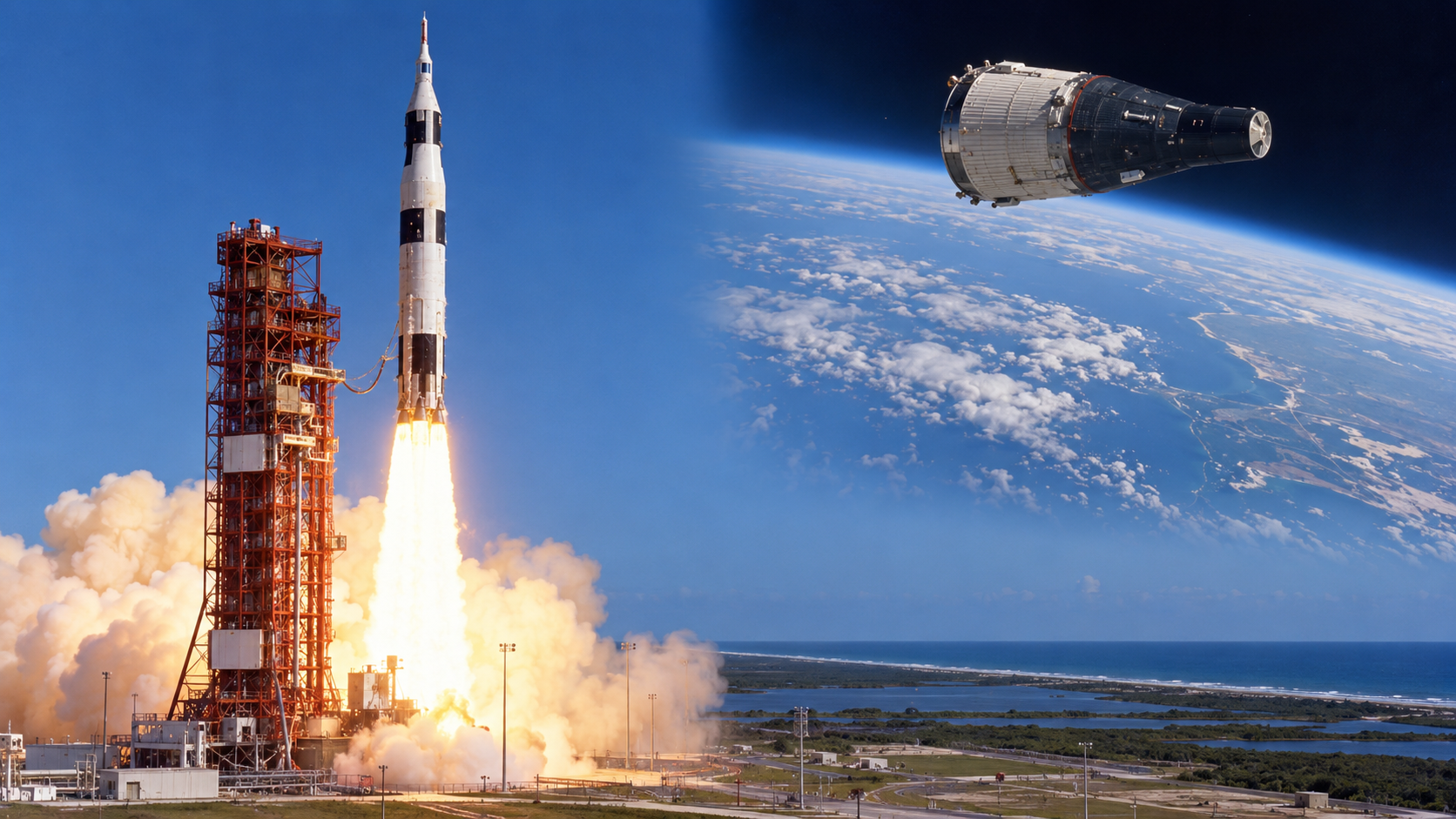
On March 23, 1965, astronauts Virgil “Gus” Grissom and John Young launched aboard Gemini 3, the first crewed flight of NASA’s two-person Gemini spacecraft. Nicknamed Molly Brown, the capsule completed three Earth orbits in just under five hours. The brief mission tested a vehicle designed to bridge the gap between Mercury’s solo flights and the complex rendezvous, spacewalk, and long-duration operations required for Apollo.
Gemini 3 was the first crewed spacecraft to alter the size and shape of its orbit using onboard thrusters. Grissom and Young fired the orbital attitude and maneuvering system in a planned series of burns, proving that astronauts could change their trajectory rather than simply ride a path determined at launch. That ability was fundamental to meeting another spacecraft in orbit and to controlling a return from lunar missions.
The crew evaluated life support, controls, communications, and a lifting reentry that used the capsule’s offset center of gravity to adjust the landing path. Not every detail went as intended: the spacecraft landed short of the planned point, and Young famously revealed a corned-beef sandwich that had not been approved for flight. Crumbs in weightlessness highlighted why even small unofficial items could become equipment hazards.
The mission ended safely with recovery by USS Intrepid. Its three orbits provided enough evidence for NASA to proceed to longer Gemini flights, extravehicular activity, and rendezvous. Gemini 3’s importance lies in controlled mobility. Human spaceflight had moved from proving that a person could survive orbit to proving that a crew could actively navigate, test systems, and shape what happened next. The anniversary also highlights the difference between a first result and a finished understanding. A successful observation can settle one question while opening several harder ones, and even a failed objective can return measurements that reshape later designs. Preserved data, specimens, photographs, and hardware allow new generations to revisit the work with better tools. Science advances through that continuity, where a specific date marks progress without pretending that inquiry stopped there. Its place on the calendar is therefore useful as an entry point, not an endpoint. The people involved worked with the instruments, assumptions, and social conditions of their time, and later research has both extended and corrected their conclusions. Reconstructing the event carefully means separating what was known that day from what became clear afterward. That distinction protects the history from myth while showing how cumulative evidence turns a memorable episode into lasting scientific knowledge. For science history, the episode is also a case study in how evidence moves from an observation or engineered test into a durable body of knowledge. Instruments supplied measurements, specialists debated interpretation, and later work refined what the first result could mean. Archives preserve the early record while new methods let researchers ask different questions of it. That continuing revision is not a weakness in the original achievement; it is the process through which a dated milestone remains scientifically useful.
Grissom and Young flew the first crewed Gemini mission in a capsule nicknamed Molly Brown.
Three orbits tested the systems needed for a more capable phase of human spaceflight.
The crew fired maneuvering thrusters to alter the spacecraft's path around Earth.
Controlled orbital changes were essential preparation for rendezvous and lunar missions.
Gemini 3 tested life support, communications, lifting reentry, and recovery procedures.
An unapproved sandwich also demonstrated how loose crumbs could threaten equipment in weightlessness.
Explore more of "On This Day ..."
Discover more events from the same date across news, politics, technology, sports, and other fields. Each link highlights significant moments that shaped history on different fronts.