

On This Day in Science: March 24, 1965
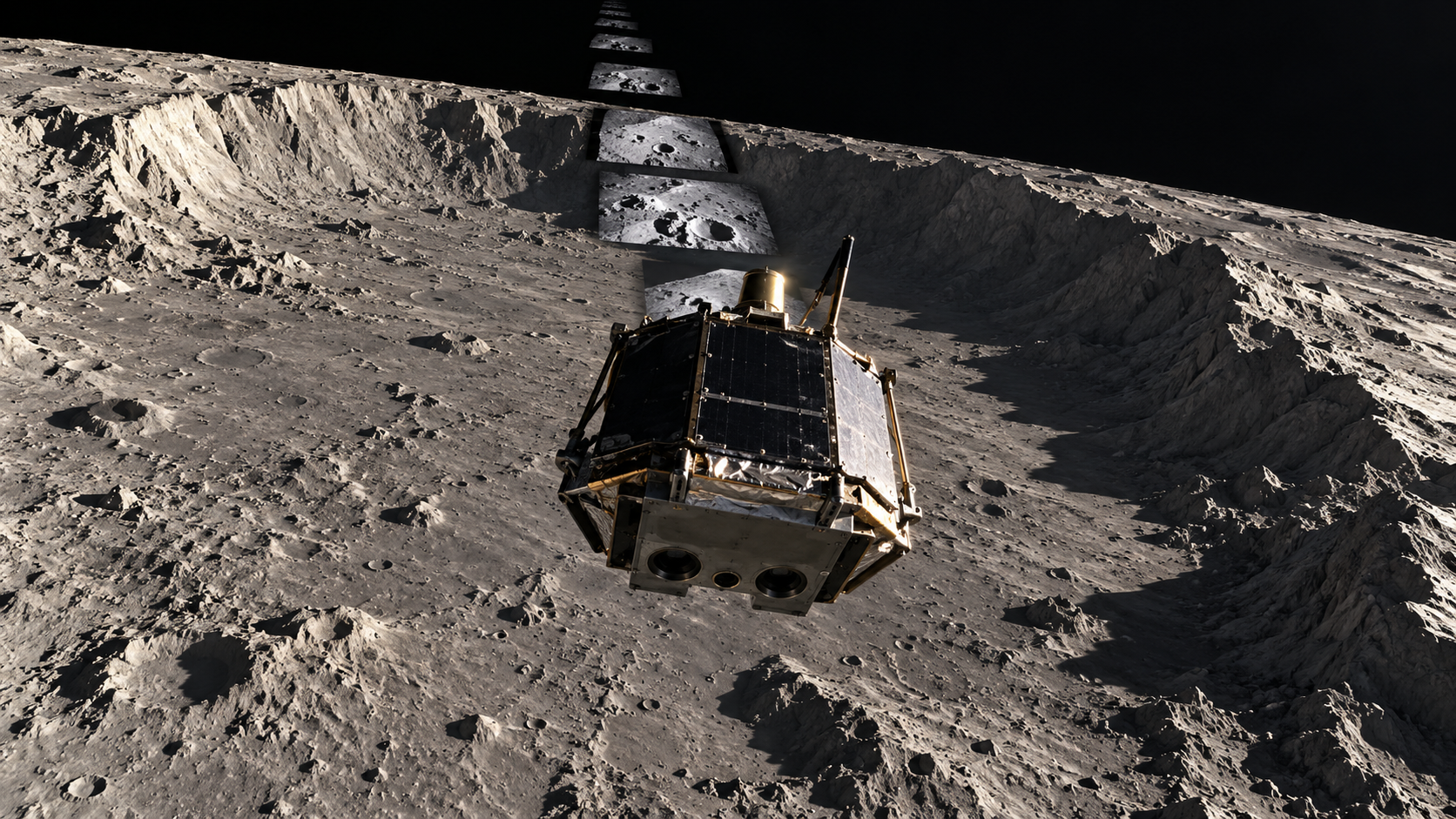
On March 24, 1965, Ranger 9 completed its three-day journey by striking the Moon inside Alphonsus crater. During the final minutes, six television cameras transmitted 5,814 images as the spacecraft fell from regional altitude to the surface. Networks converted the live signal for public broadcast, allowing viewers to watch the lunar landscape expand on television before the picture ended at impact.
The cameras began operating about twenty minutes before impact. Successive frames covered smaller ground areas, improving resolution until the best views showed features only a few tens of centimeters across. Because the cameras looked more nearly along the flight direction than on earlier Rangers, the sequence provided a clear visual approach. The final transmission ended at 14:08:20 Universal Time when the spacecraft struck at about 2.7 kilometers per second.
Alphonsus was scientifically interesting because dark markings and crater-floor features had prompted debate about relatively recent lunar volcanism. Ranger images helped investigators compare those features with impact structures, fractures, and ejecta. The mission also improved knowledge of lunar mass distribution and supplied engineering confidence for later robotic and Apollo operations, even though no instrument survived the encounter.
The public broadcast made remote sensing unusually immediate. Television did not merely summarize a completed mission; it carried data while the experiment was being destroyed. Ranger 9 closed a program that had endured costly failures before three successful lunar impacts. Its last frame represented both an endpoint and a handoff to Surveyor landers and Lunar Orbiters, which would study candidate terrain without the same deliberate plunge. Its place on the calendar is therefore useful as an entry point, not an endpoint. The people involved worked with the instruments, assumptions, and social conditions of their time, and later research has both extended and corrected their conclusions. Reconstructing the event carefully means separating what was known that day from what became clear afterward. That distinction protects the history from myth while showing how cumulative evidence turns a memorable episode into lasting scientific knowledge. For science history, the episode is also a case study in how evidence moves from an observation or engineered test into a durable body of knowledge. Instruments supplied measurements, specialists debated interpretation, and later work refined what the first result could mean. Archives preserve the early record while new methods let researchers ask different questions of it. That continuing revision is not a weakness in the original achievement; it is the process through which a dated milestone remains scientifically useful. Seen across a longer timeline, the event also shows that scientific milestones are junctions rather than isolated beginnings. Earlier experiments, tools, and institutions made the work possible, while later teams tested its limits and carried the result into new settings. What survives is more than an anniversary fact: it is a traceable chain of evidence, correction, and application that allows one moment to remain relevant as knowledge and technology continue to change.
Ranger 9 transmitted thousands of frames during the final twenty minutes before impact.
Each closer view covered less terrain and revealed progressively smaller features.
The spacecraft's signal was converted for commercial television as it approached Alphonsus crater.
Viewers watched scientific data arrive in real time until impact ended transmission.
Three successful Block III missions followed a difficult series of earlier failures.
Their close-range images prepared the way for orbiters, soft landers, and Apollo site analysis.
Explore more of "On This Day ..."
Discover more events from the same date across news, politics, technology, sports, and other fields. Each link highlights significant moments that shaped history on different fronts.