

On This Day in Science: April 13, 1970
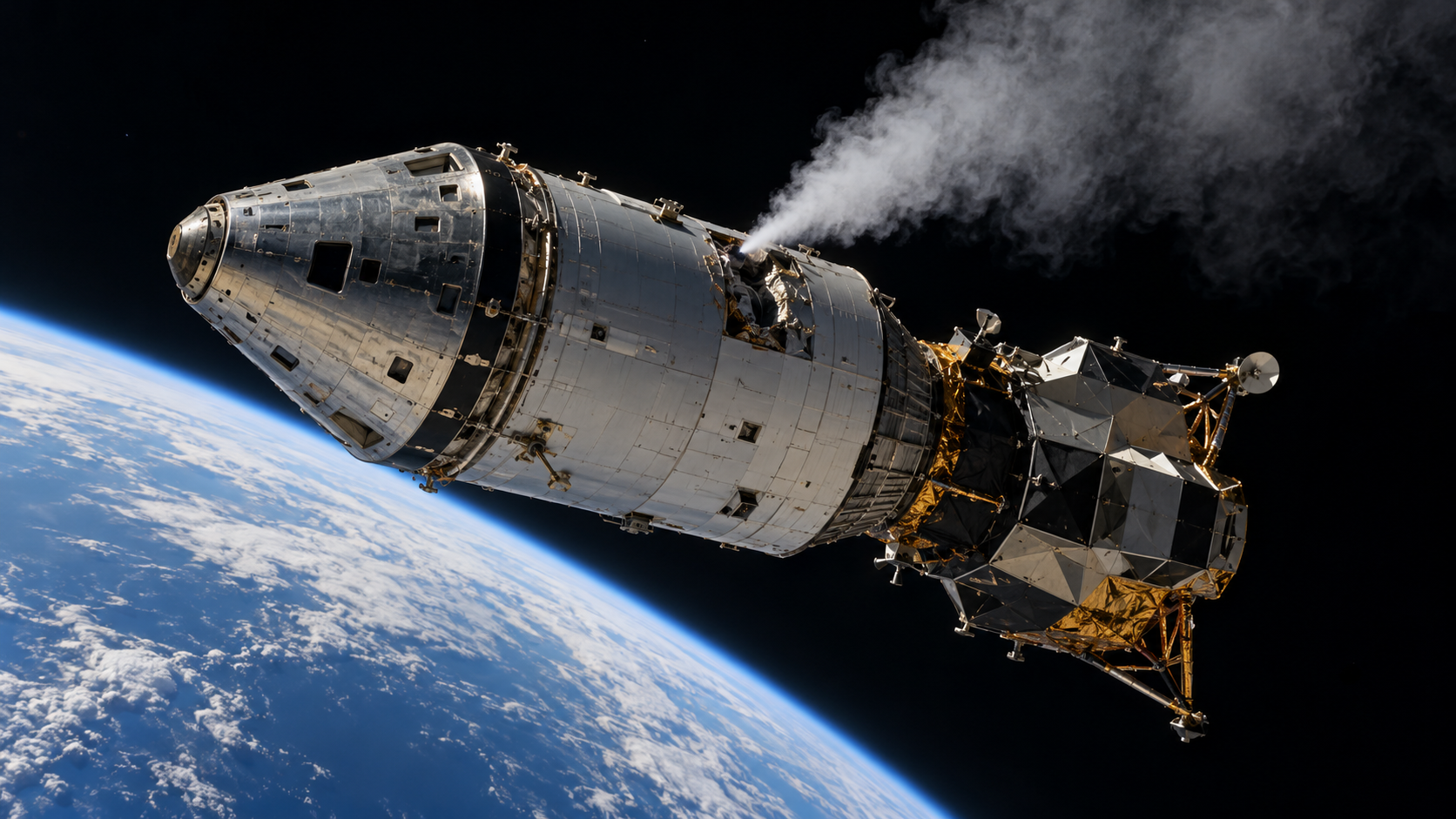
On April 13, 1970, about fifty-six hours after launch and roughly 200,000 miles from Earth, an oxygen tank ruptured in Apollo 13’s service module. Jack Swigert reported a problem after a sharp bang and warning lights appeared. The failure disabled two fuel cells and caused oxygen to vent into space, ending the planned lunar landing and placing Jim Lovell, Swigert, and Fred Haise in immediate danger.
The accident followed a routine command to stir the cryogenic oxygen tanks. Damaged wiring inside tank number two shorted in the oxygen-rich environment, starting a fire and rapid pressure rise. The explosion damaged the neighboring tank and service-module bay. Because the command module depended on oxygen-fed fuel cells for electricity and water, losing the tanks meant losing essential life support and power.
Controllers and crew powered down Odyssey and used the lunar module Aquarius as a lifeboat. Teams developed new procedures for navigation, power, water, carbon-dioxide removal, and engine burns using hardware never intended for that combination. The spacecraft looped around the Moon on a free-return path before later corrections aimed it toward a safe Pacific reentry.
The crisis became a landmark in systems engineering because survival depended on understanding coupled resources under extreme time pressure. Hardware redundancy mattered, but so did simulation, clear communication, and the willingness to devise procedures from first principles. The accident transformed a geology mission into an experiment in diagnosis and recovery. For science history, the event also shows how evidence moves from an observation or engineered test into a durable body of knowledge. Instruments supplied measurements, specialists debated interpretation, and later work refined what the first result could mean. Archives preserve the early record while new methods let researchers ask different questions of it. That continuing revision is the process through which a dated milestone remains scientifically useful. Seen across a longer timeline, scientific milestones are junctions rather than isolated beginnings. Earlier experiments, tools, and institutions made the work possible, while later teams tested its limits and carried the result into new settings. What survives is a traceable chain of evidence, correction, and application that allows one moment to remain relevant as knowledge and technology continue to change. The anniversary highlights the difference between a first result and a finished understanding. A successful observation can settle one question while opening several harder ones, and even a failed objective can reshape later designs. Preserved data, specimens, photographs, and hardware allow new generations to revisit the work with better tools. Science advances through that continuity rather than stopping on a memorable date.
Damaged wiring ignited material inside a cryogenic oxygen tank during a routine stir.
The explosion disabled fuel cells and caused the spacecraft's oxygen supply to escape.
The crew shut down the command module and moved into the lunar module.
Its limited power, water, oxygen, and carbon-dioxide control had to support three people.
Mission Control developed new checklists, engine burns, and improvised filter connections.
The rescue showed that training and systems knowledge can turn existing hardware toward an unplanned goal.
Explore more of "On This Day ..."
Discover more events from the same date across news, politics, technology, sports, and other fields. Each link highlights significant moments that shaped history on different fronts.