

On This Day in Science: May 3, 1952
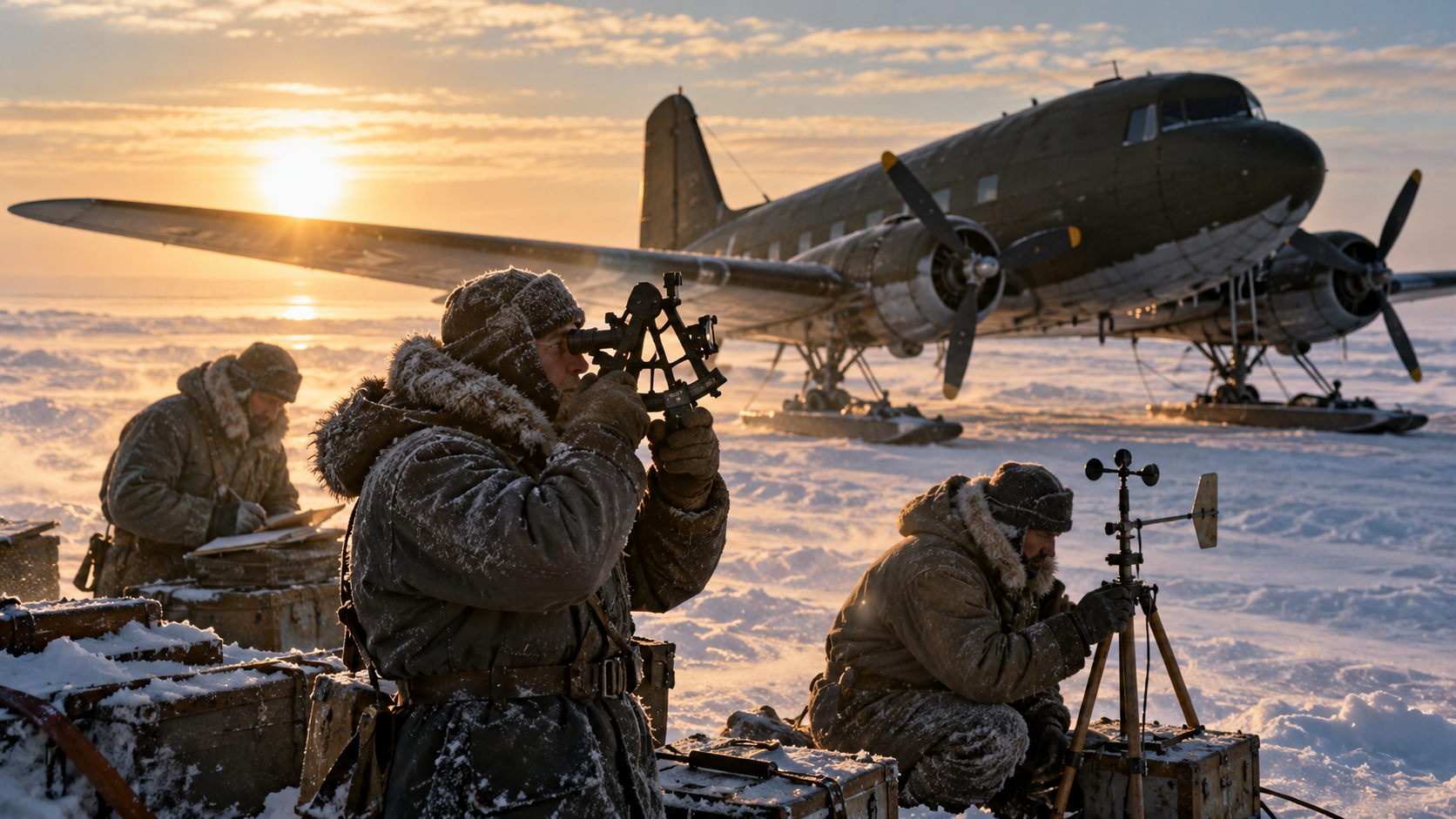
On May 3, 1952, a ski-equipped U.S. Air Force C-47 landed on sea ice at the geographic North Pole. Lieutenant Colonels William Benedict and Joseph Fletcher flew from the drifting research base known as Ice Island T-3 with navigator Herbert Thompson, a flight crew, polar scientist Albert Crary, and other expedition members. The landing connected aviation, navigation, meteorology, and field science in one of Earth’s most difficult environments.
The pole is not a fixed landmark. It lies on moving ocean ice, where pressure ridges, cracks, fog, and featureless light can make landing hazardous. Near the pole, ordinary magnetic-compass navigation is unreliable, so crews depended on celestial observations, radio, and careful position calculations. The C-47’s skis distributed its weight across the snow and allowed operation without a prepared runway.
The expedition grew from work at T-3, a thick tabular ice island used as a drifting scientific platform. Researchers there collected weather, ocean, ice, and atmospheric observations from a part of the Arctic with few continuous records. Claims about who first reached the exact pole had long been disputed, so the 1952 flight is best understood through its documented instruments, crew, and measured position rather than through an absolute priority claim.
The landing demonstrated that aircraft could support repeated polar science and logistics. It also showed how exploration depends on environmental knowledge: the ice itself was both research subject and temporary airfield. The anniversary highlights the difference between a first result and a finished understanding. A successful observation can settle one question while opening several harder ones, and even a failed objective can reshape later designs. Preserved data, specimens, photographs, and hardware allow new generations to revisit the work with better tools. Science advances through that continuity rather than stopping on a memorable date. Its calendar date is an entry point, not an endpoint. The people involved worked with the instruments, assumptions, and social conditions of their time, and later research has both extended and corrected their conclusions. Separating what was known that day from what became clear afterward protects the history from myth and shows how cumulative evidence turns an episode into lasting scientific knowledge. For science history, the event also shows how evidence moves from an observation or engineered test into a durable body of knowledge. Instruments supplied measurements, specialists debated interpretation, and later work refined what the first result could mean. Archives preserve the early record while new methods let researchers ask different questions of it. That continuing revision is the process through which a dated milestone remains scientifically useful. Seen across a longer timeline, scientific milestones are junctions rather than isolated beginnings. Earlier experiments, tools, and institutions made the work possible, while later teams tested limits and carried the result into new settings. What survives is a traceable chain of evidence, correction, and application that allows one moment to remain relevant as knowledge and technology continue to change.
The crew selected sea ice strong and level enough for a ski-equipped C-47.
Drift and pressure cracks meant that the landing surface could change after it was surveyed.
Magnetic compasses become unreliable close to the geographic pole.
Celestial observations and position calculations were essential to confirm the aircraft's location.
The flight originated at T-3, an ice island used for long-term Arctic observations.
Aircraft logistics expanded the reach of meteorology, oceanography, and ice research.
Explore more of "On This Day ..."
Discover more events from the same date across news, politics, technology, sports, and other fields. Each link highlights significant moments that shaped history on different fronts.