

On This Day in Science: May 2, 1952
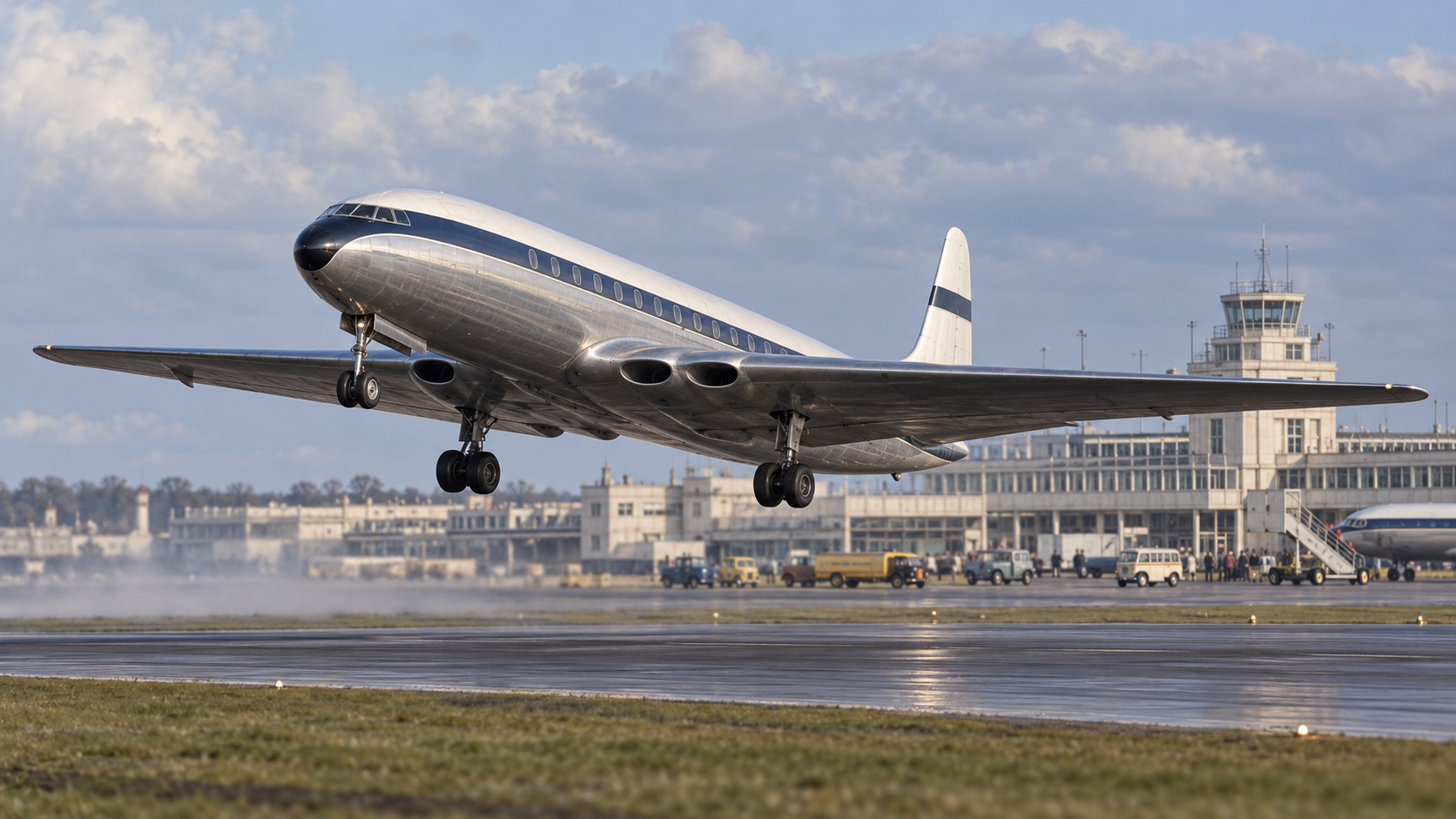
On May 2, 1952, a British Overseas Airways Corporation de Havilland Comet 1 departed London for Johannesburg, beginning the world’s first scheduled passenger service by jet airliner. The route included several stops through Europe, the Middle East, and Africa, but the aircraft’s speed and smooth high-altitude flight announced a new era in civil aviation. Fare-paying passengers were traveling behind four de Havilland Ghost turbojet engines rather than propellers.
The Comet used a pressurized cabin, swept wings, and engines buried in the wing roots. Its clean shape reduced drag, while jet propulsion allowed cruising above much weather and cut journey times. Designing a pressurized metal fuselage for repeated climbs and descents, however, created stresses that were not yet fully understood. The aircraft joined advanced propulsion with a demanding structural problem.
After early enthusiasm, several Comets were lost in accidents. Investigators used an immense water tank to cycle a fuselage through simulated flights and found fatigue cracking around stress concentrations in the pressure shell. The findings led to stronger structures, redesigned openings, new inspection methods, and a much deeper understanding of metal fatigue in pressurized aircraft.
Later Comet models returned to service, but American jetliners became dominant. The inaugural flight still matters because it made jet travel operational while the subsequent failures reshaped aerospace testing. Progress came from both the successful service and the engineering lessons that followed. Seen across a longer timeline, scientific milestones are junctions rather than isolated beginnings. Earlier experiments, tools, and institutions made the work possible, while later teams tested limits and carried the result into new settings. What survives is a traceable chain of evidence, correction, and application that allows one moment to remain relevant as knowledge and technology continue to change. The anniversary highlights the difference between a first result and a finished understanding. A successful observation can settle one question while opening several harder ones, and even a failed objective can reshape later designs. Preserved data, specimens, photographs, and hardware allow new generations to revisit the work with better tools. Science advances through that continuity rather than stopping on a memorable date. Its calendar date is an entry point, not an endpoint. The people involved worked with the instruments, assumptions, and social conditions of their time, and later research has both extended and corrected their conclusions. Separating what was known that day from what became clear afterward protects the history from myth and shows how cumulative evidence turns an episode into lasting scientific knowledge. For science history, the event also shows how evidence moves from an observation or engineered test into a durable body of knowledge. Instruments supplied measurements, specialists debated interpretation, and later work refined what the first result could mean. Archives preserve the early record while new methods let researchers ask different questions of it. That continuing revision is the process through which a dated milestone remains scientifically useful.
The Comet carried fare-paying travelers from London toward Johannesburg on a scheduled route.
Jet power promised higher cruising altitude, greater speed, and less vibration than piston airliners.
Repeated cabin pressurization produced fatigue cracks around stress concentrations.
Full-scale testing helped investigators reproduce the failure and identify its mechanism.
Manufacturers strengthened pressure cabins and improved fatigue analysis and inspection.
The Comet's experience influenced every later generation of commercial jet design.
Explore more of "On This Day ..."
Discover more events from the same date across news, politics, technology, sports, and other fields. Each link highlights significant moments that shaped history on different fronts.