

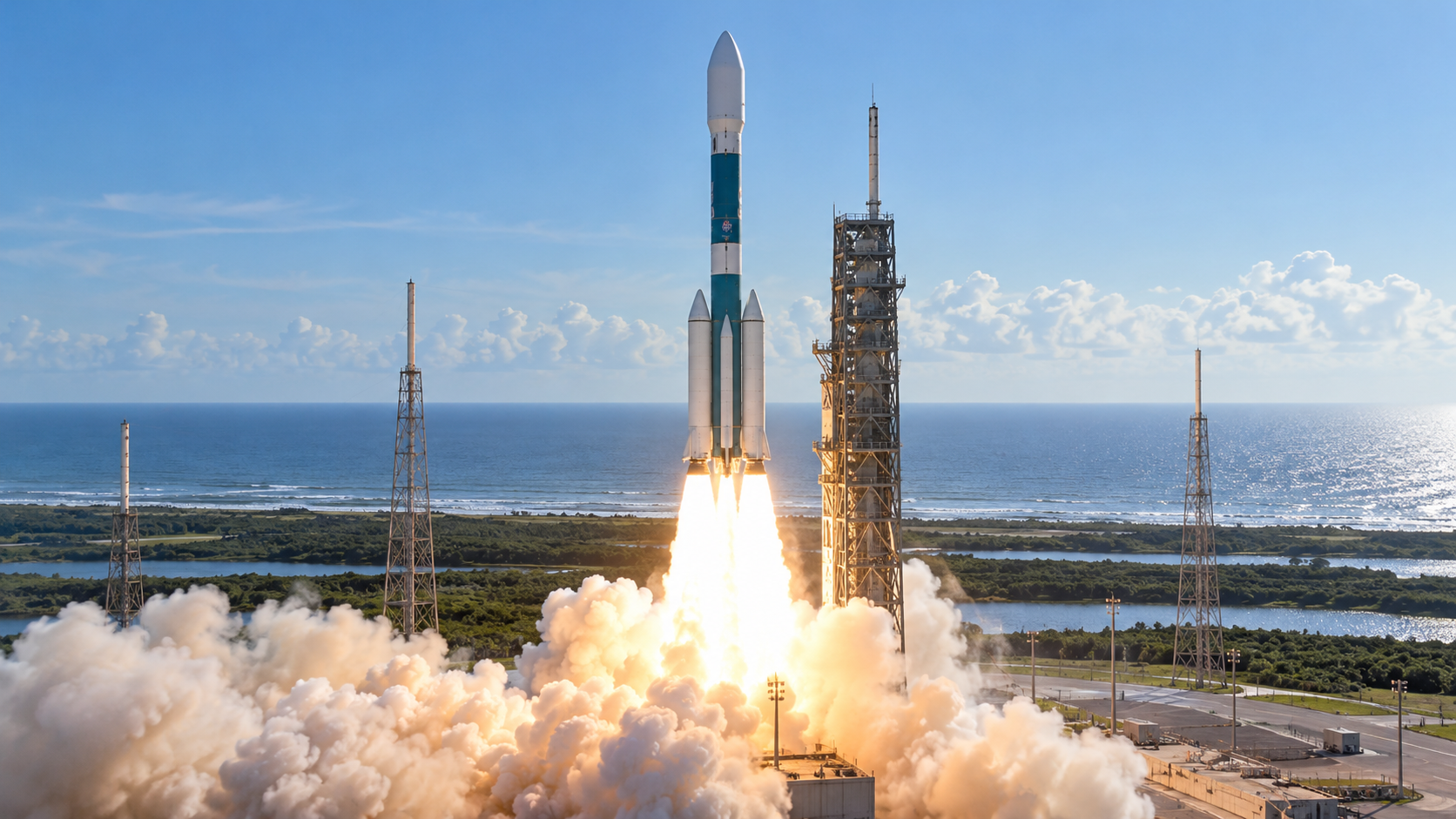
On This Day in Science: June 11, 2008
On June 11, 2008, a Delta II rocket launched NASA’s Gamma-ray Large Area Space Telescope from Cape Canaveral. Renamed the Fermi Gamma-ray Space Telescope after commissioning, the observatory was built to survey the sky at energies millions to billions of times greater than visible light. Its targets included pulsars, active galaxies, supernova remnants, and gamma-ray bursts.
Gamma rays cannot be focused with ordinary mirrors. Fermi’s Large Area Telescope converts incoming photons into electron-positron pairs, tracks the particles through layers of silicon, and measures their energy in a calorimeter. Its wide field of view lets it scan most of the sky every few hours. A second instrument watches for brief bursts across a broad energy range.
Repeated all-sky coverage turned gamma-ray astronomy from occasional pointings into a changing map. Fermi revealed thousands of sources, detected gamma-ray pulsars, tracked jets powered by supermassive black holes, and measured terrestrial gamma-ray flashes associated with thunderstorms. Rapid alerts allow observatories using other wavelengths and messengers to follow transient events.
The launch opened a long-duration survey whose value grows with time. Comparing years of observations reveals variable sources, rare eruptions, and diffuse backgrounds that a short mission could not separate, making Fermi both an observatory and a continuously updated record of the energetic sky. The anniversary highlights the difference between a first result and a finished understanding. A successful observation can settle one question while opening several harder ones, and even a failed objective can reshape later designs. Preserved data, specimens, photographs, and hardware allow new generations to revisit the work with better tools. Science advances through that continuity rather than stopping on a memorable date. Its calendar date is an entry point, not an endpoint. The people involved worked with the instruments, assumptions, and social conditions of their time, and later research has both extended and corrected their conclusions. Separating what was known that day from what became clear afterward protects the history from myth and shows how cumulative evidence turns an episode into lasting scientific knowledge. For science history, the event also shows how evidence moves from an observation or engineered test into a durable body of knowledge. Instruments supplied measurements, specialists debated interpretation, and later work refined what the first result could mean. Archives preserve the early record while new methods let researchers ask different questions of it. That continuing revision is the process through which a dated milestone remains scientifically useful. Seen across a longer timeline, scientific milestones are junctions rather than isolated beginnings. Earlier experiments, tools, and institutions made the work possible, while later teams tested limits and carried the result into new settings. What survives is a traceable chain of evidence, correction, and application that allows one moment to remain relevant as knowledge and technology continue to change.
High-energy photons pass through or damage conventional reflective telescopes.
Fermi infers their direction from particle tracks created when they convert inside the detector.
A wide field of view and scanning orbit cover most directions every few hours.
That cadence makes long-term variability and short transients visible.
Sources include pulsars, black-hole jets, supernova remnants, and explosive bursts.
Fermi also detects energetic flashes produced in Earth's atmosphere.
Explore more of "On This Day ..."
Discover more events from the same date across news, politics, technology, sports, and other fields. Each link highlights significant moments that shaped history on different fronts.