

On This Day in Science: June 9, 1928
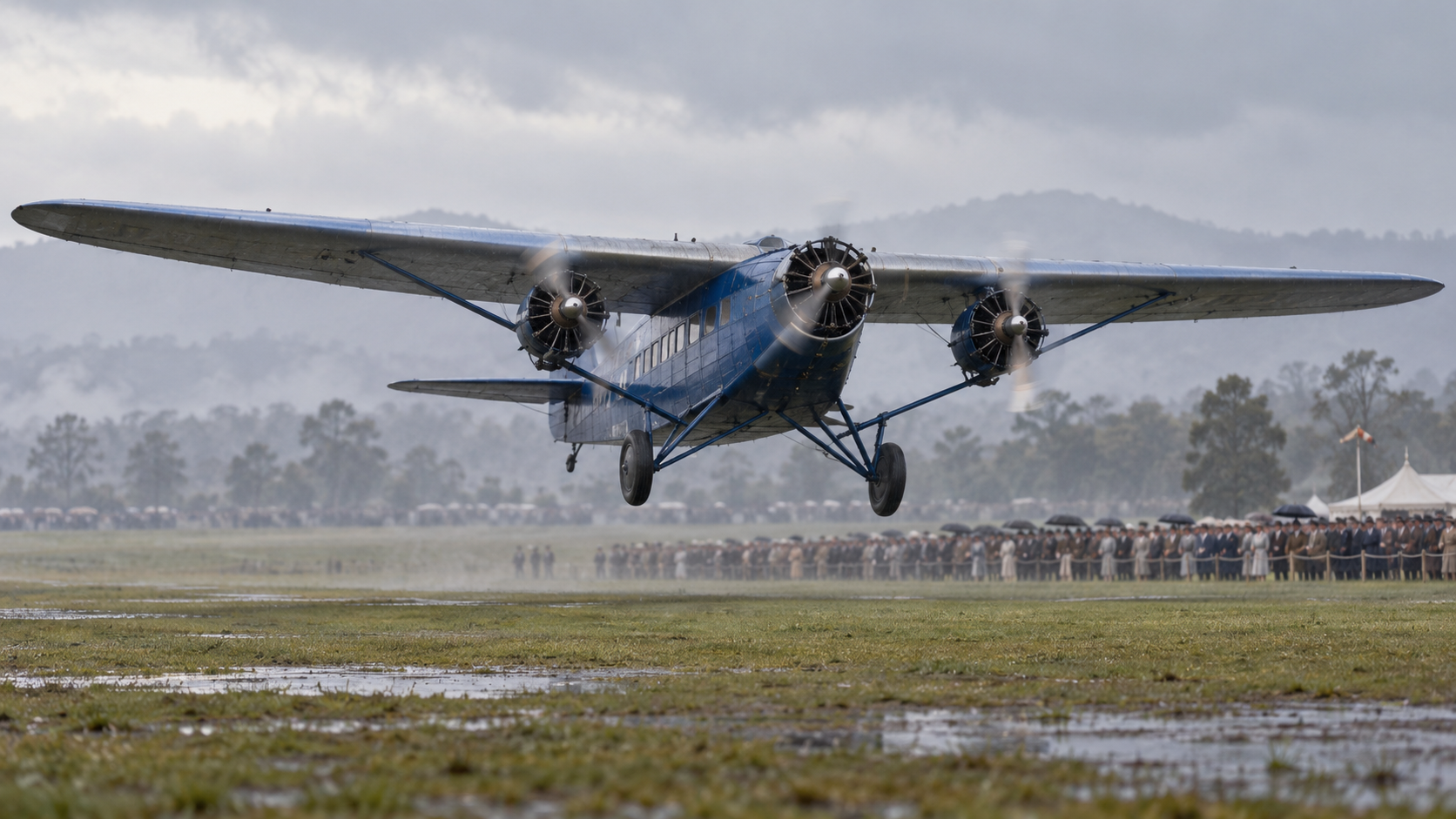
On June 9, 1928, the Fokker F.VIIb-3m Southern Cross landed at Brisbane, completing the first flight across the Pacific from the United States to Australia. Pilots Charles Kingsford Smith and Charles Ulm, navigator Harry Lyon, and radio operator James Warner had left Oakland on May 31 and crossed the ocean in stages through Hawaii and Fiji.
The route demanded three long overwater legs, including an immense stretch from Hawaii to Fiji. The trimotor carried extra fuel, radios, navigation instruments, emergency supplies, and a crew divided among specialized tasks. Lyon combined celestial observations, dead reckoning, wind estimates, and ship reports while Warner maintained radio contact across distances few aircraft had attempted.
Weather repeatedly hid the horizon and stars, turning navigation into a continuous calculation rather than a line on a map. The aircraft’s three engines offered some redundancy, but an ocean landing would still have been perilous. Advance planning placed the route near shipping lanes when possible and linked the crew to shore stations and vessels.
The arrival demonstrated that long-range aviation could connect continents across the largest ocean, although routine service required better aircraft, navigation, weather forecasting, and infrastructure. The original route map preserved by the Smithsonian shows the achievement as a network of measurements and communications, not a single act of piloting. For science history, the event also shows how evidence moves from an observation or engineered test into a durable body of knowledge. Instruments supplied measurements, specialists debated interpretation, and later work refined what the first result could mean. Archives preserve the early record while new methods let researchers ask different questions of it. That continuing revision is the process through which a dated milestone remains scientifically useful. Seen across a longer timeline, scientific milestones are junctions rather than isolated beginnings. Earlier experiments, tools, and institutions made the work possible, while later teams tested limits and carried the result into new settings. What survives is a traceable chain of evidence, correction, and application that allows one moment to remain relevant as knowledge and technology continue to change. The anniversary highlights the difference between a first result and a finished understanding. A successful observation can settle one question while opening several harder ones, and even a failed objective can reshape later designs. Preserved data, specimens, photographs, and hardware allow new generations to revisit the work with better tools. Science advances through that continuity rather than stopping on a memorable date. Its calendar date is an entry point, not an endpoint. The people involved worked with the instruments, assumptions, and social conditions of their time, and later research has both extended and corrected their conclusions. Separating what was known that day from what became clear afterward protects the history from myth and shows how cumulative evidence turns an episode into lasting scientific knowledge.
Southern Cross flew from Oakland to Hawaii, then Fiji, and finally Brisbane.
Island stops made the crossing possible while leaving extraordinarily long legs over open water.
Celestial sights and dead reckoning estimated position between sparse landmarks.
Radio reports from shore and ships helped check the aircraft's progress.
The flight proved a Pacific route could be completed with 1928 technology.
Safe passenger service still required years of advances in range, forecasting, radios, and airports.
Explore more of "On This Day ..."
Discover more events from the same date across news, politics, technology, sports, and other fields. Each link highlights significant moments that shaped history on different fronts.