

On This Day in Science: June 30, 1908
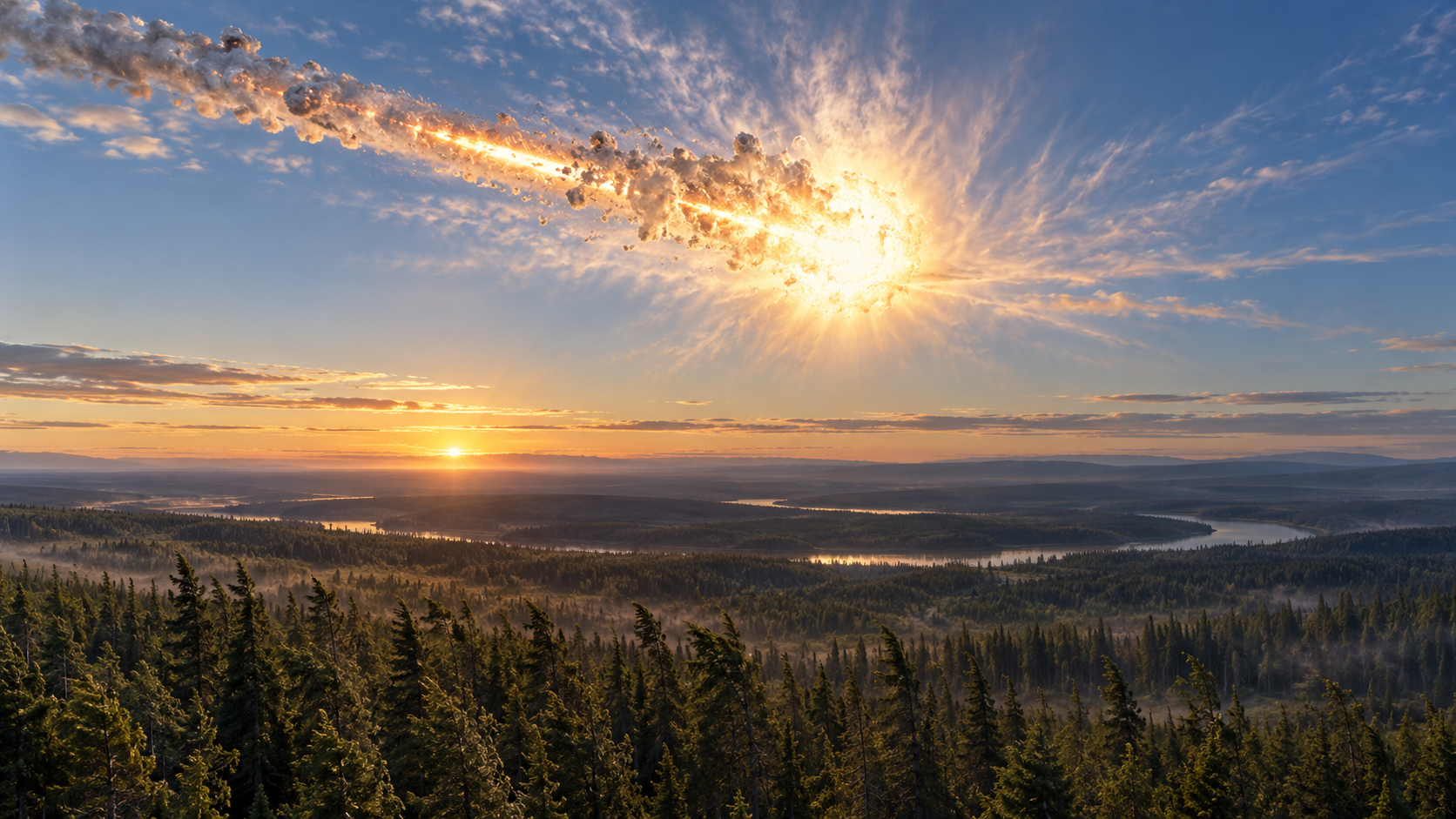
On June 30, 1908, a small asteroid or comet fragment entered Earth’s atmosphere over the remote Tunguska region of Siberia. It broke apart and released energy several kilometers above the ground. The airburst flattened roughly two thousand square kilometers of forest, with trees lying in a radial pattern around the central region.
Witnesses far away described a brilliant fireball, heat, thunderous sounds, and shock waves. Seismic and atmospheric pressure instruments recorded disturbances across great distances. Because the object disintegrated in the air, investigators found no large impact crater and only tiny candidate particles, making the event difficult to interpret.
The first major scientific expedition did not reach the site until 1927, when Leonid Kulik documented the fallen forest and searched for a crater. Later field surveys, tree-ring studies, physics models, and comparisons with observed meteors converged on an atmospheric explosion caused by a tens-of-meters-scale cosmic body. Exact composition and trajectory remain debated.
Tunguska is a central example in planetary-defense research because an object need not reach the ground to cause regional devastation. Modern sky surveys, orbit calculations, impact-probability studies, and deflection tests aim to discover hazardous bodies early enough for evidence-based action. Seen across a longer timeline, scientific milestones are junctions rather than isolated beginnings. Earlier experiments, tools, and institutions made the work possible, while later teams tested limits and carried the result into new settings. What survives is a traceable chain of evidence, correction, and application that allows one moment to remain relevant as knowledge and technology continue to change. The anniversary highlights the difference between a first result and a finished understanding. A successful observation can settle one question while opening several harder ones, and even a failed objective can reshape later designs. Preserved data, specimens, photographs, and hardware allow new generations to revisit the work with better tools. Science advances through that continuity rather than stopping on a memorable date. Its calendar date is an entry point, not an endpoint. The people involved worked with the instruments, assumptions, and social conditions of their time, and later research has both extended and corrected their conclusions. Separating what was known that day from what became clear afterward protects the history from myth and shows how cumulative evidence turns an episode into lasting scientific knowledge. For science history, the event also shows how evidence moves from an observation or engineered test into a durable body of knowledge. Instruments supplied measurements, specialists debated interpretation, and later work refined what the first result could mean. Archives preserve the early record while new methods let researchers ask different questions of it. That continuing revision is the process through which a dated milestone remains scientifically useful.
Atmospheric pressure and heating fragmented the incoming body before it reached the surface.
The resulting blast wave knocked down forest without excavating a conventional large crater.
The remote site was not systematically surveyed until nearly two decades later.
Tree patterns, eyewitness accounts, seismic records, and models had to be combined.
Tunguska-sized objects are smaller and more numerous than civilization-ending asteroids.
Finding them early is difficult, yet their regional consequences can be severe.
Explore more of "On This Day ..."
Discover more events from the same date across news, politics, technology, sports, and other fields. Each link highlights significant moments that shaped history on different fronts.