

On This Day in Science: July 2, 1900
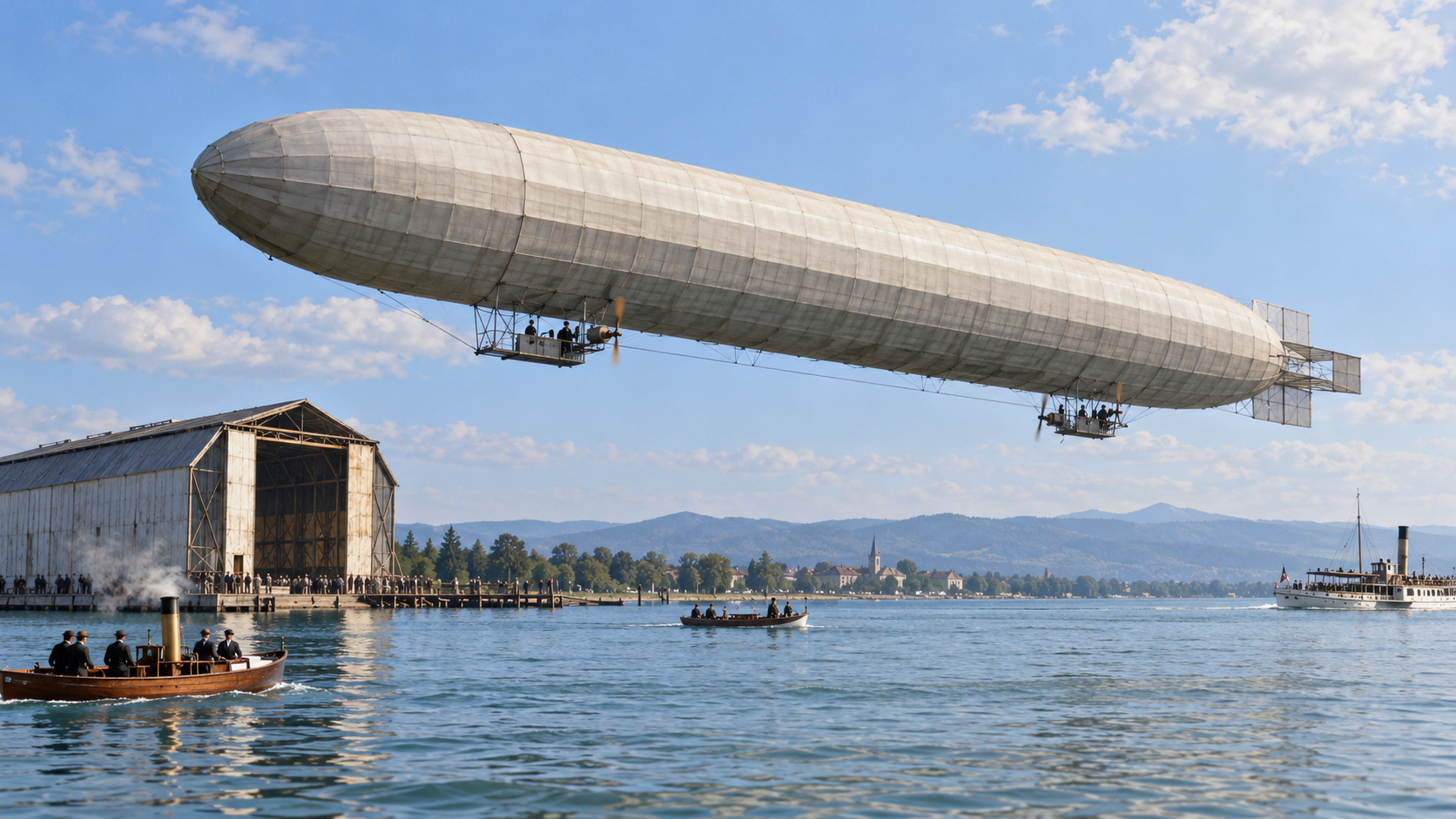
On July 2, 1900, Count Ferdinand von Zeppelin’s experimental airship LZ 1 rose from a floating hangar on Lake Constance near Friedrichshafen, Germany. The rigid craft carried Zeppelin, engineers, and crew above the water for about twenty minutes. It was the first flight of the design that would make the Zeppelin name synonymous with large rigid airships.
Unlike a simple balloon, LZ 1 used an aluminum framework covered by fabric and divided its lifting hydrogen among multiple gas cells. Two small Daimler engines drove propellers, while movable weights and control surfaces helped manage pitch and direction. Building and launching over the lake reduced obstacles and gave the team a broad operating area, but added its own handling challenges.
The flight demonstrated that the enormous structure could become airborne and be propelled, yet it also revealed control and mechanical problems. The craft was damaged during landing, money ran short, and testing stopped after only a few flights. Zeppelin nevertheless continued raising support and revising the design.
Later rigid airships would carry passengers, military observers, mail, and scientific instruments across long distances. Their history also included accidents and the danger of flammable hydrogen. LZ 1 was therefore a proof of possibility rather than a mature transport: an ambitious engineering trial whose limitations drove the next generation. Seen across a longer timeline, scientific milestones are junctions rather than isolated beginnings. Earlier experiments, tools, and institutions made the work possible, while later teams tested limits and carried the result into new settings. What survives is a traceable chain of evidence, correction, and application that allows one moment to remain relevant as knowledge and technology continue to change. The anniversary highlights the difference between a first result and a finished understanding. A successful observation can settle one question while opening several harder ones, and even a failed objective can reshape later designs. Preserved data, specimens, photographs, and hardware allow new generations to revisit the work with better tools. Science advances through that continuity rather than stopping on a memorable date. Its calendar date is an entry point, not an endpoint. The people involved worked with the instruments, assumptions, and social conditions of their time, and later research has both extended and corrected their conclusions. Separating what was known that day from what became clear afterward protects the history from myth and shows how cumulative evidence turns an episode into lasting scientific knowledge. For science history, the event also shows how evidence moves from an observation or engineered test into a durable body of knowledge. Instruments supplied measurements, specialists debated interpretation, and later work refined what the first result could mean. Archives preserve the early record while new methods let researchers ask different questions of it. That continuing revision is the process through which a dated milestone remains scientifically useful.
An internal aluminum framework preserved the hull's elongated shape.
Separate hydrogen cells provided lift inside the fabric-covered structure.
The first flight proved that the huge craft could rise and move under power.
Control difficulties and landing damage showed how much engineering remained.
Zeppelin persisted after the early program ran out of money.
Later designs made rigid airships symbols of long-range flight and its risks.
Explore more of "On This Day ..."
Discover more events from the same date across news, politics, technology, sports, and other fields. Each link highlights significant moments that shaped history on different fronts.