

On This Day in Science: July 27, 1921
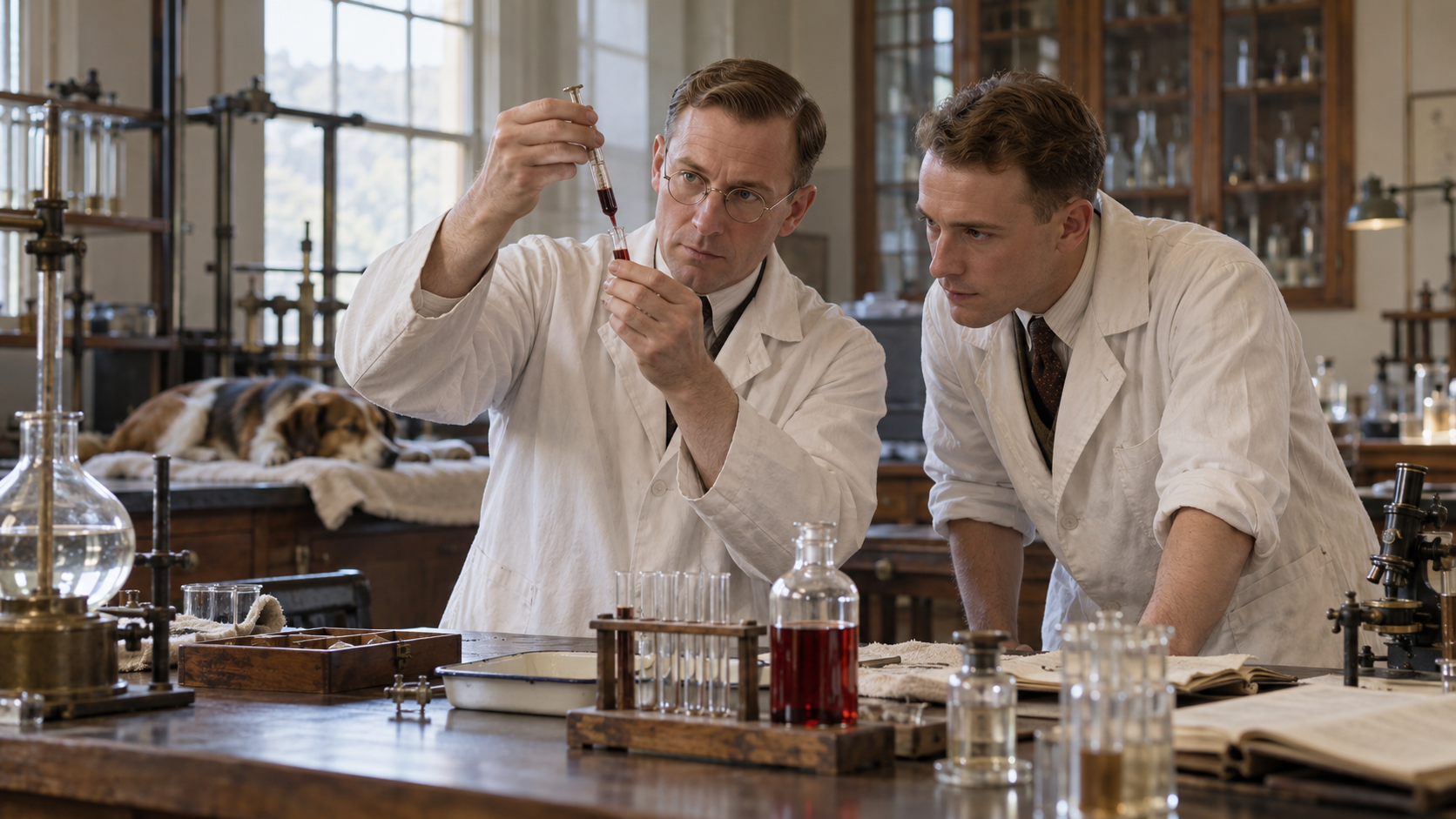
On July 27, 1921, at the University of Toronto, Frederick Banting and medical student Charles Best recorded a marked fall in blood glucose after injecting a pancreatic extract into a dog whose pancreas had been removed. Their laboratory notes identified the animal as Dog 410. The result became an important step toward an effective treatment for diabetes.
Banting’s idea was to isolate the pancreas’s internal secretion from digestive enzymes that might destroy it. Under physiologist J.J.R. Macleod’s supervision, Banting and Best prepared extracts and measured blood sugar in experimental animals. Early results were uneven, and the work involved repeated surgery, chemical preparation, and testing rather than a single sudden discovery.
Biochemist James Collip later improved purification, while Macleod supplied facilities, expertise, and direction. In January 1922, fourteen-year-old Leonard Thompson received the extract; an initial preparation caused problems, but a more purified dose produced clear benefit. Manufacturing partnerships then made the treatment available on a larger scale.
Insulin transformed type 1 diabetes from a rapidly fatal disease into a treatable chronic condition, although it is not a cure and access remains unequal. The July experiment matters as one documented point in a collaborative process involving previous research, animal studies, purification, clinical testing, production, and continuing improvements in insulin formulations and delivery. The anniversary highlights the difference between a first result and a finished understanding. A successful observation can settle one question while opening several harder ones, and even a failed objective can reshape later designs. Preserved data, specimens, photographs, and hardware allow new generations to revisit the work with better tools. Science advances through that continuity rather than stopping on a memorable date. Its calendar date is an entry point, not an endpoint. The people involved worked with the instruments, assumptions, and social conditions of their time, and later research has both extended and corrected their conclusions. Separating what was known that day from what became clear afterward protects the history from myth and shows how cumulative evidence turns an episode into lasting scientific knowledge. For science history, the event also shows how evidence moves from an observation or engineered test into a durable body of knowledge. Instruments supplied measurements, specialists debated interpretation, and later work refined what the first result could mean. Archives preserve the early record while new methods let researchers ask different questions of it. That continuing revision is the process through which a dated milestone remains scientifically useful. Seen across a longer timeline, scientific milestones are junctions rather than isolated beginnings. Earlier experiments, tools, and institutions made the work possible, while later teams tested limits and carried the result into new settings. What survives is a traceable chain of evidence, correction, and application that allows one moment to remain relevant as knowledge and technology continue to change.
Researchers removed the pancreas to create severe experimental diabetes.
The injected extract lowered the animal's measured blood glucose.
Macleod provided laboratory support and scientific direction.
Collip's purification work was essential before reliable human treatment.
Insulin replaces a hormone the body cannot produce adequately.
It saves lives but requires lifelong management and dependable access.
Explore more of "On This Day ..."
Discover more events from the same date across news, politics, technology, sports, and other fields. Each link highlights significant moments that shaped history on different fronts.