

On This Day in Science: August 6, 2012
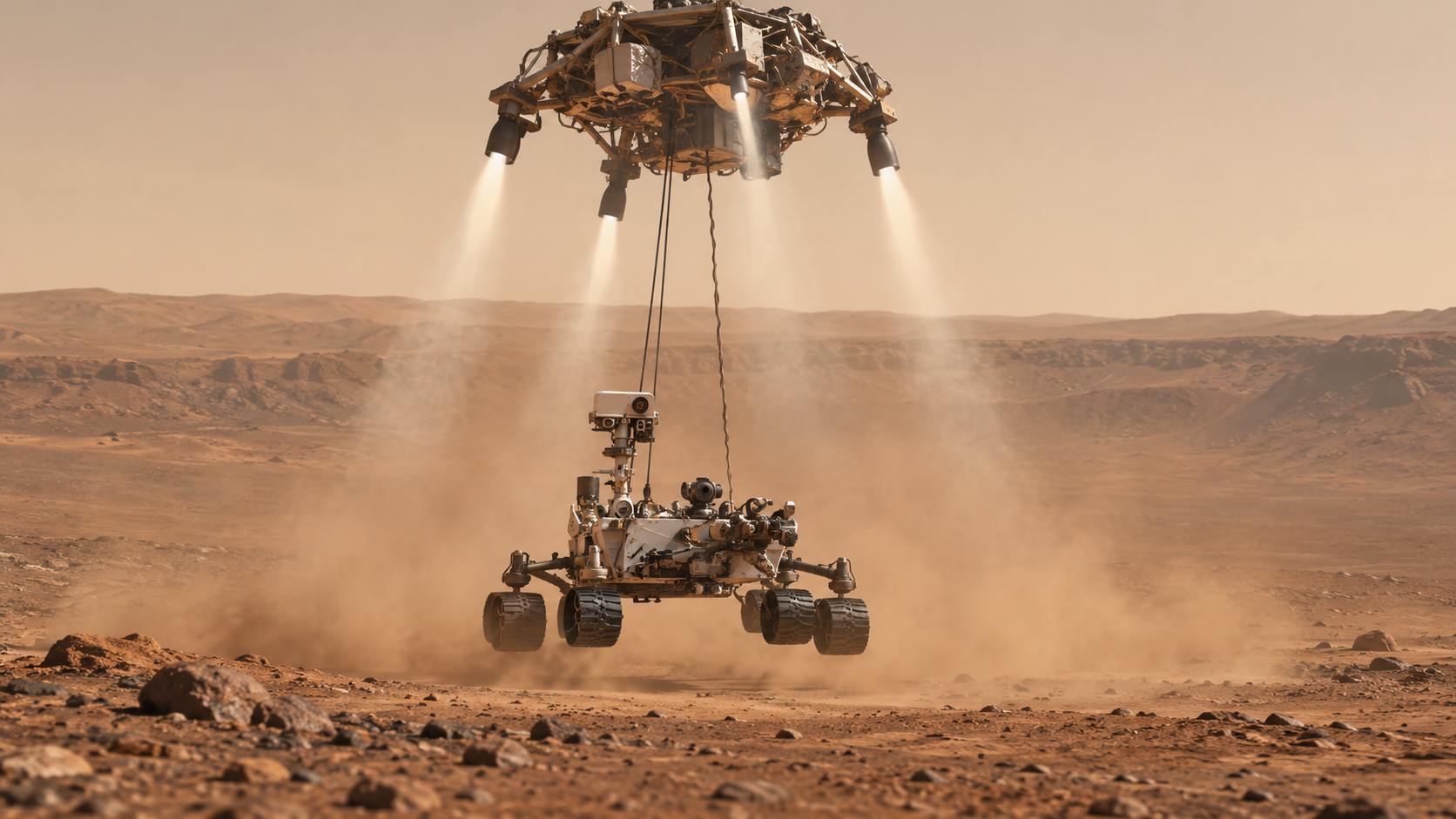
On August 6, 2012, Universal Time, NASA’s Curiosity rover landed inside Gale Crater on Mars. The Mars Science Laboratory spacecraft had entered the atmosphere at high speed, survived intense heating, deployed a supersonic parachute, and separated from its protective backshell before a rocket-powered descent stage lowered the rover on cables.
Curiosity was too heavy for the airbag system used by earlier rovers. The sky crane allowed its six wheels to touch the surface ready to drive while the descent stage flew away to crash at a safe distance. Because radio signals took many minutes to reach Earth, the complete entry, descent, and landing sequence ran autonomously.
The rover’s goal was not to detect life directly but to determine whether ancient Mars ever offered environmental conditions suitable for microbes. Cameras, spectrometers, weather sensors, a drill, a laser instrument, and onboard laboratories examined rocks and atmosphere. Early work found evidence of an ancient lake environment with water, key chemical elements, and usable energy sources.
The landing placed a mobile geochemistry laboratory at the foot of Mount Sharp, a layered mountain preserving a long record of environmental change. Curiosity’s continuing climb has connected mineral transitions, climate history, and surface habitability while proving a landing system later adapted for Perseverance. Seen across a longer timeline, scientific milestones are junctions rather than isolated beginnings. Earlier experiments, tools, and institutions made the work possible, while later teams tested limits and carried the result into new settings. What survives is a traceable chain of evidence, correction, and application that allows one moment to remain relevant as knowledge and technology continue to change. The anniversary highlights the difference between a first result and a finished understanding. A successful observation can settle one question while opening several harder ones, and even a failed objective can reshape later designs. Preserved data, specimens, photographs, and hardware allow new generations to revisit the work with better tools. Science advances through that continuity rather than stopping on a memorable date. Its calendar date is an entry point, not an endpoint. The people involved worked with the instruments, assumptions, and social conditions of their time, and later research has both extended and corrected their conclusions. Separating what was known that day from what became clear afterward protects the history from myth and shows how cumulative evidence turns an episode into lasting scientific knowledge. For science history, the event also shows how evidence moves from an observation or engineered test into a durable body of knowledge. Instruments supplied measurements, specialists debated interpretation, and later work refined what the first result could mean. Archives preserve the early record while new methods let researchers ask different questions of it. That continuing revision is the process through which a dated milestone remains scientifically useful.
Mars was too far away for live piloting during atmospheric entry.
Onboard computers managed every transition from heat shield to touchdown.
Curiosity’s mass exceeded the practical limit of the earlier airbag approach.
Cables placed the rover directly on its wheels beneath a hovering descent stage.
Layered rocks preserve changes in water, sediment, and climate.
The rover’s long traverse turned one landing site into a geological history.
Explore more of "On This Day ..."
Discover more events from the same date across news, politics, technology, sports, and other fields. Each link highlights significant moments that shaped history on different fronts.