

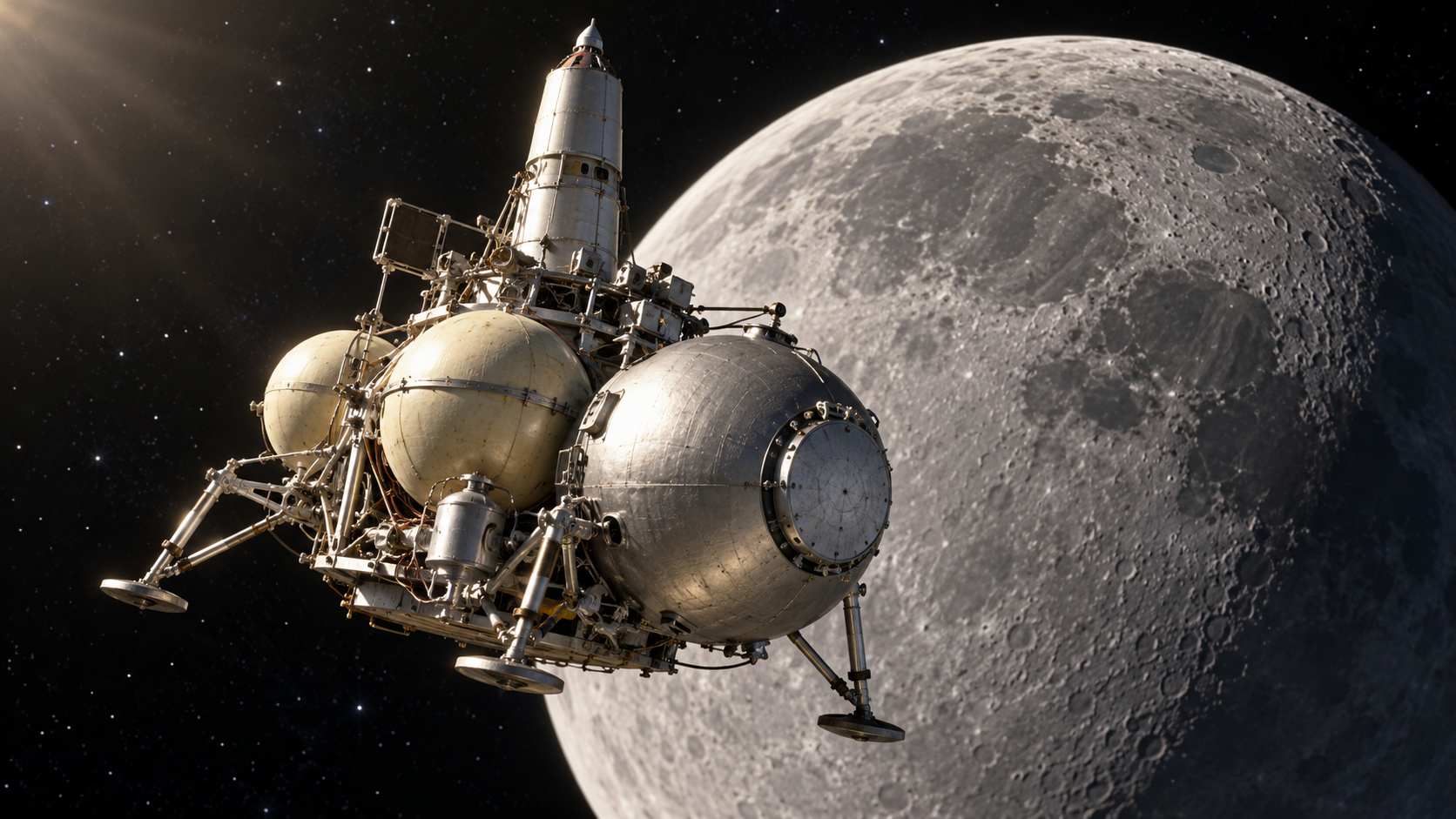
On This Day in Science: August 9, 1976
On August 9, 1976, the Soviet Union launched Luna 24 toward the Moon on a Proton rocket. The automated mission was designed to land in Mare Crisium, drill below the surface, seal a core sample inside a return capsule, and send that material back to Earth without a crew. It followed the damaged sampling attempt of Luna 23.
After entering lunar orbit and refining its path, Luna 24 landed on August 18. A rotary percussion drill reached roughly two meters while preserving the sequence of material in the core. The ascent stage then lifted off, and the small capsule returned through Earth’s atmosphere for recovery in the Soviet Union.
Scientists received about 170 grams of lunar soil. The layered core provided information about regolith formation and volcanic history, and analyses found evidence of water at levels that received renewed attention decades later. Samples were shared with researchers in other countries, including exchanges with Apollo material.
The launch began the last successful lunar sample-return mission of the twentieth century. Luna 24 showed that an uncrewed system could perform landing, drilling, ascent, navigation, reentry, and recovery as one chain, a model that modern robotic sample-return programs continue to refine. For science history, the event also shows how evidence moves from an observation or engineered test into a durable body of knowledge. Instruments supplied measurements, specialists debated interpretation, and later work refined what the first result could mean. Archives preserve the early record while new methods let researchers ask different questions of it. That continuing revision is the process through which a dated milestone remains scientifically useful. Seen across a longer timeline, scientific milestones are junctions rather than isolated beginnings. Earlier experiments, tools, and institutions made the work possible, while later teams tested limits and carried the result into new settings. What survives is a traceable chain of evidence, correction, and application that allows one moment to remain relevant as knowledge and technology continue to change. The anniversary highlights the difference between a first result and a finished understanding. A successful observation can settle one question while opening several harder ones, and even a failed objective can reshape later designs. Preserved data, specimens, photographs, and hardware allow new generations to revisit the work with better tools. Science advances through that continuity rather than stopping on a memorable date. Its calendar date is an entry point, not an endpoint. The people involved worked with the instruments, assumptions, and social conditions of their time, and later research has both extended and corrected their conclusions. Separating what was known that day from what became clear afterward protects the history from myth and shows how cumulative evidence turns an episode into lasting scientific knowledge.
The previous lander reached Mare Crisium but damaged its sampling system.
Luna 24 used revised landing and drilling operations.
The drill collected a narrow column while preserving depth order.
Layering revealed changes beneath the churned surface soil.
The ascent stage carried a sealed capsule away from the Moon.
Atmospheric reentry and ground recovery completed the automated sample chain.
Explore more of "On This Day ..."
Discover more events from the same date across news, politics, technology, sports, and other fields. Each link highlights significant moments that shaped history on different fronts.