

On This Day in Science: August 10, 1990
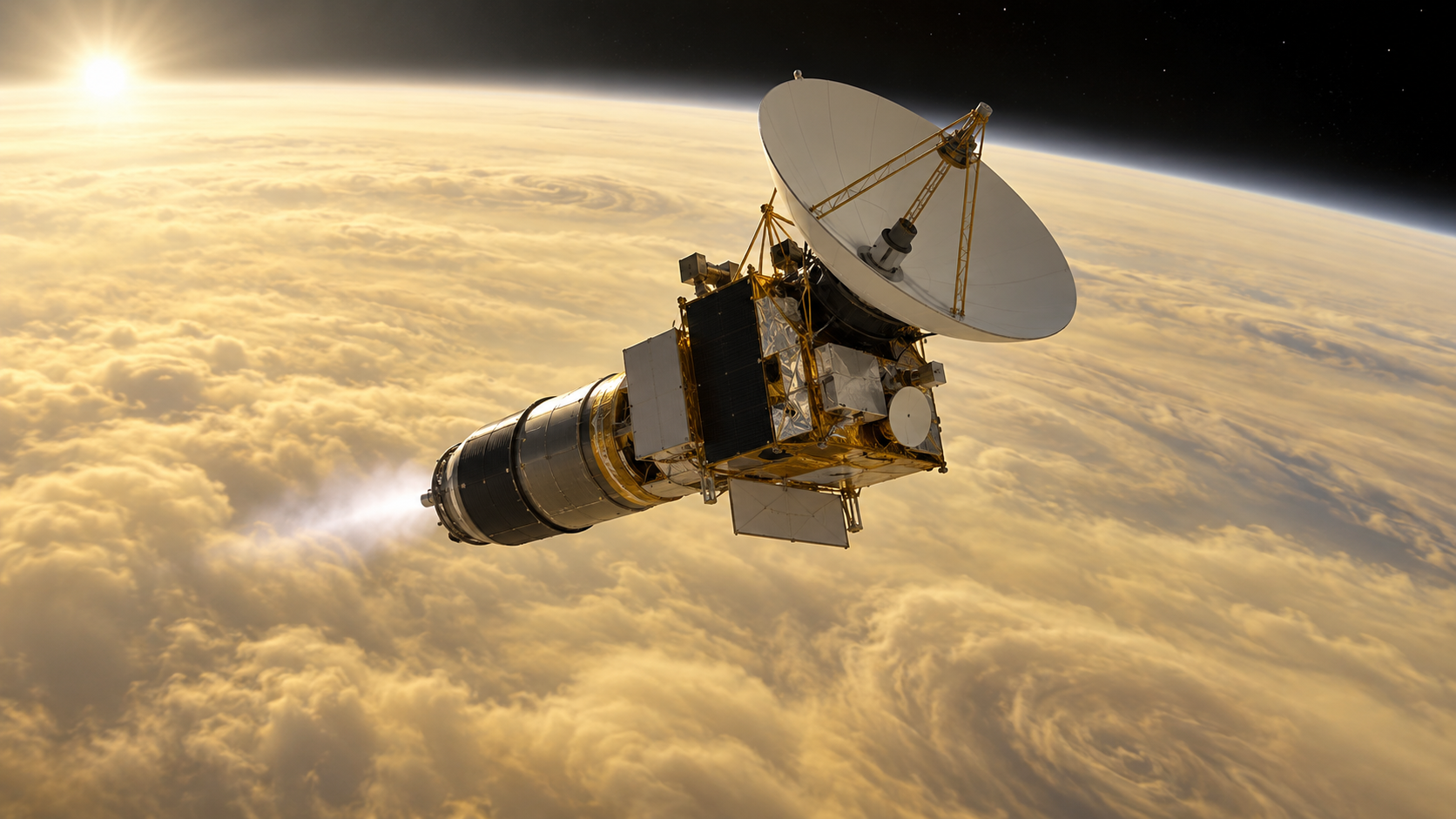
On August 10, 1990, NASA’s Magellan spacecraft fired a solid rocket motor and entered orbit around Venus after a fifteen-month cruise. Thick clouds hide the planet’s surface from ordinary cameras, so Magellan carried a synthetic-aperture radar designed to map terrain by timing and analyzing radio echoes.
The initial orbit was highly elliptical and nearly polar. As Venus rotated beneath the spacecraft, repeated radar swaths built a global mosaic. Radar brightness reflected roughness, slope, and electrical properties rather than visible color, requiring careful interpretation but revealing structures impossible to observe through the atmosphere.
Magellan mapped about 98 percent of Venus at far better resolution than earlier missions. The images showed broad volcanic plains, immense shield volcanoes, long lava channels, deformed mountain belts, coronae, and relatively few impact craters. Later mission phases used radio tracking to map gravity and aerobraking to alter the orbit.
Orbit insertion transformed Venus from a mostly concealed world into a mapped geological planet. Magellan’s data remain central to debates about resurfacing, volcanism, tectonics, and current activity, and they provide the baseline against which future Venus radar missions will measure change. Seen across a longer timeline, scientific milestones are junctions rather than isolated beginnings. Earlier experiments, tools, and institutions made the work possible, while later teams tested limits and carried the result into new settings. What survives is a traceable chain of evidence, correction, and application that allows one moment to remain relevant as knowledge and technology continue to change. The anniversary highlights the difference between a first result and a finished understanding. A successful observation can settle one question while opening several harder ones, and even a failed objective can reshape later designs. Preserved data, specimens, photographs, and hardware allow new generations to revisit the work with better tools. Science advances through that continuity rather than stopping on a memorable date. Its calendar date is an entry point, not an endpoint. The people involved worked with the instruments, assumptions, and social conditions of their time, and later research has both extended and corrected their conclusions. Separating what was known that day from what became clear afterward protects the history from myth and shows how cumulative evidence turns an episode into lasting scientific knowledge. For science history, the event also shows how evidence moves from an observation or engineered test into a durable body of knowledge. Instruments supplied measurements, specialists debated interpretation, and later work refined what the first result could mean. Archives preserve the early record while new methods let researchers ask different questions of it. That continuing revision is the process through which a dated milestone remains scientifically useful.
Microwave radar penetrated the opaque sulfuric-acid cloud deck.
Echo strength and timing were converted into maps of surface form and texture.
The survey exposed volcanoes, lava channels, ridges, and circular coronae.
Few craters suggested that much of the surface is geologically young.
Radio tracking measured variations in Venus’s gravity field.
Aerobraking tested controlled passage through the upper atmosphere.
Explore more of "On This Day ..."
Discover more events from the same date across news, politics, technology, sports, and other fields. Each link highlights significant moments that shaped history on different fronts.