

On This Day in Science: August 16, 1960
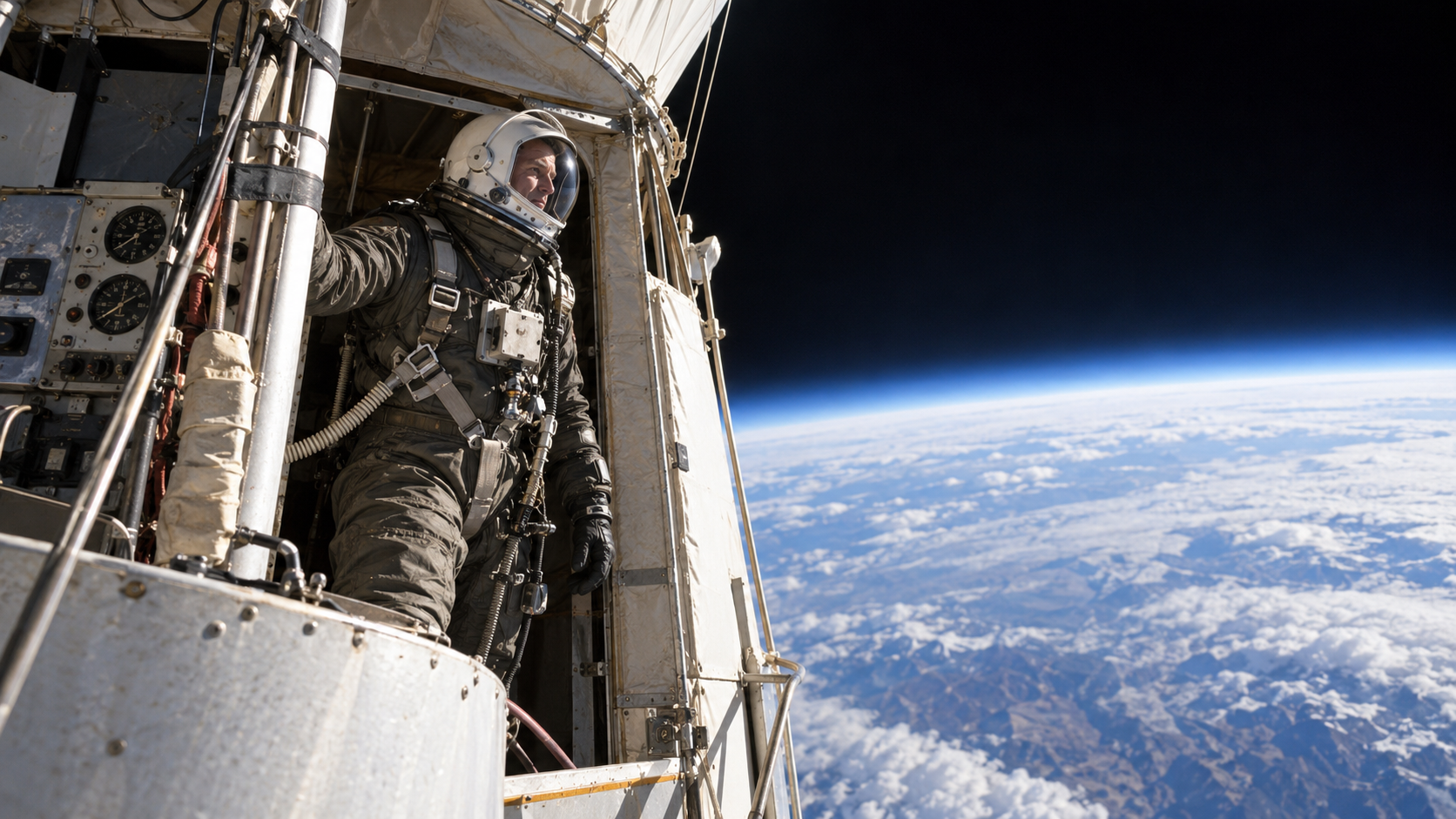
On August 16, 1960, U.S. Air Force Captain Joseph Kittinger stepped from the open Excelsior III balloon gondola at about 102,800 feet above New Mexico. The jump was a research test of pressure suits, parachutes, and stabilization methods for pilots who might need to escape from aircraft at extreme altitude.
Air at that height is too thin to breathe and provides little aerodynamic damping. Kittinger wore a full-pressure suit and used a small stabilization parachute intended to prevent the uncontrolled flat spin that had endangered him during an earlier test. One glove failed to pressurize during ascent, painfully swelling his hand, but he continued.
He fell for more than four minutes before deploying the main parachute and landed safely. The descent established records for balloon altitude, free-fall, and parachute descent that lasted for decades. Cameras and instruments recorded physiological and engineering data rather than treating the jump simply as a stunt.
Project Excelsior helped validate systems and procedures for the emerging era of high-altitude aviation and spaceflight. Later record jumps used improved suits and vehicles, but Kittinger’s flight remains a landmark in understanding human survival, stability, and recovery in the near-vacuum above most of the atmosphere. Its calendar date is an entry point, not an endpoint. The people involved worked with the instruments, assumptions, and social conditions of their time, and later research has both extended and corrected their conclusions. Separating what was known that day from what became clear afterward protects the history from myth and shows how cumulative evidence turns an episode into lasting scientific knowledge. For science history, the event also shows how evidence moves from an observation or engineered test into a durable body of knowledge. Instruments supplied measurements, specialists debated interpretation, and later work refined what the first result could mean. Archives preserve the early record while new methods let researchers ask different questions of it. That continuing revision is the process through which a dated milestone remains scientifically useful. Seen across a longer timeline, scientific milestones are junctions rather than isolated beginnings. Earlier experiments, tools, and institutions made the work possible, while later teams tested limits and carried the result into new settings. What survives is a traceable chain of evidence, correction, and application that allows one moment to remain relevant as knowledge and technology continue to change. The anniversary highlights the difference between a first result and a finished understanding. A successful observation can settle one question while opening several harder ones, and even a failed objective can reshape later designs. Preserved data, specimens, photographs, and hardware allow new generations to revisit the work with better tools. Science advances through that continuity rather than stopping on a memorable date.
A helium balloon carried Kittinger into a region with almost no breathable air.
His pressure suit functioned as a personal life-support envelope.
A small drogue parachute stabilized his body in thin air.
The system addressed a failure mode seen in an earlier Excelsior test.
The flight measured suit, parachute, and human performance.
Its purpose was safer emergency escape from very high aircraft.
Explore more of "On This Day ..."
Discover more events from the same date across news, politics, technology, sports, and other fields. Each link highlights significant moments that shaped history on different fronts.