

On This Day in Science: August 18, 1868
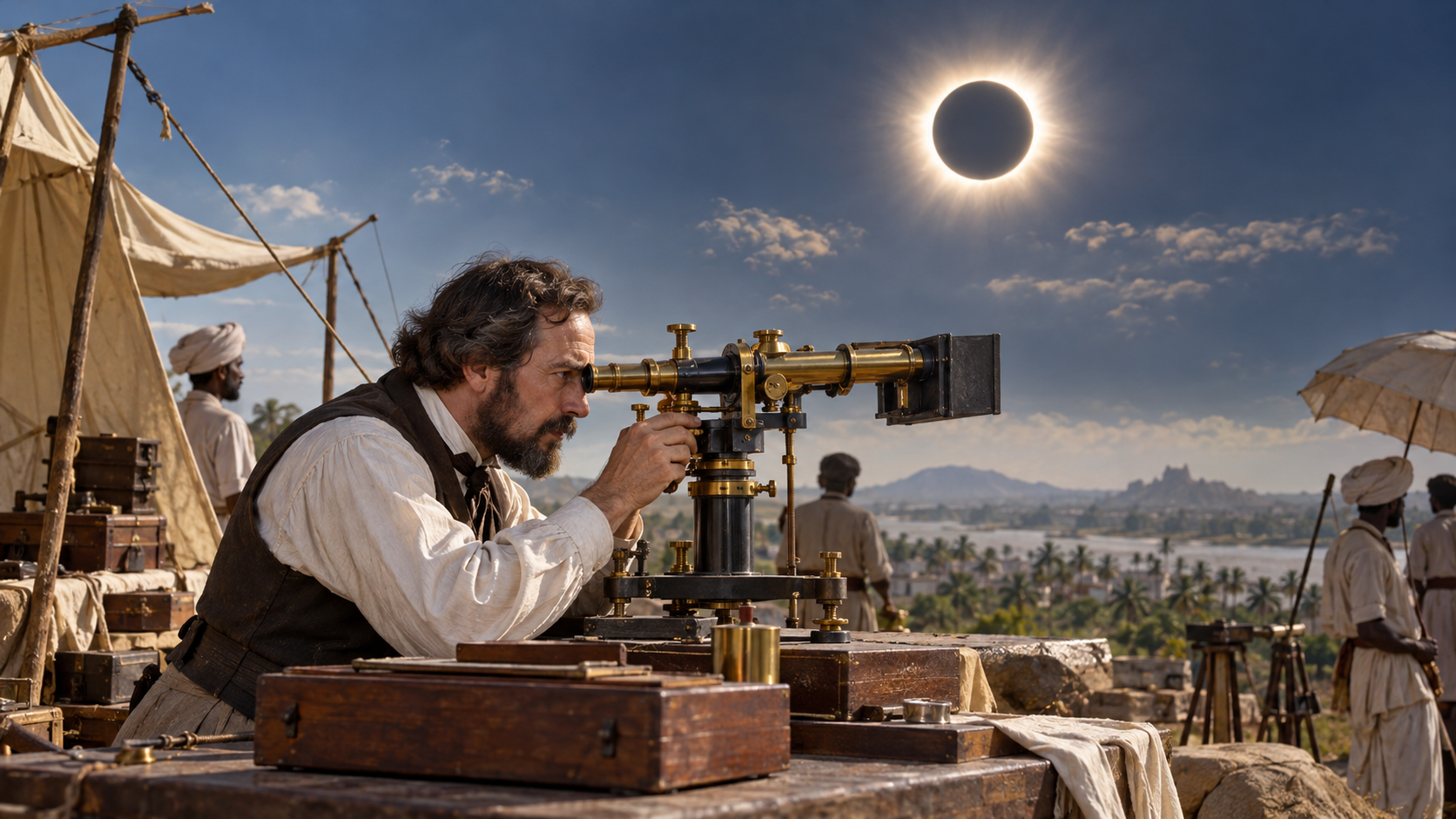
On August 18, 1868, French astronomer Jules Janssen observed a total solar eclipse from Guntur in India and studied the Sun’s prominences with a spectroscope. He recorded a bright yellow line close to, but distinct from, the familiar sodium lines. The observation became part of the evidence for an element not then known on Earth.
A spectroscope separates light by wavelength, allowing chemical elements to be recognized by characteristic lines. Janssen realized prominences could be examined spectroscopically even without an eclipse. In England, Norman Lockyer independently observed the same yellow line and proposed that it came from a previously unknown solar substance.
The element was named helium from the Greek word for Sun. Its existence remained inferred from solar light until William Ramsay isolated helium on Earth in 1895 from a uranium-bearing mineral, after which its spectrum matched the solar line. The discovery showed that chemistry could reach across astronomical distances.
The eclipse observation helped establish astrophysical spectroscopy as a method for determining what distant objects are made of. Today the same principle reveals temperatures, motions, magnetic fields, and composition in stars, nebulae, galaxies, and planetary atmospheres. Seen across a longer timeline, scientific milestones are junctions rather than isolated beginnings. Earlier experiments, tools, and institutions made the work possible, while later teams tested limits and carried the result into new settings. What survives is a traceable chain of evidence, correction, and application that allows one moment to remain relevant as knowledge and technology continue to change. The anniversary highlights the difference between a first result and a finished understanding. A successful observation can settle one question while opening several harder ones, and even a failed objective can reshape later designs. Preserved data, specimens, photographs, and hardware allow new generations to revisit the work with better tools. Science advances through that continuity rather than stopping on a memorable date. Its calendar date is an entry point, not an endpoint. The people involved worked with the instruments, assumptions, and social conditions of their time, and later research has both extended and corrected their conclusions. Separating what was known that day from what became clear afterward protects the history from myth and shows how cumulative evidence turns an episode into lasting scientific knowledge. For science history, the event also shows how evidence moves from an observation or engineered test into a durable body of knowledge. Instruments supplied measurements, specialists debated interpretation, and later work refined what the first result could mean. Archives preserve the early record while new methods let researchers ask different questions of it. That continuing revision is the process through which a dated milestone remains scientifically useful.
The spectroscope showed a feature that did not match known terrestrial elements.
Precise wavelength, not visible color alone, made the distinction possible.
Janssen worked during the eclipse in India.
Lockyer soon detected the line from England and argued for a new element.
Helium was identified in the Sun before it was isolated on Earth.
Spectroscopy became a foundation of modern astrophysics.
Explore more of "On This Day ..."
Discover more events from the same date across news, politics, technology, sports, and other fields. Each link highlights significant moments that shaped history on different fronts.