

On This Day in Science: August 31, 1979
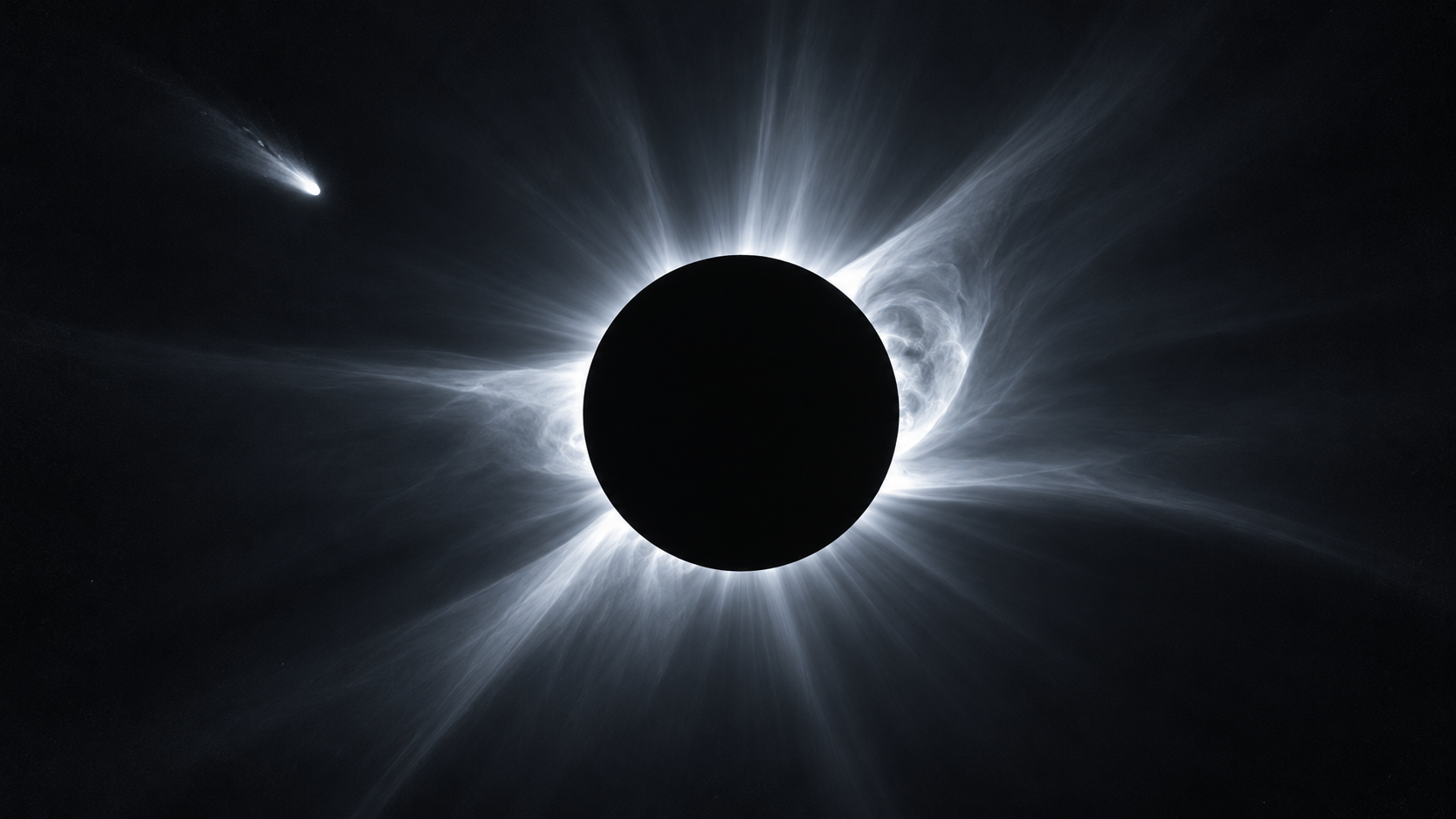
On August 31, 1979, a small comet later named Howard–Koomen–Michels plunged into the Sun. It was discovered in images from the SOLWIND coronagraph aboard the U.S. P78-1 satellite. The instrument blocked the brilliant solar disk so fainter structures and an approaching object could be seen near the Sun.
Researchers found the comet retrospectively while examining recorded data. Successive frames showed it brightening and moving inward until it disappeared at the solar limb, with no later outbound track. The sequence became the first recorded observation of a comet colliding with the Sun.
The object is associated with the Kreutz family of sungrazing comets, fragments that follow similar orbits and pass extremely close to the Sun. Heating, tidal stress, and intense radiation can destroy small members before or during perihelion, making them visible only briefly to coronagraphs.
SOLWIND’s result anticipated a field transformed by the later SOHO spacecraft, whose images have revealed thousands of sungrazing comets. The 1979 event showed that solar-observing instruments could also become powerful comet surveys and that archives may hold discoveries not recognized when the data were first collected. The anniversary highlights the difference between a first result and a finished understanding. A successful observation can settle one question while opening several harder ones, and even a failed objective can reshape later designs. Preserved data, specimens, photographs, and hardware allow new generations to revisit the work with better tools. Science advances through that continuity rather than stopping on a memorable date. Its calendar date is an entry point, not an endpoint. The people involved worked with the instruments, assumptions, and social conditions of their time, and later research has both extended and corrected their conclusions. Separating what was known that day from what became clear afterward protects the history from myth and shows how cumulative evidence turns an episode into lasting scientific knowledge. For science history, the event also shows how evidence moves from an observation or engineered test into a durable body of knowledge. Instruments supplied measurements, specialists debated interpretation, and later work refined what the first result could mean. Archives preserve the early record while new methods let researchers ask different questions of it. That continuing revision is the process through which a dated milestone remains scientifically useful. Seen across a longer timeline, scientific milestones are junctions rather than isolated beginnings. Earlier experiments, tools, and institutions made the work possible, while later teams tested limits and carried the result into new settings. What survives is a traceable chain of evidence, correction, and application that allows one moment to remain relevant as knowledge and technology continue to change.
The instrument hid the bright solar disk behind an occulting circle.
That artificial eclipse revealed a faint object approaching the Sun.
Successive frames carried the comet inward to the solar limb.
Its disappearance showed that it did not survive the encounter.
Howard–Koomen–Michels belonged to a family of related close-Sun comets.
Later coronagraph missions turned incidental detections into vast comet catalogues.
Explore more of "On This Day ..."
Discover more events from the same date across news, politics, technology, sports, and other fields. Each link highlights significant moments that shaped history on different fronts.