

On This Day in Science: September 2, 1859
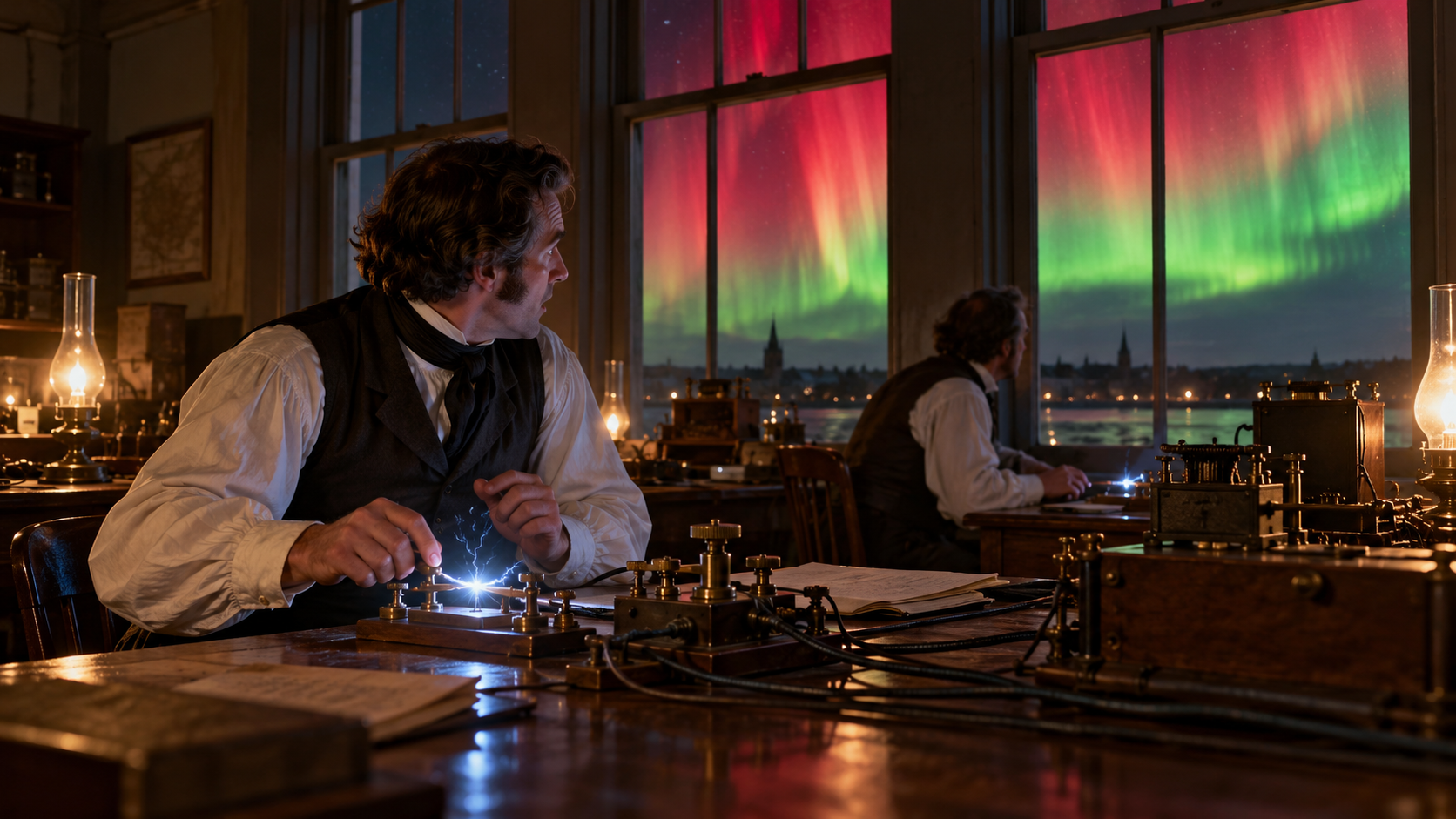
In the early hours of September 2, 1859, an extraordinary geomagnetic storm reached its most dramatic phase. Auroras brightened skies far outside their usual polar range, appearing across the Caribbean and reportedly illuminating landscapes enough to read by. Telegraph networks in Europe and North America carried powerful induced currents that shocked operators, sparked equipment, and sometimes transmitted messages after batteries were disconnected.
The disturbance followed a brilliant white-light solar flare observed on September 1 by British astronomers Richard Carrington and Richard Hodgson. A fast solar eruption then struck Earth’s magnetic environment in roughly seventeen hours. That connection between a solar outburst and a terrestrial magnetic storm helped establish what is now called space weather.
The event is commonly known as the Carrington Event, though it unfolded over several days and involved more than one solar disturbance. Historical magnetometer traces and eyewitness reports allow researchers to estimate its intensity, while uncertainty remains about the exact strength and structure of the eruption.
Modern society depends on technologies far more sensitive to geomagnetic activity than the telegraph. Power grids, satellites, navigation, radio, and pipelines can all be affected, which makes the 1859 storm a continuing benchmark for forecasting and resilience. Seen across a longer timeline, scientific milestones are junctions rather than isolated beginnings. Earlier experiments, tools, and institutions made the work possible, while later teams tested limits and carried the result into new settings. What survives is a traceable chain of evidence, correction, and application that allows one moment to remain relevant as knowledge and technology continue to change. The anniversary highlights the difference between a first result and a finished understanding. A successful observation can settle one question while opening several harder ones, and even a failed objective can reshape later designs. Preserved data, specimens, photographs, and hardware allow new generations to revisit the work with better tools. Science advances through that continuity rather than stopping on a memorable date. Its calendar date is an entry point, not an endpoint. The people involved worked with the instruments, assumptions, and social conditions of their time, and later research has both extended and corrected their conclusions. Separating what was known that day from what became clear afterward protects the history from myth and shows how cumulative evidence turns an episode into lasting scientific knowledge. For science history, the event also shows how evidence moves from an observation or engineered test into a durable body of knowledge. Instruments supplied measurements, specialists debated interpretation, and later work refined what the first result could mean. Archives preserve the early record while new methods let researchers ask different questions of it. That continuing revision is the process through which a dated milestone remains scientifically useful.
Charged particles and magnetic disturbance drove brilliant light displays at unusually low latitudes.
People in tropical and subtropical regions saw skies normally associated with polar nights.
Rapid magnetic changes induced electrical currents in long conductors.
Operators reported sparks, shocks, and circuits that worked without their normal batteries.
Carrington's solar observation preceded the strongest phase of the geomagnetic storm.
The sequence helped scientists connect activity on the Sun with effects at Earth.
Explore more of "On This Day ..."
Discover more events from the same date across news, politics, technology, sports, and other fields. Each link highlights significant moments that shaped history on different fronts.