

On This Day in Science: September 7, 1927
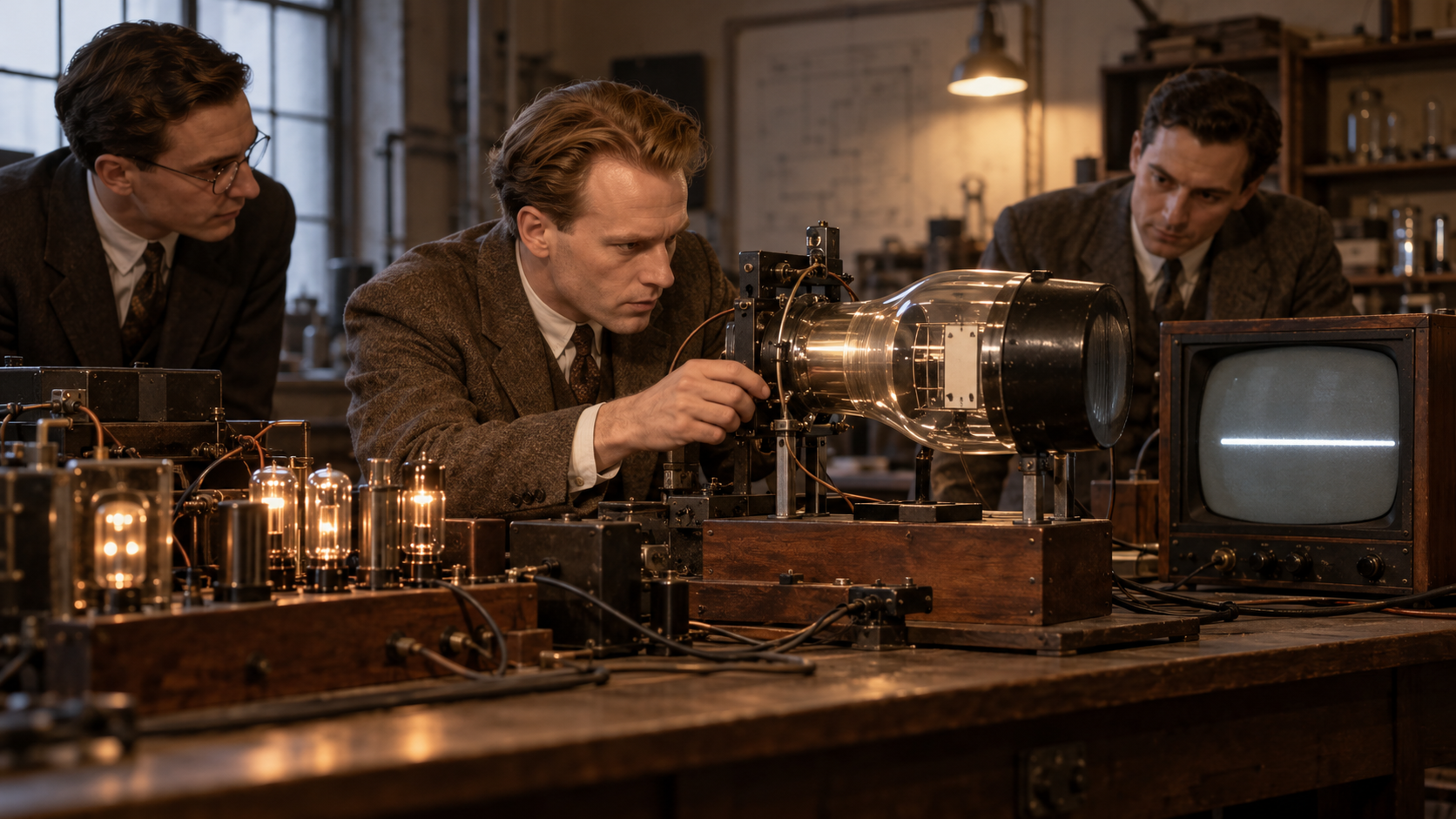
On September 7, 1927, inventor Philo T. Farnsworth and his small team transmitted an image using an all-electronic television system in a San Francisco laboratory. The simple test image was a straight line, but the achievement showed that a scene could be converted into an electronic signal, sent, and reconstructed without a mechanical scanning disk.
At the heart of the camera was Farnsworth’s image dissector tube. An optical image formed on a photosensitive surface, and electron beams represented different portions of that image as the system scanned it. A separate cathode-ray display reconstructed the signal. The early pictures were crude, unstable, and small, yet the operating principle was clear.
Television development involved many inventors and institutions, and later practical cameras used improved electronic designs. Patent disputes followed, particularly with RCA, but Farnsworth successfully demonstrated that key features of his system predated competing claims. His laboratory work became part of the foundation for electronic television.
The line seen in 1927 was less important as content than as proof. Once both capture and display could be electronic, engineers gained a route toward higher scanning speeds, better resolution, and broadcasting systems without fragile moving mechanisms. The anniversary highlights the difference between a first result and a finished understanding. A successful observation can settle one question while opening several harder ones, and even a failed objective can reshape later designs. Preserved data, specimens, photographs, and hardware allow new generations to revisit the work with better tools. Science advances through that continuity rather than stopping on a memorable date. Its calendar date is an entry point, not an endpoint. The people involved worked with the instruments, assumptions, and social conditions of their time, and later research has both extended and corrected their conclusions. Separating what was known that day from what became clear afterward protects the history from myth and shows how cumulative evidence turns an episode into lasting scientific knowledge. For science history, the event also shows how evidence moves from an observation or engineered test into a durable body of knowledge. Instruments supplied measurements, specialists debated interpretation, and later work refined what the first result could mean. Archives preserve the early record while new methods let researchers ask different questions of it. That continuing revision is the process through which a dated milestone remains scientifically useful. Seen across a longer timeline, scientific milestones are junctions rather than isolated beginnings. Earlier experiments, tools, and institutions made the work possible, while later teams tested limits and carried the result into new settings. What survives is a traceable chain of evidence, correction, and application that allows one moment to remain relevant as knowledge and technology continue to change.
The first transmitted subject was deliberately simple.
Its changing orientation showed that the receiver was reproducing a live electronic image.
A photosensitive tube converted an optical scene into a scanned electron signal.
A cathode-ray tube at the receiver turned that signal back into light.
The 1927 apparatus was experimental rather than a household television.
Its electronic approach helped define the path toward practical modern imaging.
Explore more of "On This Day ..."
Discover more events from the same date across news, politics, technology, sports, and other fields. Each link highlights significant moments that shaped history on different fronts.