

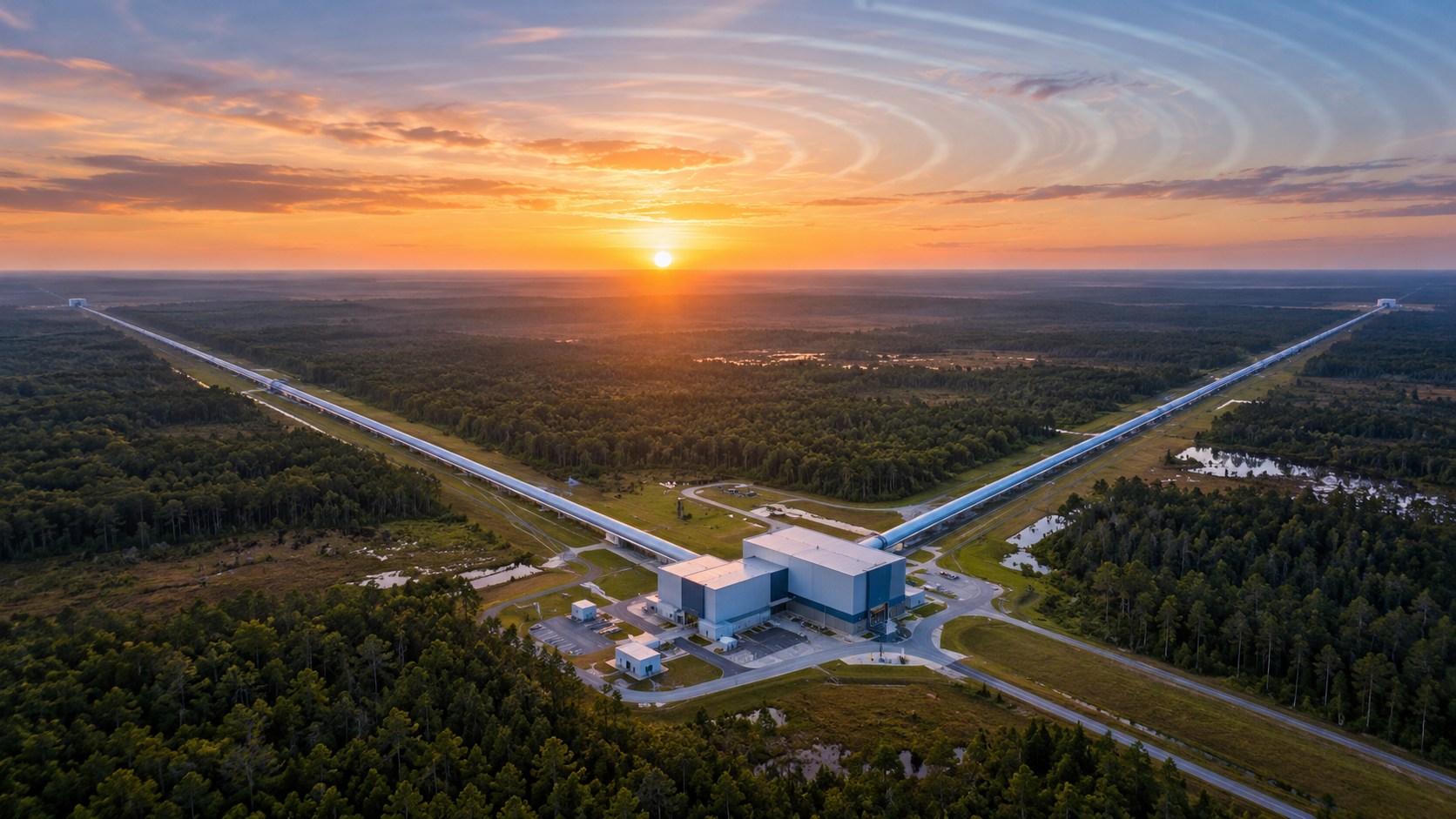
On This Day in Science: September 14, 2015
On September 14, 2015, the two detectors of the Laser Interferometer Gravitational-Wave Observatory recorded a brief signal from the merger of two black holes. The waveform arrived first at LIGO Livingston in Louisiana and about seven milliseconds later at LIGO Hanford in Washington, matching the travel time expected for a disturbance moving at light speed.
Each detector uses laser light in two perpendicular four-kilometer arms to compare distances with extraordinary precision. A passing gravitational wave stretches space in one direction while compressing it in the other. The recorded change was far smaller than a proton, yet its rising frequency and amplitude matched general relativity’s prediction for orbiting black holes spiraling together.
Analysis indicated black holes of about 36 and 29 solar masses merging into one roughly 62 times the Sun’s mass. The difference was radiated as gravitational-wave energy in a fraction of a second. Independent teams checked instruments, environmental monitors, data pipelines, and possible false signals before the discovery was announced in 2016.
The event, named GW150914, was the first direct detection of gravitational waves and the first observation of a binary black-hole merger. It opened a new form of astronomy in which researchers listen to the motion of massive objects that may emit little or no light. Seen across a longer timeline, scientific milestones are junctions rather than isolated beginnings. Earlier experiments, tools, and institutions made the work possible, while later teams tested limits and carried the result into new settings. What survives is a traceable chain of evidence, correction, and application that allows one moment to remain relevant as knowledge and technology continue to change. The anniversary highlights the difference between a first result and a finished understanding. A successful observation can settle one question while opening several harder ones, and even a failed objective can reshape later designs. Preserved data, specimens, photographs, and hardware allow new generations to revisit the work with better tools. Science advances through that continuity rather than stopping on a memorable date. Its calendar date is an entry point, not an endpoint. The people involved worked with the instruments, assumptions, and social conditions of their time, and later research has both extended and corrected their conclusions. Separating what was known that day from what became clear afterward protects the history from myth and shows how cumulative evidence turns an episode into lasting scientific knowledge. For science history, the event also shows how evidence moves from an observation or engineered test into a durable body of knowledge. Instruments supplied measurements, specialists debated interpretation, and later work refined what the first result could mean. Archives preserve the early record while new methods let researchers ask different questions of it. That continuing revision is the process through which a dated milestone remains scientifically useful.
Livingston and Hanford recorded nearly the same rising waveform milliseconds apart.
The agreement helped distinguish a cosmic signal from local disturbance.
Laser beams repeatedly traveled along perpendicular four-kilometer arms.
Interference revealed a relative length change smaller than the width of a proton.
The waveform encoded the masses and final moments of two merging black holes.
Gravitational-wave astronomy gained a direct way to study otherwise dark systems.
Explore more of "On This Day ..."
Discover more events from the same date across news, politics, technology, sports, and other fields. Each link highlights significant moments that shaped history on different fronts.