

On This Day in Science: September 13, 1959
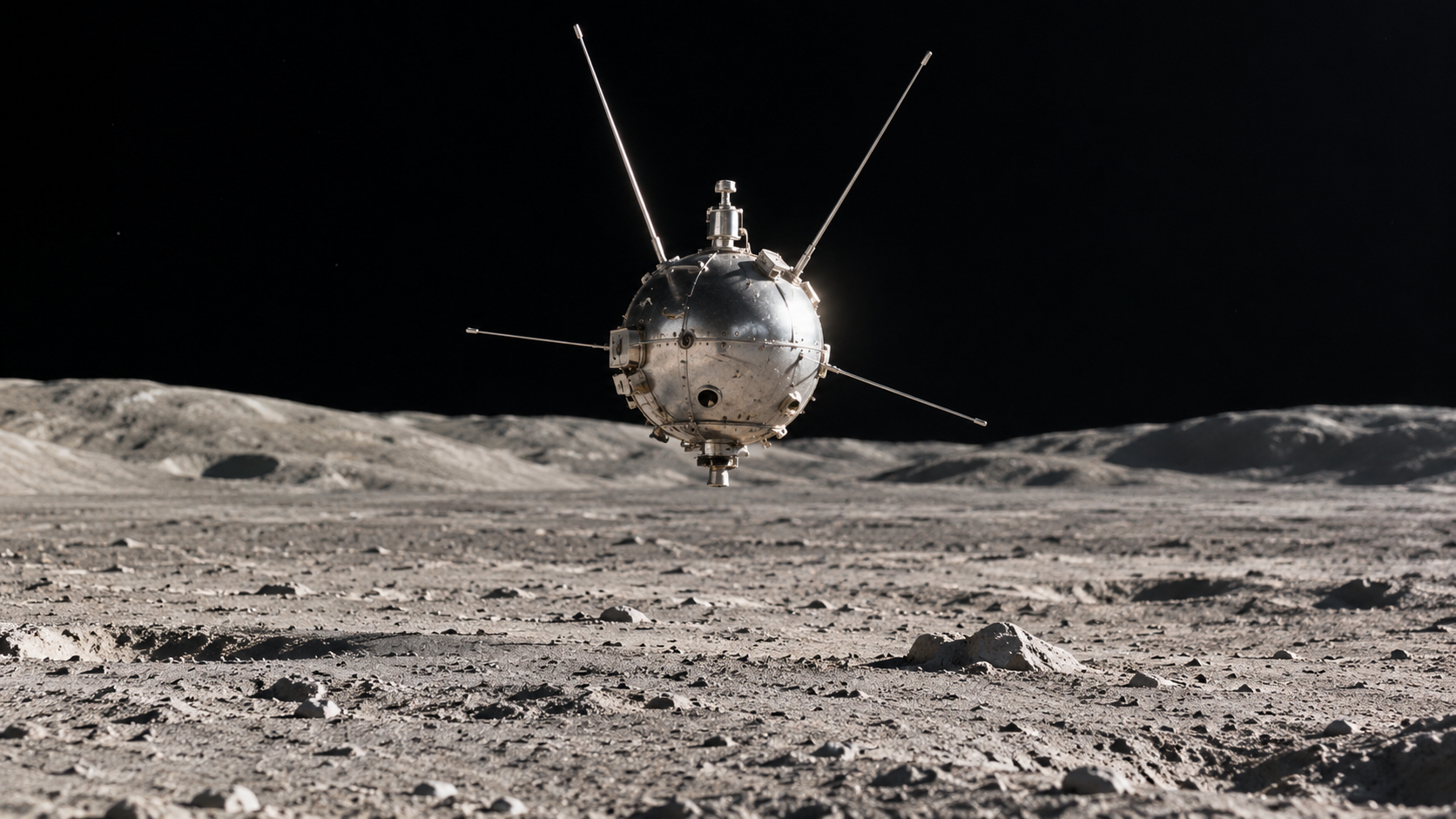
On September 13, 1959, the Soviet spacecraft Luna 2 struck the Moon near the region east of Mare Imbrium. Its radio transmissions stopped at the predicted time, and tracking observations supported the impact. Luna 2 thereby became the first human-made object confirmed to reach the surface of another celestial body.
The probe was a metal sphere with protruding antennas and scientific sensors. It had traveled directly from Earth without entering lunar orbit and carried pennants made of small metal elements stamped with Soviet emblems. A separate upper-stage component reached the Moon shortly after the main spacecraft.
During the flight, instruments measured cosmic rays, charged particles, magnetic fields, and micrometeoroids. The data indicated that the Moon lacked a strong global magnetic field and Earth-like radiation belts. Although the mission ended in impact, useful measurements continued until the final moments.
Luna 2’s arrival demonstrated the precision needed to target a moving world across hundreds of thousands of kilometers. It helped turn the Moon from a remote astronomical subject into a destination for engineered experiments, leading to orbiters, soft landers, rovers, sample returns, and human expeditions. For science history, the event also shows how evidence moves from an observation or engineered test into a durable body of knowledge. Instruments supplied measurements, specialists debated interpretation, and later work refined what the first result could mean. Archives preserve the early record while new methods let researchers ask different questions of it. That continuing revision is the process through which a dated milestone remains scientifically useful. Seen across a longer timeline, scientific milestones are junctions rather than isolated beginnings. Earlier experiments, tools, and institutions made the work possible, while later teams tested limits and carried the result into new settings. What survives is a traceable chain of evidence, correction, and application that allows one moment to remain relevant as knowledge and technology continue to change. The anniversary highlights the difference between a first result and a finished understanding. A successful observation can settle one question while opening several harder ones, and even a failed objective can reshape later designs. Preserved data, specimens, photographs, and hardware allow new generations to revisit the work with better tools. Science advances through that continuity rather than stopping on a memorable date. Its calendar date is an entry point, not an endpoint. The people involved worked with the instruments, assumptions, and social conditions of their time, and later research has both extended and corrected their conclusions. Separating what was known that day from what became clear afterward protects the history from myth and shows how cumulative evidence turns an episode into lasting scientific knowledge.
Ground stations tracked Luna 2 until its transmission stopped on schedule.
The timing and trajectory confirmed that the spacecraft had reached the lunar surface.
The probe sampled radiation, particles, fields, and dust along its route.
Its results constrained ideas about the Moon's magnetic environment.
A direct hit required careful prediction of both spacecraft and lunar motion.
The success established the Moon as a reachable site for robotic exploration.
Explore more of "On This Day ..."
Discover more events from the same date across news, politics, technology, sports, and other fields. Each link highlights significant moments that shaped history on different fronts.