

On This Day in Science: September 17, 1789
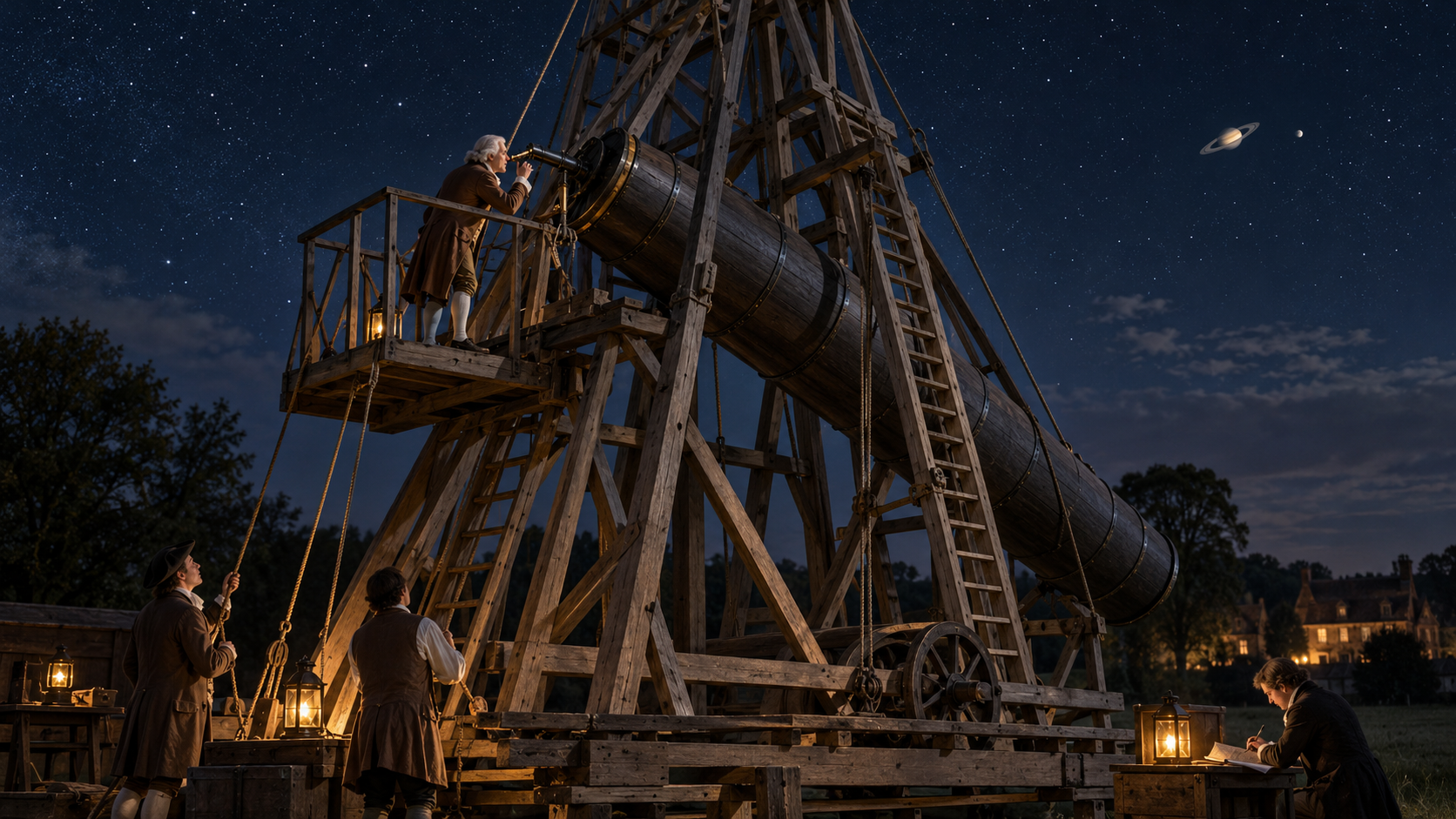
On September 17, 1789, astronomer William Herschel identified a previously unknown moon of Saturn, later named Mimas. He observed from Slough, England, with a newly completed reflecting telescope whose tube was forty feet long and whose large metal mirror gathered far more light than most instruments of the period.
Finding a small moon close to bright Saturn and its rings required favorable geometry, careful focus, and repeated observation. Herschel had discovered another Saturnian moon, Enceladus, weeks earlier. The two additions expanded the known architecture of the ringed planet and demonstrated the reach of large reflecting telescopes.
Mimas is now known to be an icy, heavily cratered world about 396 kilometers across. Its enormous Herschel crater, named for the discoverer, gives it a distinctive appearance in spacecraft images. Modern measurements also indicate a complex interior, with evidence consistent with an ocean beneath its shell.
The 1789 observation linked craftsmanship directly to discovery: Herschel designed telescopes, cast and polished mirrors, and then used them to extend the Solar System’s inventory. Later spacecraft transformed his faint point of light into a mapped geological body. For science history, the event also shows how evidence moves from an observation or engineered test into a durable body of knowledge. Instruments supplied measurements, specialists debated interpretation, and later work refined what the first result could mean. Archives preserve the early record while new methods let researchers ask different questions of it. That continuing revision is the process through which a dated milestone remains scientifically useful. Seen across a longer timeline, scientific milestones are junctions rather than isolated beginnings. Earlier experiments, tools, and institutions made the work possible, while later teams tested limits and carried the result into new settings. What survives is a traceable chain of evidence, correction, and application that allows one moment to remain relevant as knowledge and technology continue to change. The anniversary highlights the difference between a first result and a finished understanding. A successful observation can settle one question while opening several harder ones, and even a failed objective can reshape later designs. Preserved data, specimens, photographs, and hardware allow new generations to revisit the work with better tools. Science advances through that continuity rather than stopping on a memorable date. Its calendar date is an entry point, not an endpoint. The people involved worked with the instruments, assumptions, and social conditions of their time, and later research has both extended and corrected their conclusions. Separating what was known that day from what became clear afterward protects the history from myth and shows how cumulative evidence turns an episode into lasting scientific knowledge.
Herschel's reflector used a large speculum-metal mirror and a long open tube.
Its light-gathering power made faint objects near bright planets easier to detect.
Mimas was difficult to separate from glare and the complex ring system.
Repeated observations established that the point moved as a satellite.
Voyager and Cassini revealed a cratered moon dominated by the Herschel basin.
New orbital measurements continue to revise ideas about its hidden interior.
Explore more of "On This Day ..."
Discover more events from the same date across news, politics, technology, sports, and other fields. Each link highlights significant moments that shaped history on different fronts.