

On This Day in Science: October 8, 1958
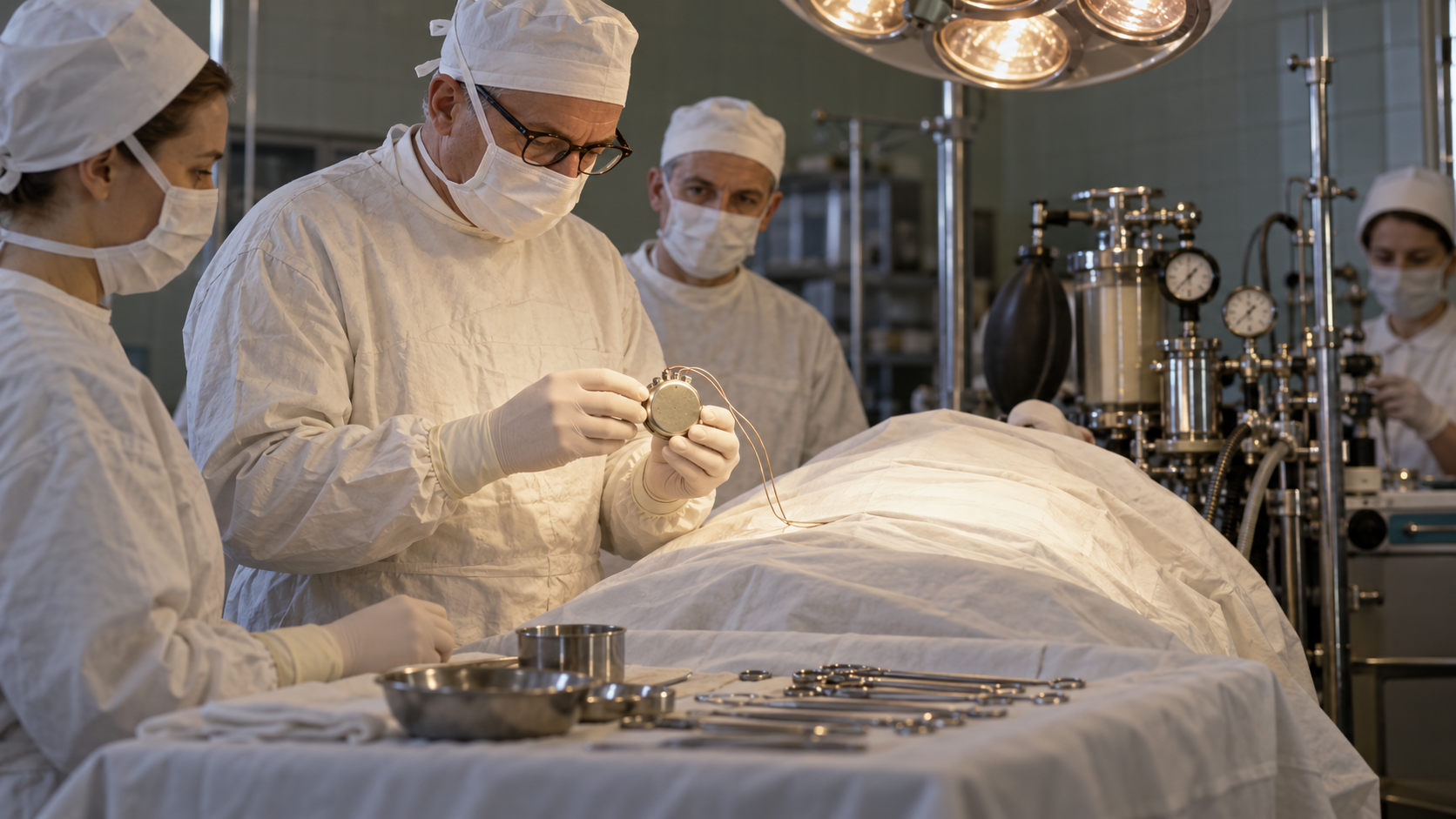
On October 8, 1958, surgeon Åke Senning implanted a fully internal cardiac pacemaker in patient Arne Larsson at Karolinska Hospital in Stockholm. Engineer Rune Elmqvist had built the compact pulse generator, which was connected to electrodes placed on the heart.
Larsson suffered from complete heart block and repeated attacks in which his heart rate fell dangerously low. Earlier pacemakers were external machines, and some sent current through the chest wall. The implanted design promised continuous stimulation without tethering the patient to a bedside device.
The first unit failed after only hours, and a second lasted several days. Its batteries, electronics, and encapsulation were primitive by later standards, yet the operation proved that a sealed electronic device could regulate the heart from inside the body. Larsson ultimately received many replacement pacemakers and lived until 2001.
Modern pacemakers are smaller, programmable, longer-lived, and capable of sensing and coordinating several chambers. The 1958 procedure was not a finished solution, but it established an enduring partnership among cardiac surgery, electrical engineering, materials science, and long-term clinical care. Placed in a longer timeline, the event was a junction rather than a finished answer. Earlier discoveries and technical work made it possible, while later teams tested its limits and applied the result in new settings. That traceable sequence of evidence and revision is what turns one day into a durable part of scientific history. The episode also separates a first demonstration from mature understanding. A successful observation or flight can settle one question while exposing harder problems in reliability, interpretation, safety, and scale. Preserved data allow later generations to revisit the achievement without confusing what was known on the date with what became clear afterward. Its calendar date is an entry point rather than an endpoint. The people involved worked with the tools, assumptions, institutions, and social conditions of their time. Later research has extended some conclusions and corrected others, showing how science advances by keeping evidence open to comparison instead of treating a memorable event as final. What makes the event scientifically important is not only priority, but the ability of others to check, repeat, compare, or build on the result. That process can reveal limitations hidden by the excitement of a first success. It also explains why careful archives and transparent measurements matter as much as the date remembered by the public. Modern interpretations benefit from evidence that the original participants did not possess. New instruments and analytical methods can recover additional detail, while historical scholarship clarifies questions of credit, context, and consequence. Holding the original achievement and those later corrections together produces a more accurate account than either celebration or dismissal alone.
The pulse generator was implanted rather than connected to a large external machine.
Wires carried timed electrical impulses to electrodes on the heart.
The first devices failed quickly and required replacement.
Their limitations exposed the need for better batteries, sealing, leads, and electronics.
Successive designs became reliable enough for widespread clinical use.
Pacemakers now adapt stimulation to sensed heart rhythms and patient activity.
Explore more of "On This Day ..."
Discover more events from the same date across news, politics, technology, sports, and other fields. Each link highlights significant moments that shaped history on different fronts.