

On This Day in Science: November 21, 1783
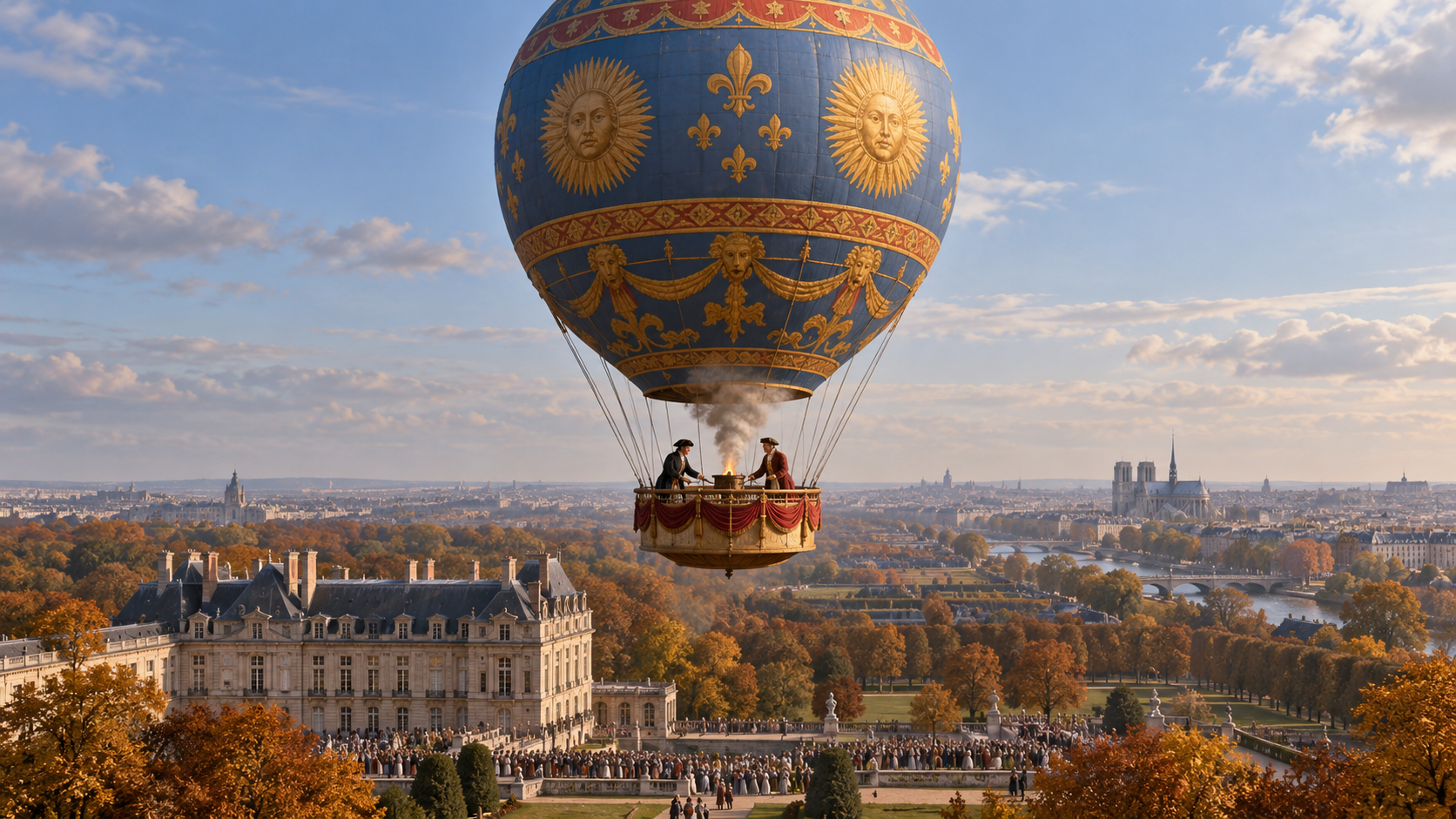
On November 21, 1783, Jean-François Pilâtre de Rozier and François Laurent, Marquis d’Arlandes, lifted from the Château de la Muette near Paris in a Montgolfier hot-air balloon.
The men tended a straw-fed fire beneath the decorated envelope while standing on a circular gallery. Their untethered craft rose above the city.
The flight lasted about twenty-five minutes and covered roughly nine kilometers before landing beyond the city walls. It was the first free human flight.
The achievement showed that controlled lighter-than-air travel was possible and immediately opened new experiments in balloon design, gases, altitude, meteorology, and navigation. The surviving record remains scientifically valuable. The episode also separates a first demonstration from mature understanding. A successful observation or flight can settle one question while exposing harder problems in reliability, interpretation, safety, and scale. Preserved data allow later generations to revisit the achievement without confusing what was known on the date with what became clear afterward. Its calendar date is an entry point rather than an endpoint. The people involved worked with the tools, assumptions, institutions, and social conditions of their time. Later research has extended some conclusions and corrected others, showing how science advances by keeping evidence open to comparison instead of treating a memorable event as final. What makes the event scientifically important is not only priority, but the ability of others to check, repeat, compare, or build on the result. That process can reveal limitations hidden by the excitement of a first success. It also explains why careful archives and transparent measurements matter as much as the date remembered by the public. Modern interpretations benefit from evidence that the original participants did not possess. New instruments and analytical methods can recover additional detail, while historical scholarship clarifies questions of credit, context, and consequence. Holding the original achievement and those later corrections together produces a more accurate account than either celebration or dismissal alone. The anniversary also illustrates how a scientific milestone becomes useful through records that later researchers can inspect. Instruments, notebooks, images, specimens, and engineering reports preserve more than a celebratory date: they show what was actually measured, what remained uncertain, and how conclusions changed as better methods became available. Placed in a longer timeline, the event was a junction rather than a finished answer. Earlier discoveries and technical work made it possible, while later teams tested its limits and applied the result in new settings. That traceable sequence of evidence and revision is what turns one day into a durable part of scientific history.
Heating the air inside the envelope lowers its density.
The large fabric volume displaced enough surrounding air to carry two people and fuel.
Earlier ascents had been held by ropes near the ground.
Releasing the balloon tested whether people could manage fire, altitude, and landing.
Balloons soon carried instruments into the atmosphere.
They enabled studies of pressure, temperature, weather, and eventually the stratosphere.
Explore more of "On This Day ..."
Discover more events from the same date across news, politics, technology, sports, and other fields. Each link highlights significant moments that shaped history on different fronts.