

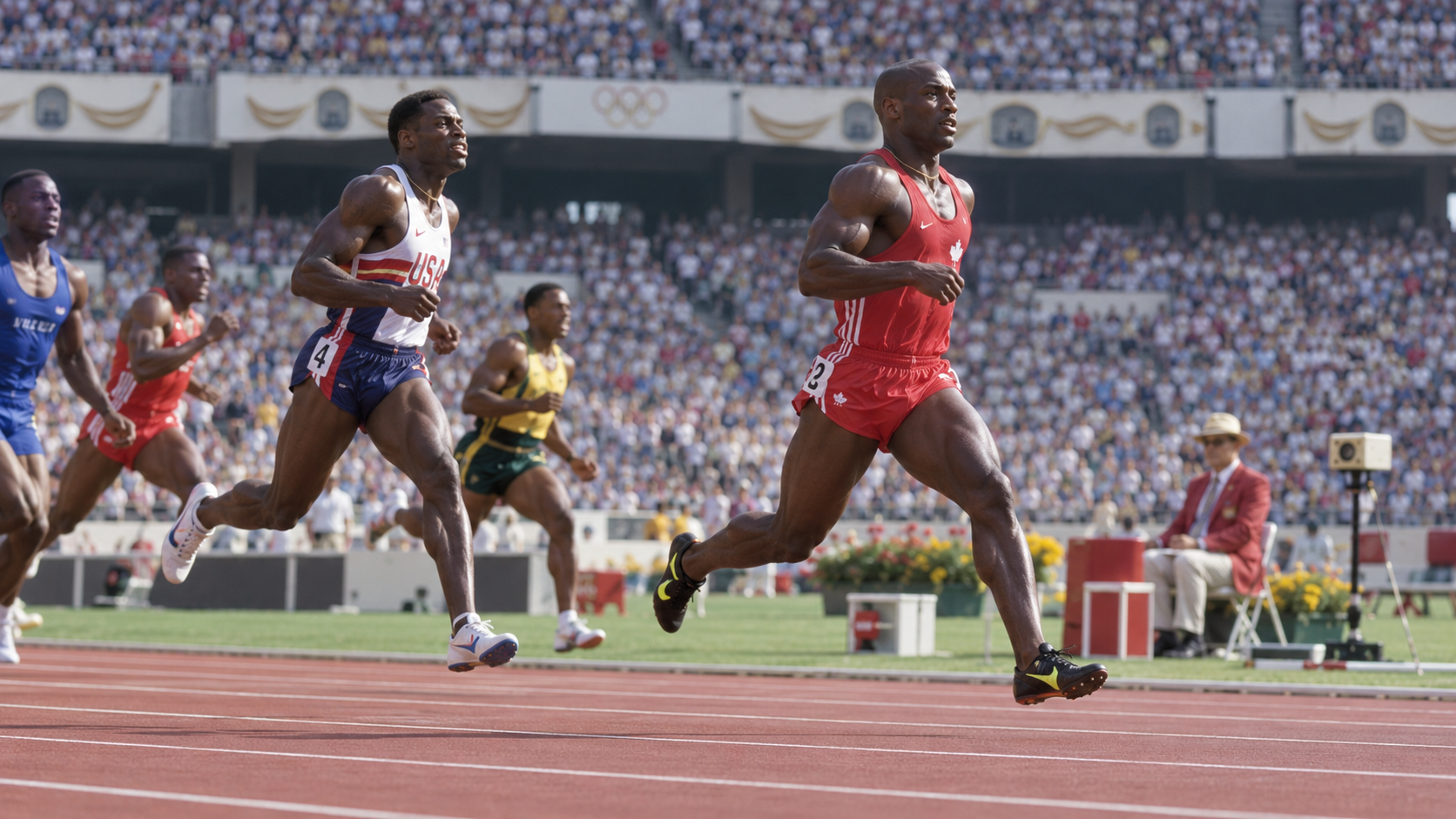
On This Day in Sports: September 24, 1988
On September 24, 1988, Canada’s Ben Johnson crossed first in the Seoul Olympic men’s 100-meter final in a world-record 9.79 seconds. The apparent triumph over Carl Lewis became one of sport’s most notorious reversals when Johnson tested positive for stanozolol and was disqualified three days later. Johnson crossed in 9.79 seconds. The prohibited substance was stanozolol. Those details establish the result and its setting, but the day’s importance came from the larger historical pressure surrounding the competition and the people who carried it through.
Johnson and Lewis had developed a bitter rivalry as the two fastest sprinters of the era. Their Olympic final drew enormous attention, with eight elite athletes lined across the track and questions about performance-enhancing drugs already troubling international sport. He was disqualified three days later. Carl Lewis received the gold medal. Together, those points show how preparation, rules, institutions and public expectations shaped the circumstances before the decisive action began. They also separate the documented background from later legend and retrospective interpretation.
Johnson exploded from the blocks and built a clear lead, raising one arm before the finish. Drug-control officials later found a prohibited anabolic steroid in his sample, and the IOC removed his medal and annulled the record. Lewis’s official winning time was 9.92. Johnson’s world record was annulled. The immediate result therefore involved more than a single score or statistic: it changed a record, championship, career or institution and gave contemporary audiences a clear reason to understand that the moment was unusual.
Lewis was elevated to gold with an Olympic-record 9.92, while Linford Christie and Calvin Smith moved to silver and bronze. The scandal intensified testing and public scrutiny, becoming a lasting warning that a timed result is not final until rules and controls are satisfied. Seen from today, the event remains useful because it connects a measurable sports outcome with the systems around it—teammates, opponents, officials, venues, media and rules. The outcome was not inevitable, and its meaning did not end when play stopped. Preserving the exact date and qualifications helps explain why later generations still return to it. It also prevents a famous image or headline from replacing the fuller story of what actually happened. The best sports history holds achievement and limitation together, showing both the performance itself and the conditions that made it possible. That broader view preserves context without taking attention away from the people who performed under pressure. In that sense, September 24, 1988 still offers a focused view of how athletic excellence, public memory and institutional change can meet in a single day.
Johnson crossed in 9.79 seconds.
The prohibited substance was stanozolol.
He was disqualified three days later.
Carl Lewis received the gold medal.
Lewis's official winning time was 9.92.
Johnson's world record was annulled.
Explore more "On This Day in Sports"
Discover more landmark games, records, championships, and turning points from sports history. Each day revisits the athletes, teams, and moments that shaped competition and culture.