

On This Day in Tech: February 1, 1975
On February 1, 1975, Bill Gates and Paul Allen completed Altair BASIC and sold it to Micro Instrumentation and Telemetry Systems, according to Microsoft’s corporate timeline. The interpreter let owners of the new Altair 8800 microcomputer write programs in the approachable BASIC language instead of entering every instruction through front-panel switches. It became the first software product associated with the partnership that soon took the name Micro-Soft. The date sits at the meeting point of two emerging businesses: inexpensive computers sold to individuals and packaged software created for those machines. Neither market was secure yet, but a working language made the Altair more useful than a kit that merely demonstrated a processor.
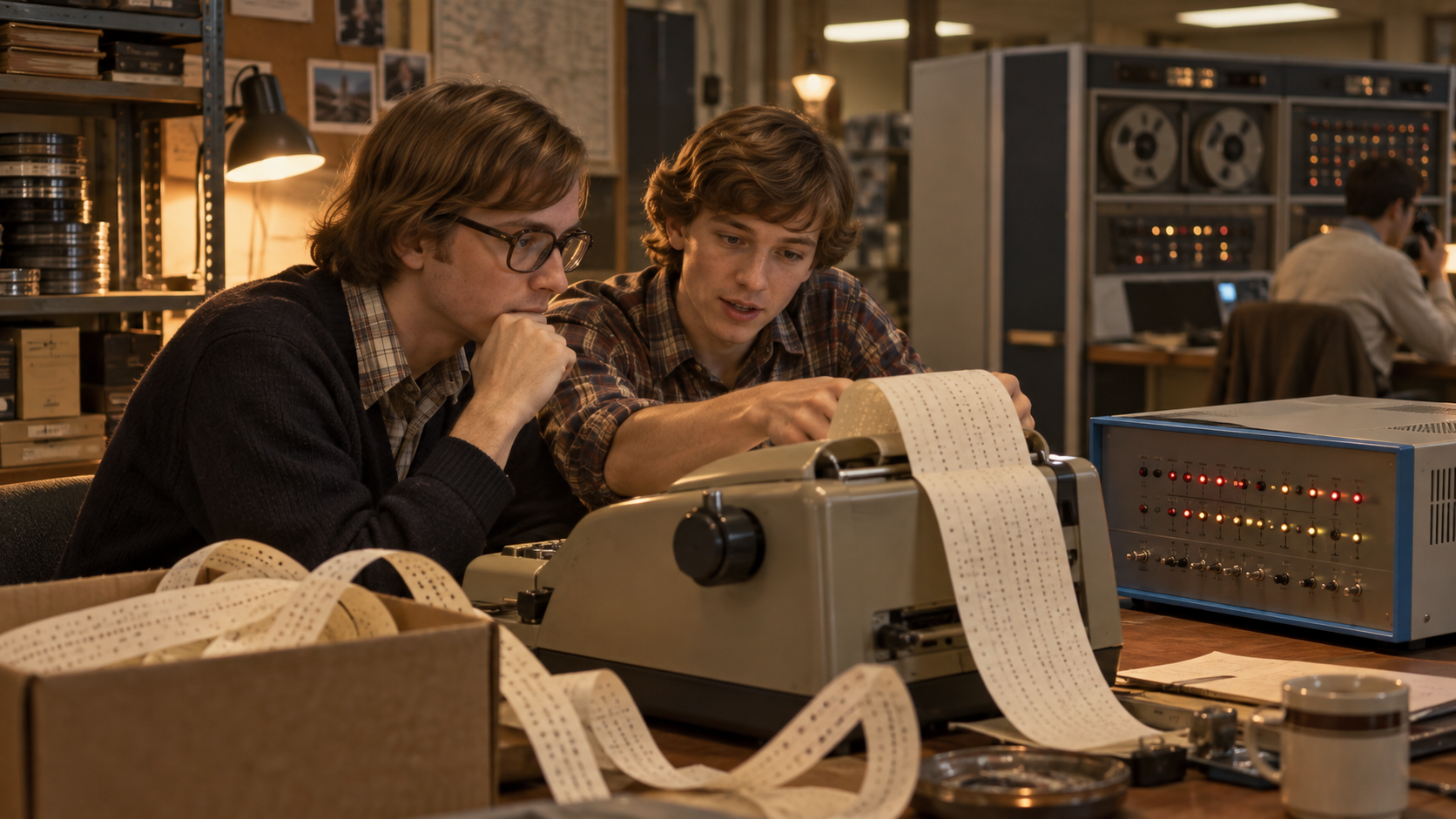
The opportunity appeared when the January 1975 issue of Popular Electronics featured the Altair on its cover. Gates, then at Harvard, and Allen contacted MITS president Ed Roberts and offered a BASIC interpreter even though they did not possess an Altair. They wrote and tested the software on a larger PDP-10 computer using a simulation of the Altair’s Intel 8080 processor. Allen then traveled to Albuquerque carrying the program on paper tape and finished a small loader needed to place it in the machine’s limited memory. The demonstration worked, an outcome made more remarkable by how little direct access the pair had to the hardware during development.
MITS distributed the interpreter in versions sized for different memory configurations. It gave hobbyists a familiar way to experiment, while the commercial arrangement gave Gates and Allen a reason to build a company in Albuquerque near MITS. The software still faced severe constraints: memory was measured in kilobytes, storage commonly involved paper tape, and early users were technically adventurous. Unauthorized copying also spread among hobbyists, prompting Gates to argue publicly in 1976 that software development required payment. That dispute revealed a market still deciding whether code should be treated as a product, shared knowledge, a service tied to hardware, or some combination of all three.
Altair BASIC’s direct technical life was soon overtaken by newer machines and languages, but its business legacy was enormous. The product helped establish Microsoft, which was formally founded in 1975 and later supplied programming languages and operating systems across the personal-computer industry. More broadly, the interpreter demonstrated that independent software could add decisive value to standardized hardware. That separation encouraged an ecosystem in which computer owners could buy applications from companies other than the machine’s manufacturer. The February milestone therefore matters beyond the biographies of two founders. It marks an early step toward software as a mass-market industry—one in which a compact program, created before its authors owned the target computer, could help turn a box of electronic components into a platform for personal creativity.
The Altair 8800 was sold primarily as a mail-order kit. Its low price and magazine exposure energized hobbyists, but the basic machine offered no keyboard, screen, or built-in programming environment.
Gates and Allen relied on a PDP-10 simulator to mimic the Altair’s processor. This cross-development approach allowed them to write most of the interpreter before gaining access to the actual microcomputer.
A paper-tape loader bridged the gap between the terminal and the Altair’s sparse memory. Successful loading and execution showed MITS that the interpreter was not merely a proposal.
The earliest market was small and technically demanding. Altair BASIC expanded what owners could do, but it did not instantly make personal computing simple or affordable for a general household audience.
The product generated the partnership’s first sustained business and drew its founders to Albuquerque. Microsoft later moved and grew far beyond languages, but software licensing remained central to its model.
Altair BASIC helped separate the value of code from the hardware on which it ran. That principle underlies modern software platforms, third-party applications, and continuing debates over licensing and copying.
Explore more of "On This Day ..."
Discover more events from the same date across news, politics, technology, sports, and other fields. Each link highlights significant moments that shaped history on different fronts.