

On This Day in Tech: September 6, 1952
At 4 p.m. on September 6, 1952, CBFT in Montreal began regular television service, giving CBC/Radio-Canada its first live station and bringing public television to Canadian screens. The debut was a technological threshold as much as a programming event. Radio engineers, camera crews, lighting specialists, set builders, performers, and control-room operators had to coordinate pictures and sound in real time, using a medium that was still unfamiliar to most homes. Outside the Montreal facilities, television receivers remained expensive and scarce, so many people encountered the broadcast in shops, public demonstrations, or a neighbor’s living room rather than on a set of their own.
The opening schedule showed how broadly the new service hoped to define television. It included the play Aladdin and His Lamp, a cartoon, a French-language film, a news report, and a bilingual variety program. That mixture of theater, film, news, and live performance reflected an industry still discovering what television should be. CBFT initially served both French- and English-speaking viewers, while CBLT in Toronto followed two days later on September 8. Together, the stations formed the first anchors of a network that would extend far beyond the two cities during the decade.
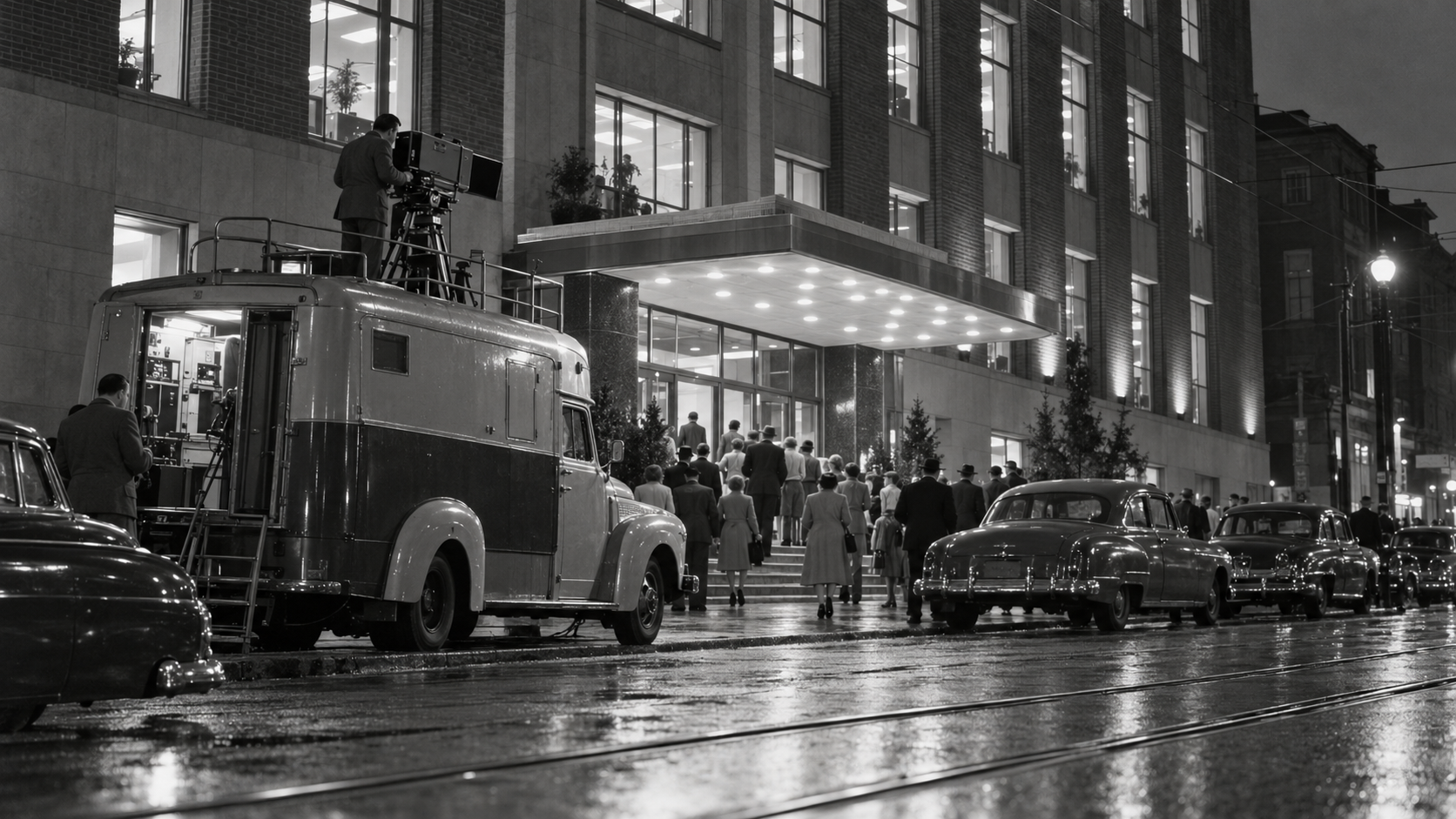
Early television demanded physical infrastructure that radio never needed: bright studios, large cameras, image transmitters, scenery, and mobile equipment capable of carrying pictures from outside events. The period’s bulky broadcast vans and rooftop cameras turned streets and arenas into temporary studios, while transmitters pushed monochrome signals over limited distances. Reception depended on rooftop antennas and careful tuning, and the picture could drift or dissolve into snow. Even so, the sight of moving images arriving live from elsewhere felt immediate in a way recorded film did not. It made engineering part of the audience experience; viewers learned to recognize test patterns, signal interruptions, and the visual grammar of a developing medium.
CBFT’s first day did not instantly create a coast-to-coast television system, but it started a rapid expansion. CBC/Radio-Canada reports that by 1955 its television service could reach about two-thirds of Canada’s population, a remarkable change in only three years. The network would reshape news, sports, entertainment, advertising, and national conversation while also carrying the country’s two major broadcast languages. The lasting significance of September 6 lies in that transition from experimental possibility to a scheduled public service. Canadian television was no longer a demonstration waiting for an audience; it had become an institution with a daily relationship to viewers.
CBFT was the first CBC/Radio-Canada television station to begin regular service, launching in Montreal on September 6, 1952. It marked the start of the national public broadcaster’s television era.
CBLT in Toronto began broadcasting two days later. Those two stations became the earliest centers of the CBC television network as transmitters and affiliates spread across the country.
The schedule combined a stage production of Aladdin and His Lamp, a cartoon, a French-language film, news, and a bilingual variety show. The range revealed how broadcasters were adapting familiar forms to a new live medium.
Most Canadians did not yet own a receiver. Opening-day audiences often gathered around store-window sets, public demonstrations, or the televisions of friends and neighbors.
Television required CBC to add image transmitters, large studio cameras, powerful lighting, scenery, control rooms, and mobile production vehicles to its radio expertise. Live pictures made every link in the chain visible to the audience.
The launch also began a fast network build-out. By 1955, CBC/Radio-Canada television service could reach roughly 66 percent of Canada’s population.
Explore more of "On This Day ..."
Discover more events from the same date across news, politics, technology, sports, and other fields. Each link highlights significant moments that shaped history on different fronts.