

On This Day in Tech: September 5, 1977
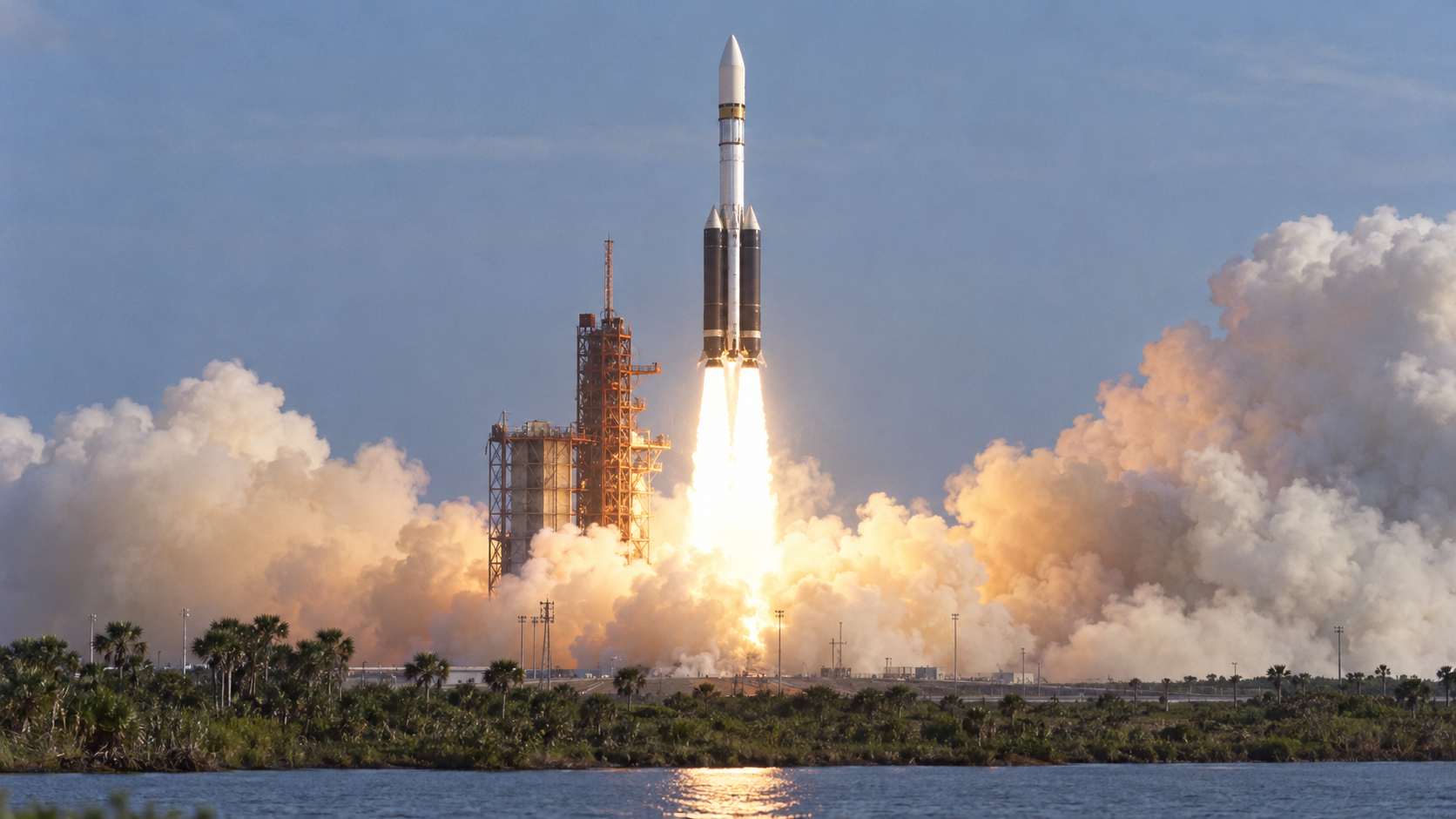
On September 5, 1977, at 12:56:01 UTC, NASA launched Voyager 1 from Launch Complex 41 at Cape Canaveral, Florida. A Titan IIIE-Centaur rocket lifted the 721.9-kilogram spacecraft onto a fast path toward Jupiter and Saturn. The mission was managed by the Jet Propulsion Laboratory for NASA, with a spacecraft built to operate far beyond the solar-powered range of Earth-orbiting satellites. Although Voyager 2 had launched sixteen days earlier, Voyager 1 received the lower number because its shorter, faster trajectory was expected to bring it to the two giant planets first.
Voyager grew from plans to exploit a rare alignment of the outer planets that allowed one world’s gravity to redirect a spacecraft toward the next. Engineers equipped the probe with cameras, spectrometers, particle and field instruments, a large high-gain antenna and radioisotope thermoelectric generators. A scan platform could point remote-sensing instruments independently while the main antenna remained oriented toward Earth. Voyager also carried a gold-plated record containing sounds and images selected to represent life and culture on Earth, a symbolic message attached to a practical robotic observatory.
The September 5 launch supplied the energy and direction needed for the interplanetary journey. After the Titan’s solid boosters and core stages completed their work, the Centaur upper stage placed Voyager 1 on its outbound course. The spacecraft then began checkout, navigation and calibration activities that prepared it for encounters still years away. Its trajectory was deliberately optimized for a close study of Saturn’s moon Titan. That choice gave the mission an exceptional view of the moon’s atmosphere but bent Voyager 1 out of the plane in which it could have continued toward Uranus and Neptune.
Voyager 1 reached Jupiter in 1979 and Saturn in 1980, returning detailed observations of rings, moons, magnetic fields and atmospheres. Its cameras helped reveal active volcanoes on Io, intricate structures in Saturn’s rings and Titan’s opaque haze. Later, with the planetary mission complete, the spacecraft continued outward as an interstellar mission. In 2012 it became the first human-made object to cross the heliopause into interstellar space. Those achievements came after decades of operations, not on launch day, but they depended on the successful start at Cape Canaveral. The 1977 launch created a durable scientific platform whose careful engineering extended a two-planet assignment into humanity’s farthest physical exploration. It also proved that long-lived software, careful fault management and Earth-based radio networks could keep one machine scientifically useful long after its designers’ original encounter plan.
The outer planets’ geometry allowed gravity assists to reduce the energy and travel time required between encounters. Mission planners used that opportunity to send compact observatories across the giant-planet region.
Voyager 2 launched first, but Voyager 1 followed a faster route. The numbering reflected planned arrival order, not the order in which the spacecraft left Earth.
The Titan IIIE-Centaur successfully injected Voyager 1 toward Jupiter and Saturn. Long-distance tracking, instrument checkout and trajectory correction then became the mission’s immediate priorities.
A close Titan flyby was central to Voyager 1’s plan, but the geometry carried the spacecraft out of the ecliptic plane. It could not continue to Uranus and Neptune as Voyager 2 later did.
Jupiter and Saturn observations transformed knowledge of active moons, rings and magnetospheres. The spacecraft’s longevity then allowed the mission to examine the distant boundary of the Sun’s influence.
Voyager’s Golden Record added a cultural message to the scientific payload. Its enduring significance comes from both that symbol and the measurements returned across unprecedented distances.
Explore more of "On This Day ..."
Discover more events from the same date across news, politics, technology, sports, and other fields. Each link highlights significant moments that shaped history on different fronts.