

On This Day in Tech: September 10, 2008
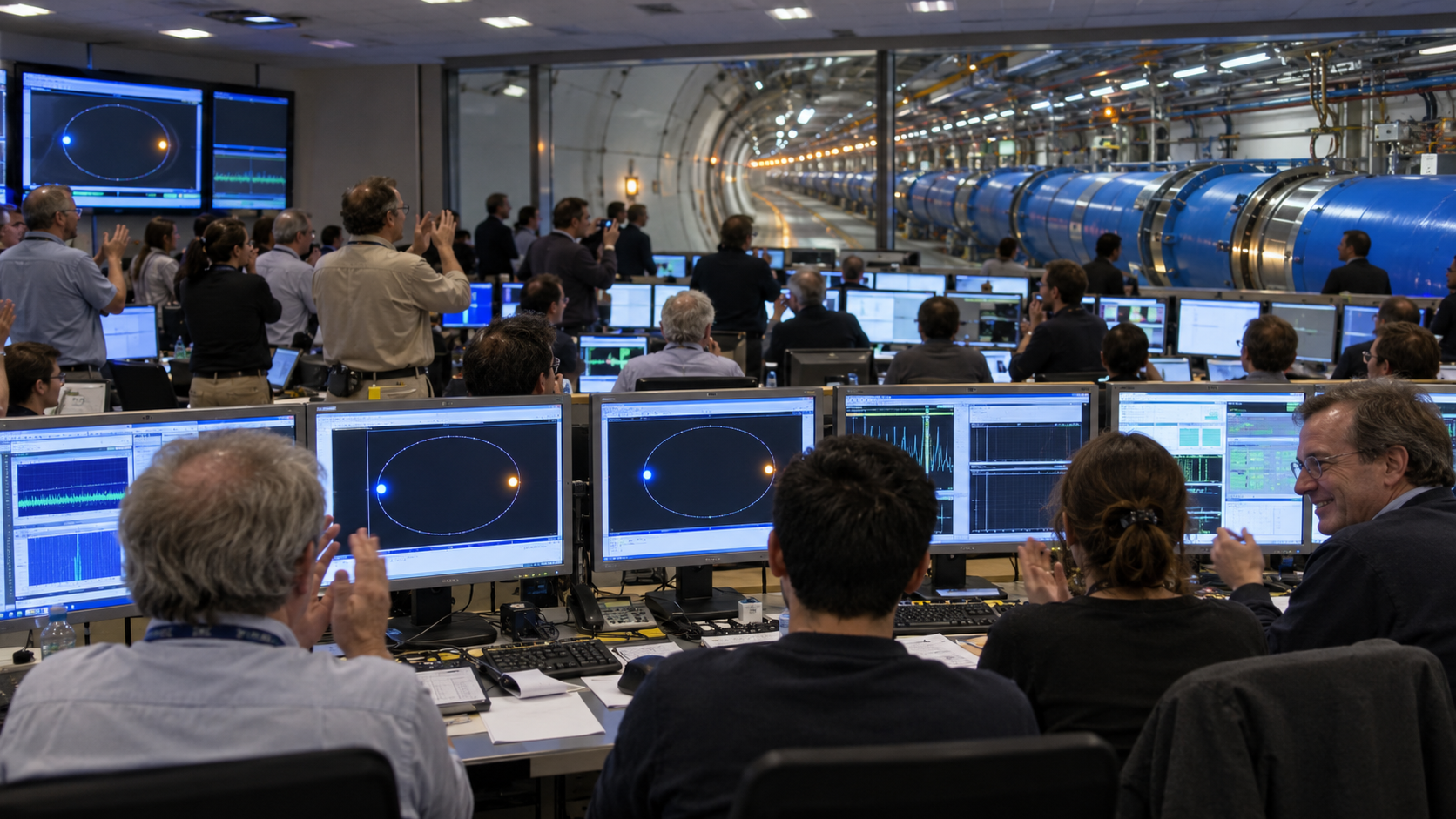
At 10:28 a.m. on September 10, 2008, a proton beam completed a full circuit of CERN’s Large Hadron Collider for the first time. The success arrived after operators injected the beam and guided it through the machine section by section, checking its position before opening the path to the next sector. When two bright spots appeared on a diagnostic screen—evidence of particles making successive revolutions—the control room erupted. The moment confirmed that thousands of accelerator components distributed around a 27-kilometre underground ring could work together as one machine.
The LHC lies beneath the French-Swiss border in a tunnel previously used for CERN’s Large Electron-Positron Collider. Its superconducting magnets bend and focus beams traveling in two separate vacuum pipes, while radio-frequency cavities add energy on repeated laps. The magnets must operate at extremely low temperatures, and the beam must pass through apertures with little room for error. Operators watched position monitors around the ring to see where the particles traveled and whether corrections were needed. A misplaced setting in a magnet, power converter, timing system, or sensor can deflect particles from the intended orbit. First-beam day was therefore an exercise in controlled commissioning rather than a single ceremonial switch-on.
The September milestone did not involve high-energy proton collisions. The immediate goal was circulation: establish a stable path in one direction, then repeat the process in the opposite direction and continue testing. Collisions would require both beams to be accelerated, focused, synchronized, and steered into the same tiny crossing points inside the experiments. By separating these stages, engineers could verify the accelerator’s behavior and locate problems safely. The methodical approach also let detectors such as ATLAS observe early “splash” events when a beam struck material upstream, producing showers of particles that illuminated many detector channels at once.
First circulation was the point at which the LHC became an operating accelerator rather than an immense construction project. Later setbacks and repairs would delay the physics program, but they do not diminish what the September 10 test established. The beam completed a ring spanning two countries, coordinated by precision magnets, cryogenics, vacuum systems, power electronics, timing networks, and software. That integration enabled the discoveries and measurements that followed, including observation of the Higgs boson in 2012. The first lap was brief, but it showed that one of the most complicated scientific instruments ever built could guide particles all the way around its vast course.
CERN operators confirmed that the first proton beam had traveled all the way around the LHC’s 27-kilometre ring. Diagnostic signals showed particles returning for another revolution.
The result followed an incremental process in which the beam was stopped, measured, and then allowed into successive sectors until the entire circuit was open.
No. September 10 was a circulation and commissioning milestone. High-energy collisions required two counter-rotating beams to be accelerated and precisely focused at experiment sites.
Detectors did record useful splash events when beam particles struck material and created broad showers. Those signals helped teams test and synchronize detector systems.
A large ring gives magnets more distance to bend extremely energetic particles without forcing an impossibly tight curve. It also reused the tunnel built for CERN’s earlier LEP collider.
The circumference supports long accelerating sections, focusing magnets, experimental collision points, and service infrastructure while crossing the French-Swiss border underground.
Explore more of "On This Day ..."
Discover more events from the same date across news, politics, technology, sports, and other fields. Each link highlights significant moments that shaped history on different fronts.