

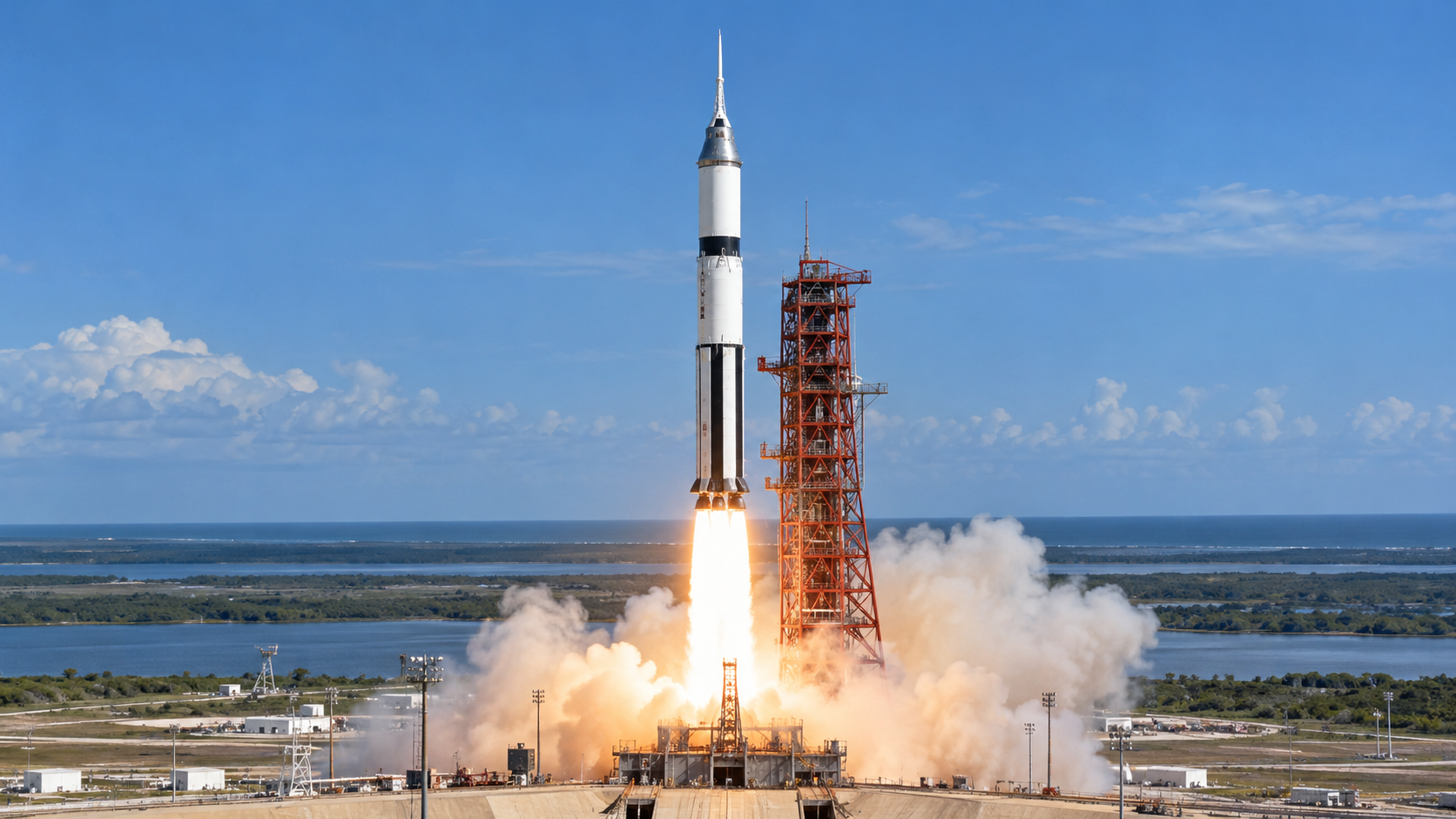
On This Day in Tech: October 11, 1968
On October 11, 1968, NASA launched Apollo 7 from Launch Complex 34 at Cape Kennedy, Florida, carrying Wally Schirra, Donn Eisele, and Walt Cunningham into Earth orbit. A Saturn IB rocket lifted the three astronauts and their command and service module into space for the first crewed mission of the Apollo program. The flight was intended to prove that the spacecraft and its supporting systems could operate reliably with people aboard. It followed extensive redesign after the fatal Apollo 1 ground-test fire in January 1967 and represented a critical return to American crewed spaceflight before attempting the Moon.
The mission focused on the Block II command and service module, the spacecraft that would transport astronauts on later lunar journeys. Changes following the fire included a redesigned hatch, improved materials, revised wiring, and safer ground procedures. Apollo 7 also tested a combination of spacecraft, launch vehicle, tracking stations, recovery forces, and mission control teams. Its Earth-orbital route kept the crew close enough to return without completing a lunar voyage, allowing engineers to examine essential equipment under sustained flight conditions. The objective was a working transportation system rather than a single spectacular demonstration or a record-setting altitude.
During almost eleven days in orbit, the astronauts tested propulsion, guidance, navigation, electrical power, environmental control, and communications. Repeated firings of the service propulsion engine demonstrated the system that later crews would depend on for major maneuvers near the Moon. The flight also included rendezvous-related exercises and the first live television broadcasts from an American spacecraft. The crew experienced head colds and disagreements with mission control over parts of the schedule, illustrating that operational success included human factors as well as machinery. Apollo 7 returned to an Atlantic splashdown on October 22, with its principal technical objectives accomplished.
The successful flight gave NASA important evidence for the next step: sending Apollo 8 around the Moon in December 1968. Apollo 7 itself carried no lunar module and did not leave Earth orbit, so its achievement should be understood as validation of the command and service module and the wider operating system around it. The sequence from ground redesign to orbital testing and then lunar missions showed how complex engineering programs build confidence through evidence. October 11 marks the beginning of the crewed flight that supplied much of that evidence. Its less dramatic work on engines, procedures, communications, and endurance helped make the later lunar landings technically and operationally possible.
Apollo 7 followed major spacecraft changes after the Apollo 1 fire. It was the first mission to take an Apollo crew into space.
Schirra, Eisele, and Cunningham launched from Florida on October 11, 1968, using a Saturn IB and the Block II command and service module.
The crew exercised propulsion, guidance, power, environmental control, and communications during an extended stay in Earth orbit.
Head colds and scheduling disputes exposed practical human factors. The flight still achieved its main spacecraft test objectives before returning on October 22.
Successful engine firings and systems operation supported NASA's decision to send Apollo 8 to the Moon later that year.
The mission illustrates the importance of validating supporting procedures and equipment together. Reliable transportation required more than a successful launch alone.
Explore more of "On This Day ..."
Discover more events from the same date across news, politics, technology, sports, and other fields. Each link highlights significant moments that shaped history on different fronts.