

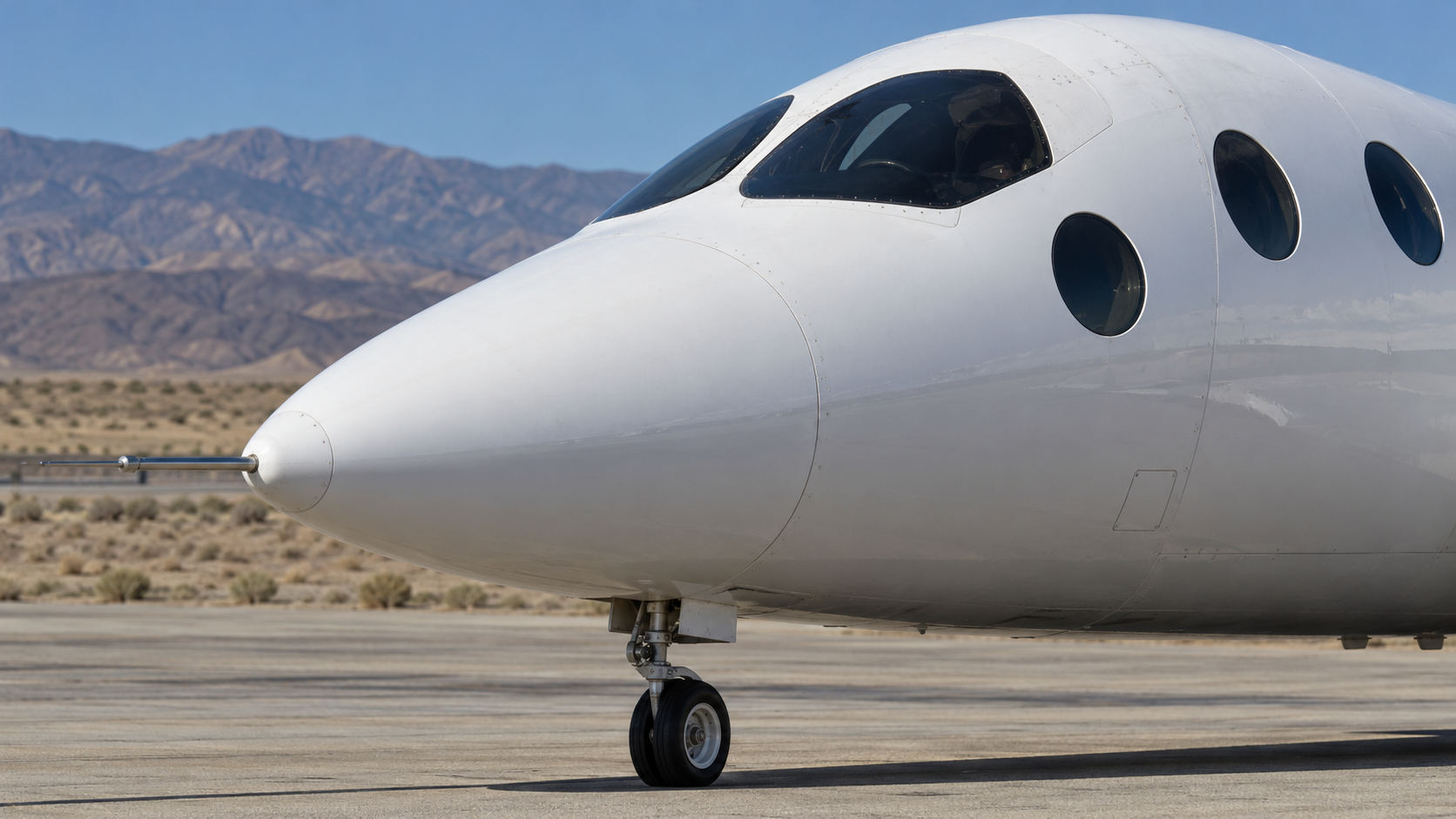
On This Day in Tech: October 10, 2010
On October 10, 2010, Virgin Galactic’s first SpaceShipTwo vehicle, VSS Enterprise, completed its first piloted free glide above California’s Mojave Desert. Test pilots Pete Siebold and Mike Alsbury flew the craft after it separated from the WhiteKnightTwo carrier aircraft at roughly forty-five thousand feet. Enterprise descended without rocket power and landed on a runway at Mojave Air and Space Port. The flight tested separation, handling, stability, and the approach to landing. It was a step in developing a commercial suborbital spacecraft, rather than a trip into space or the start of passenger service.
SpaceShipTwo grew from the smaller SpaceShipOne, which had demonstrated privately funded suborbital flight in 2004. Scaled Composites, the company founded by aircraft designer Burt Rutan, developed the larger vehicle and its twin-fuselage carrier for Virgin Galactic. The planned system would take off from a runway, carry the spacecraft to altitude, release it, and then use a rocket motor for the climb beyond the atmosphere. The spacecraft would later return as a glider. That architecture meant the landing portion of the mission could be examined before introducing the additional risks and complexity of powered ascent.
Before the first free flight, the spacecraft had traveled attached to its carrier during captive-carry tests. Releasing it created a new set of practical questions: whether separation would be clean, whether the actual aerodynamic behavior matched predictions, and how the pilots would manage energy during the descent. The approximately eleven-minute glide allowed them to test controls and rehearse an approach before touching down. The vehicle was not using a rocket motor on this flight. Its distinctive twin tail booms and movable rear structure were part of a broader design intended to handle both atmospheric flight and the return from a future suborbital trajectory.
The October test supplied data for a much longer development program. Powered testing began later, and the loss of Enterprise during a 2014 test flight showed the severe hazards involved in experimental spacecraft operations. Subsequent vehicles and procedures continued the program, eventually carrying people on suborbital missions. Those later developments should not be projected backward onto the first glide, whose goals were narrower and measurable. October 10 remains significant as the first independent flight of this particular spacecraft design. It illustrates how ambitious aerospace systems are developed through staged demonstrations, with ordinary atmospheric handling and a safe runway approach forming essential foundations for more demanding flight regimes. Each successful test reduced a particular uncertainty while leaving other questions for subsequent flights and engineering review.
SpaceShipTwo was a larger successor to SpaceShipOne. Its flight system combined a carrier aircraft, a rocket-powered spacecraft, and an unpowered runway return.
The first free glide took place on October 10, 2010, after earlier captive-carry tests. Pete Siebold and Mike Alsbury were the test pilots.
The flight tested clean separation and aerodynamic handling after release at high altitude. It ended with a runway landing at Mojave.
This was an atmospheric glide test without rocket propulsion. It should be distinguished from a powered ascent, a spaceflight, or a passenger mission.
Flight data helped guide later stages of development. Subsequent testing also revealed serious hazards, including the fatal loss of Enterprise in 2014.
The milestone shows the value of staged aerospace testing: establish basic handling and landing behavior before attempting more demanding operating conditions.
Explore more of "On This Day ..."
Discover more events from the same date across news, politics, technology, sports, and other fields. Each link highlights significant moments that shaped history on different fronts.