

On This Day in Tech: November 1, 1963
On November 1, 1963, an inauguration ceremony marked the opening of the Arecibo Ionospheric Observatory in Puerto Rico. Developed by Cornell University with support from the Advanced Research Projects Agency, the instrument grew from electrical engineer William Gordon’s proposal for a powerful radar to investigate the upper atmosphere. Its enormous reflector occupied a natural depression in the island’s limestone hills. The opening introduced a working scientific facility, not merely a large antenna structure. Transmitters, receivers, controls, cables, and a specially shaped reflecting surface had to operate together to turn faint radio signals into measurements that researchers could interpret.
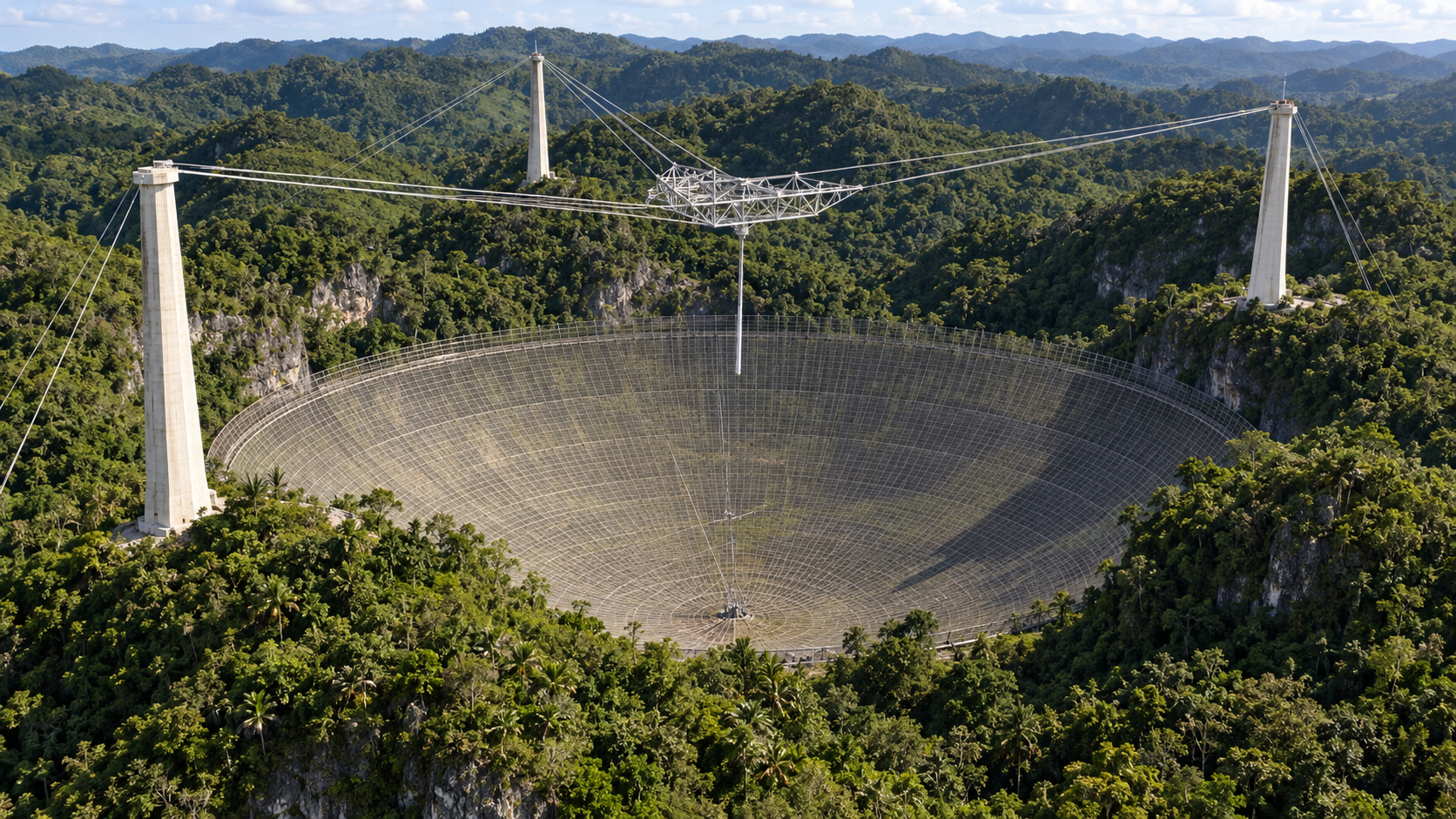
The fixed reflector measured roughly one thousand feet across. Unlike a conventional steerable dish, it could not tilt to point at a target. Three towers supported a suspended triangular platform, and equipment moving above the reflector selected different directions within the instrument’s observing range. The original reflecting surface was wire mesh, with a long line feed hanging beneath the platform; the solid panels and conspicuous dome familiar from later photographs belonged to subsequent upgrades. Using the landscape reduced some structural demands, but introduced others. Engineers still had to maintain the reflector’s shape, control the receiving geometry, and support substantial equipment high above the ground.
The initial purpose was ionospheric research, examining the electrically charged upper atmosphere and its interaction with radio waves. The design also offered opportunities for radio astronomy and planetary radar. Receiving emissions from distant objects and transmitting a signal to study its returning echo were different operations, requiring appropriate electronics and observing methods. Early performance did not fulfill every expectation, and later changes improved the feed, transmitter, and reflector. Those upgrades mattered to what the observatory could measure. The 1963 ceremony should therefore not be treated as the arrival of the final configuration or as the date of all the discoveries subsequently associated with Arecibo.
Over the following decades, researchers used Arecibo for studies of planetary surfaces, asteroids, pulsars, and other radio sources. Its capabilities helped connect electrical engineering with questions about the solar system and the wider universe. Maintaining the installation required continuing attention to cables, corrosion, electronics, and a demanding tropical environment. Cable failures ultimately led to the main telescope’s collapse in December 2020, long after the opening remembered here. November 1 marks the beginning of a facility whose scientific usefulness depended on an unusual combination of natural terrain and engineered precision. Its history shows how an instrument designed around one research problem can support a much broader program when its hardware, operating knowledge, and methods continue to develop.
William Gordon proposed a powerful ionospheric radar. Cornell and ARPA developed the Puerto Rico facility around that scientific and engineering objective.
The observatory was inaugurated on November 1, 1963. Its original mesh reflector and line feed differed from the later configuration seen in many familiar photographs.
The dish remained fixed in the landscape while suspended equipment helped select observing directions. Three towers and their cables supported the platform.
Early feed performance and other limitations prompted later upgrades. The opening date was not the completion date of every capability the observatory eventually acquired.
Arecibo became valuable to planetary radar and radio astronomy as well as atmospheric research. Engineers and operators adapted the instrument to new questions.
The telescope's long life required intensive maintenance. Its 2020 collapse does not diminish the research record, but underlines the dependence of scientific instruments on structural reliability.
Explore more of "On This Day ..."
Discover more events from the same date across news, politics, technology, sports, and other fields. Each link highlights significant moments that shaped history on different fronts.