

On This Day in Tech: November 27, 1971
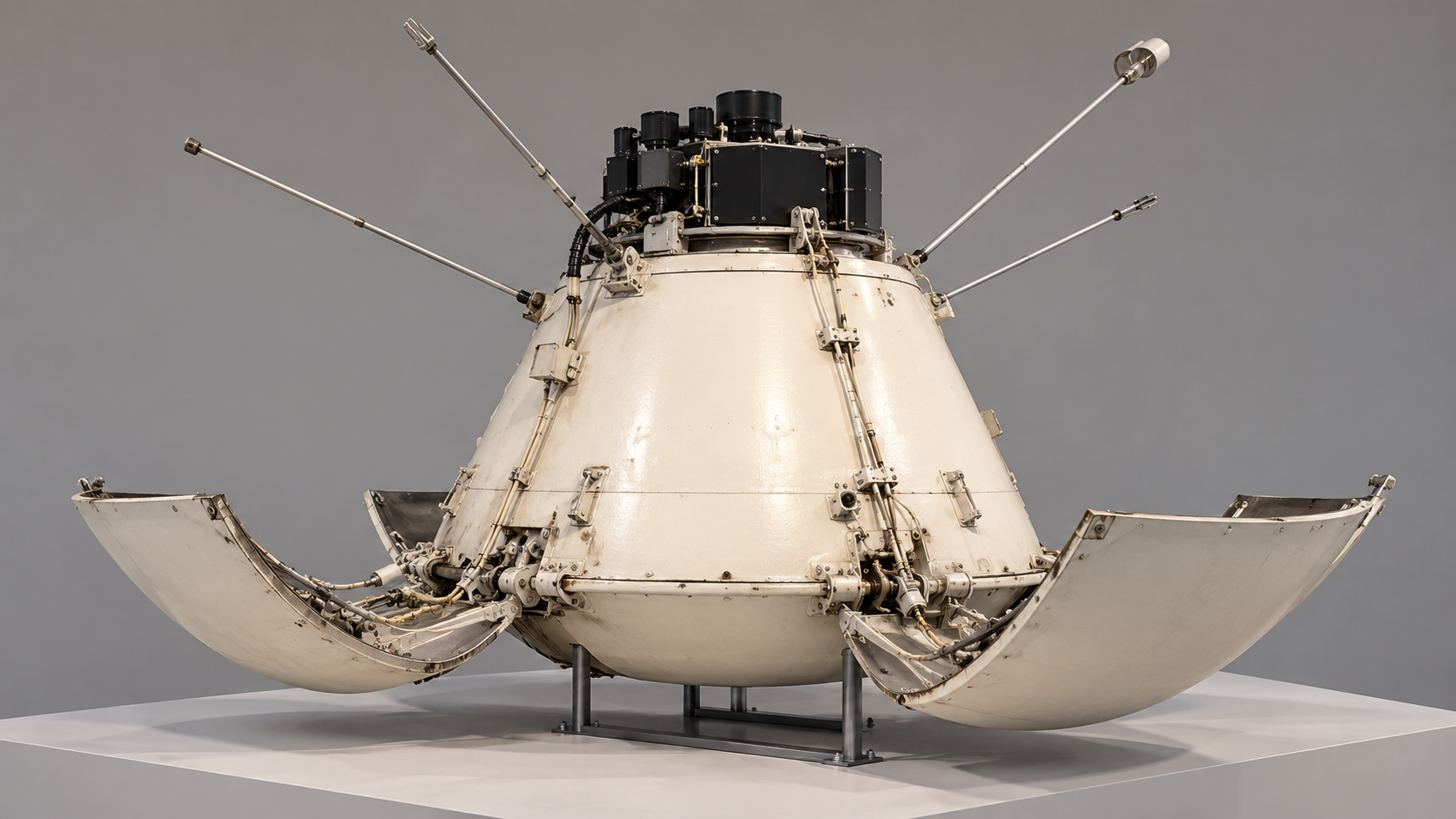
On November 27, 1971, the Soviet Mars 2 mission reached Mars, where its separated descent vehicle struck the surface after an unsuccessful landing attempt. The impact made the lander the first human-made object to reach the Martian ground, but it was not a controlled touchdown or an operating surface station. The accompanying orbiter entered orbit and continued the mission’s work from above. The distinction between those two components is essential: the failure of the landing system did not mean that the entire spacecraft simply crashed, nor did physical arrival by impact amount to a successful landing.
Mars 2 was one of a pair of Soviet spacecraft launched toward the planet in 1971. Its companion, Mars 3, carried a similar combination of orbital and landing equipment. Both missions belonged to an ambitious attempt to investigate Mars at a time when spacecraft engineering still faced major uncertainties about the destination. The atmosphere was thin enough to complicate slowing a descending vehicle, while the distance from Earth prevented controllers from steering each stage in real time. A landing sequence therefore depended on onboard systems performing the planned actions at the right moments as speed, altitude, and atmospheric conditions changed.
The Mars 2 lander’s approach was too steep for its descent system to complete the intended landing sequence. It did not return scientific observations from a working station on the surface. A major Martian dust storm also complicated the broader observing campaign being undertaken by spacecraft at the planet. NASA’s Mariner 9 had already entered orbit earlier that month, while the Soviet orbiters added another source of measurements. These missions should not be collapsed into a single race result: reaching orbit, surviving entry, touching down, transmitting data, and maintaining useful operations were different technical objectives with different outcomes for each vehicle.
Mars 3 followed with a soft landing in December 1971, although its surface transmission ended after only a brief interval. More durable and productive surface missions came later, including the Viking landers in 1976. Images taken decades afterward have also been used to examine possible debris locations, but a search area or candidate feature should not be mistaken for a confirmed photograph of Mars 2’s wreckage. November 27 records a boundary crossed through failure rather than a fully realized success. Its significance lies in the difficulty of delivering instruments to another world’s surface and in the need to describe engineering milestones precisely, without turning an impact into an achievement that the mission did not accomplish.
Mars 2 combined an orbiter with a separate descent vehicle. Their outcomes must be evaluated independently.
The lander reached the surface by impact on November 27, 1971. It did not perform the intended controlled landing.
The descent trajectory prevented the planned sequence from producing a survivable arrival. No working surface station resulted.
The orbiter continued observations, while dust affected the larger 1971 exploration campaign. A failed lander did not erase every other mission result.
Mars 3's brief soft landing came in December, not on November 27. Later Viking operations represented another stage of surface exploration.
A modern search for debris is not a verified discovery of the wreckage. Images of preserved models show the spacecraft design, not an eyewitness view of the crash.
Explore more of "On This Day ..."
Discover more events from the same date across news, politics, technology, sports, and other fields. Each link highlights significant moments that shaped history on different fronts.