

On This Day in Tech: November 28, 1964
On November 28, 1964, NASA launched Mariner 4 from Cape Kennedy in Florida aboard an Atlas-Agena rocket. The spacecraft, developed and operated by the Jet Propulsion Laboratory, was intended to fly past Mars and return close-range measurements and pictures. It did not carry a lander or a system for entering Martian orbit. The launch began a long crossing rather than an immediate encounter, and the famous images associated with the mission would not arrive until July 1965. At departure, engineers first needed to establish that the spacecraft could separate properly, deploy its equipment, communicate, and maintain its intended orientation.
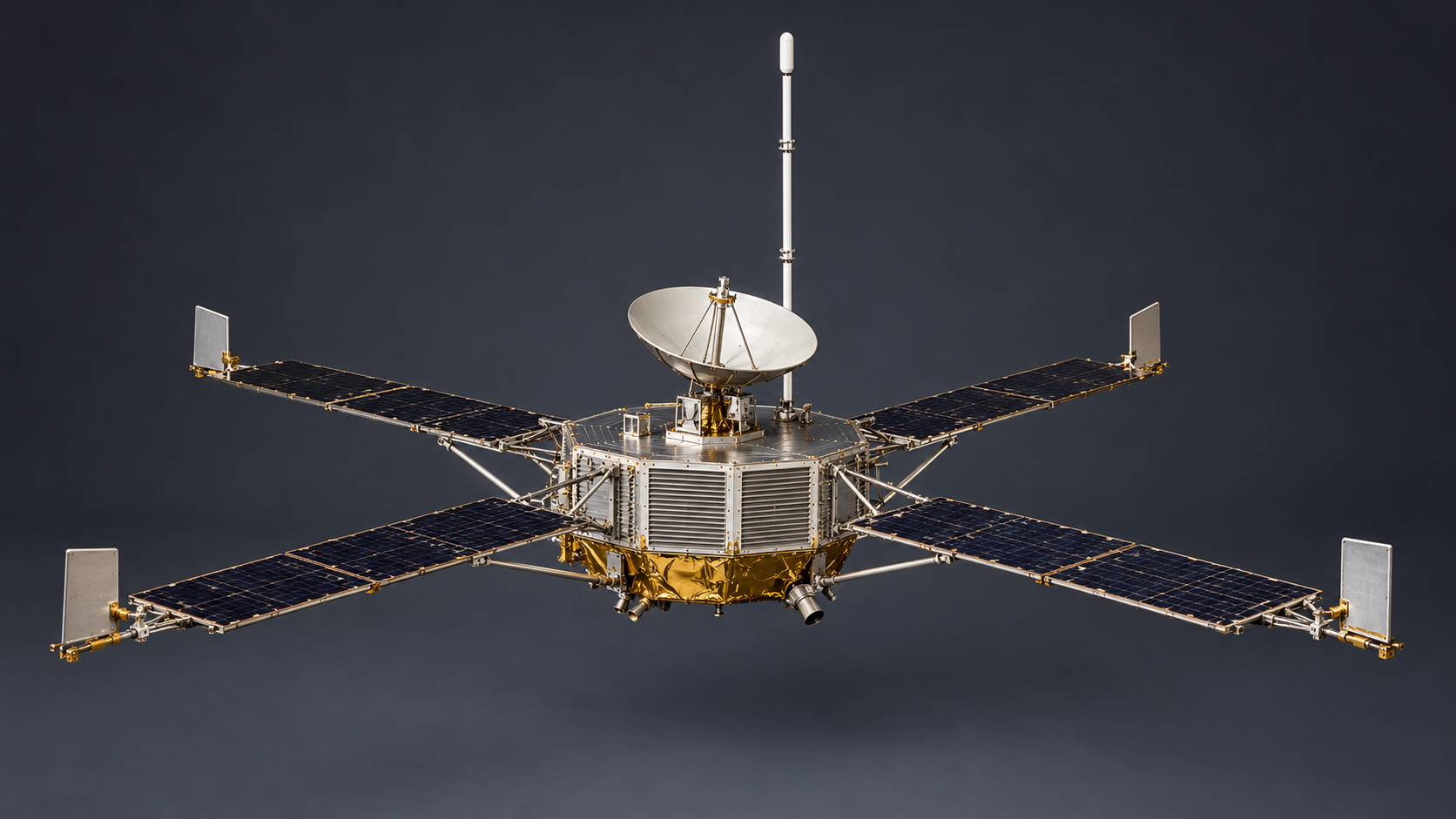
The mission followed the loss of Mariner 3 earlier in November. That spacecraft had been unable to complete its task after its protective launch shroud failed to separate properly. Mariner 4 used a revised shroud, turning an urgent hardware lesson into a practical change before the next attempt. The spacecraft itself was compact, with an octagonal central structure, four solar-panel wings, communications equipment, and instruments for studying conditions along the route and near Mars. Its design balanced scientific goals against limited power, mass, data capacity, and the launch vehicle’s ability to send a payload onto an interplanetary trajectory.
During the journey, navigation depended on tracking from Earth and carefully planned corrections rather than continuous hands-on piloting. Attitude control kept the spacecraft’s equipment pointed appropriately for power, communications, and observations. The television experiment could not simply send an uninterrupted modern video stream across space. Images were recorded and transmitted through a slow communications link, making data handling a central part of the scientific effort. The long wait between launch and encounter also meant that equipment had to survive the space environment while remaining ready for a comparatively brief period of close observation. Successful departure left those operational demands unresolved.
In July 1965, Mariner 4 passed Mars and returned the first close-range spacecraft photographs of another planet. The pictures revealed a heavily cratered landscape within the limited area imaged, while other measurements helped characterize the planet’s atmosphere and environment. That narrow sample did not describe every region of Mars, a limitation later orbiters made especially clear as they mapped volcanoes, canyons, and varied terrain. The mission nevertheless replaced speculation with direct evidence that could be checked and extended. November 28 marks the launch of that observational turning point. Its legacy includes not only memorable pictures but also the combination of navigation, communications, instrument design, and disciplined interpretation needed to make a short planetary flyby scientifically useful.
Mariner 4 departed on November 28, 1964. Its Mars encounter occurred the following year, not on launch day.
The mission was a flyby. It neither entered Mars orbit nor delivered equipment to the surface.
Mariner 3's shroud failure prompted a change before Mariner 4 launched. Development continued in response to an identifiable hardware problem.
Power, pointing, recording, and slow data transmission all shaped the camera experiment. Close-range pictures required a complete supporting spacecraft.
The cratered region photographed was only a small portion of Mars. Later missions broadened the geological picture considerably.
The first close-range planetary images changed the evidence available to researchers. Their value depended on recognizing both what they showed and what lay outside their coverage.
Explore more of "On This Day ..."
Discover more events from the same date across news, politics, technology, sports, and other fields. Each link highlights significant moments that shaped history on different fronts.