

On This Day in Tech: December 9, 1968
On December 9, 1968, Douglas Engelbart demonstrated the oNLine System, or NLS, at the Fall Joint Computer Conference in San Francisco. Working with colleagues from the Stanford Research Institute in Menlo Park, he showed an audience how people could edit documents interactively, follow links between information, and collaborate through connected terminals. The roughly ninety-minute presentation later became known as the Mother of All Demos. Its importance was not the introduction of a finished home computer for sale. It was a working demonstration of a broader way to use computers as tools for thinking, organizing knowledge, and cooperating with other people.
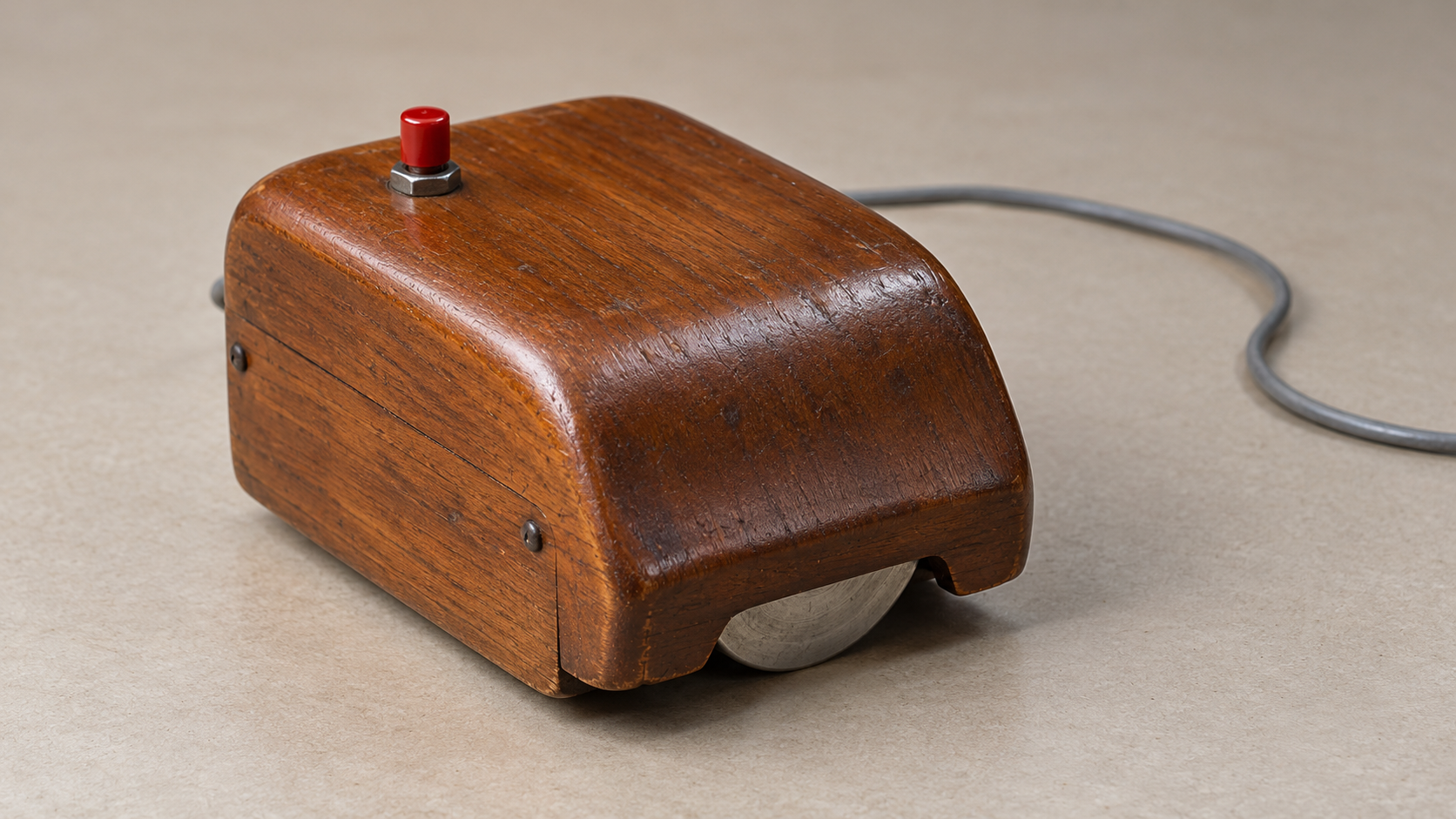
Engelbart’s Augmentation Research Center had developed NLS against a background in which much computing still involved submitting jobs and waiting for results. He wanted a more immediate relationship between a person and information on a screen. The team combined a display, a keyboard, a mouse, and a five-key chord keyset with software for manipulating structured text. Bill English helped turn the mouse concept into working hardware, with early wooden prototypes preceding the demonstration by several years. The 1968 presentation did not mean that one person invented every component that day. It made an interconnected research program visible through an operating system of tools.
The performance itself required substantial communications engineering. Engelbart was onstage in San Francisco while the computing system and supporting colleagues were at SRI in Menlo Park. Telephone and video links connected the locations, and cameras showed his face, hands, and screen content to the audience. Bill English coordinated the video presentation. Engelbart inserted and moved text, navigated linked material, and worked with remote colleagues on shared information. These activities were everyday-looking tasks by later standards, but their combination challenged the idea that a computer was mainly a remote calculating machine controlled through batches of punched cards.
NLS remained a specialized research environment rather than an immediately universal consumer product. Its controls required learning, its infrastructure was substantial, and subsequent personal computers did not simply reproduce the entire system. Nevertheless, researchers and later developers carried related ideas into other institutions and commercial systems. The lasting lesson was larger than a particular pointing device: interactive documents, navigable connections, responsive displays, and collaboration could reinforce one another. December 9 marks a public demonstration of those possibilities, not the instant arrival of the modern internet or every feature of today’s desktop. It is a useful anniversary because it connects recognizable computer habits with a deliberate effort to improve how teams work with knowledge.
Engelbart called his approach the augmentation of human intellect. The objective was to improve the work of people and groups, not merely to make calculations run faster.
The early mouse was part of a larger input system that also included a keyboard and chord keyset. The demonstration should not be reduced to the unveiling of one accessory.
The stage console communicated with computing equipment at SRI. Links, cameras, switching equipment, and a supporting team made the remote presentation possible.
The wooden prototype illustrated here predates the event. The demonstration used a later mouse configuration, so the reconstruction is not presented as the exact device on Engelbart's desk that day.
NLS showed how links and structured documents could support navigation through information. Those ideas became important in later systems without making NLS itself the World Wide Web.
The presentation's continuing influence concerns a combination of tools and working methods. A responsive interface became more powerful when paired with shared documents and collaboration.
Explore more of "On This Day ..."
Discover more events from the same date across news, politics, technology, sports, and other fields. Each link highlights significant moments that shaped history on different fronts.