

On This Day in Tech: December 17, 1903
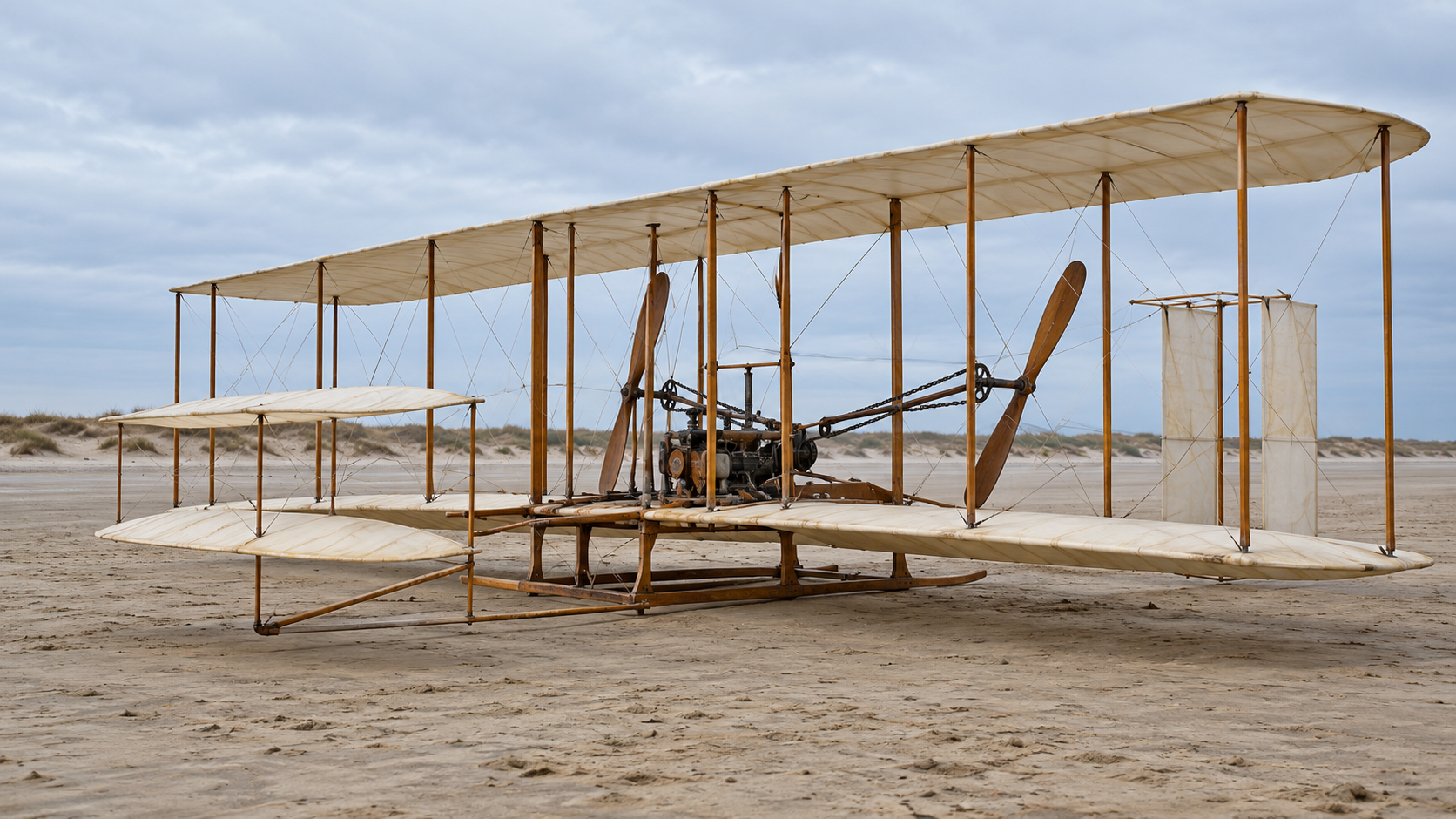
On December 17, 1903, Orville and Wilbur Wright made four powered airplane flights near Kill Devil Hills, North Carolina. Orville piloted the first, traveling 120 feet in twelve seconds, while Wilbur made the longest flight later that day. Their wood-and-fabric Flyer combined a gasoline engine, two propellers, lifting wings, and a system that allowed the pilot to control the aircraft. The flights are recognized as the first successful sustained, controlled flights of a powered heavier-than-air machine. They were brief experiments, not the start of a passenger airline or a demonstration that an airplane could already operate safely in every weather condition.
The brothers had spent years investigating flight while running their bicycle business in Dayton, Ohio. Their glider experiments taught them that a successful aircraft needed controllable balance as well as sufficient lift. They tested airfoils in a wind tunnel and used the results to improve their designs. Control involved changing the wings’ shape and coordinating that action with movable tail surfaces, while a forward elevator governed climbing and descent. This combination mattered because simply attaching an engine to a large wing would not give a pilot a dependable way to guide the resulting machine through the air.
Propulsion required further original work. The Wrights developed efficient aircraft propellers and obtained a lightweight engine built with the help of their mechanic, Charlie Taylor. Chains drove the two propellers, which turned in opposite directions to counteract their twisting effects. The Flyer used skids and a launching rail rather than wheeled landing gear. An unsuccessful attempt on December 14 required repairs before the brothers could try again. On December 17, strong headwinds helped the wings generate lift while limiting speed over the ground. Orville’s first flight was followed by alternating attempts, culminating in Wilbur’s fifty-nine-second flight covering 852 feet.
The day’s results did not end the engineering work. The Flyer remained difficult to control, and later aircraft and further experiments were necessary before powered flight became a more practical capability. Nor did the accomplishment emerge from an empty field of previous ideas: the Wrights studied earlier work and then tested the parts they found incomplete. Their contribution was a functioning combination of aerodynamic knowledge, propulsion, structure, and piloting technique. December 17 therefore marks more than a machine briefly leaving the ground. It illustrates a method of technological development in which measurement, repeated trials, and attention to the interaction of subsystems can solve a problem that greater power alone cannot overcome.
The flights occurred near Kill Devil Hills, south of Kitty Hawk. Both place names appear in accounts because Kitty Hawk provided the familiar regional reference.
The Wrights' bicycle experience contributed to their practical understanding of balance, mechanisms, and lightweight construction, but their aircraft still required new experiments.
The first successful flight lasted twelve seconds. The often-cited fifty-nine seconds and 852 feet describe Wilbur's fourth flight, not Orville's first attempt that morning.
Charlie Taylor helped provide the engine, while the brothers developed their propellers. The achievement depended on work beyond the visible fabric wings.
The 1903 aircraft was an experimental machine with limitations. Later improvements should not be projected backward into a claim that the first Flyer was already a dependable commercial airplane.
The key technical problem joined lift, control, and propulsion. The anniversary is best understood through their integration rather than through a simple race to install the most powerful engine.
Explore more of "On This Day ..."
Discover more events from the same date across news, politics, technology, sports, and other fields. Each link highlights significant moments that shaped history on different fronts.