

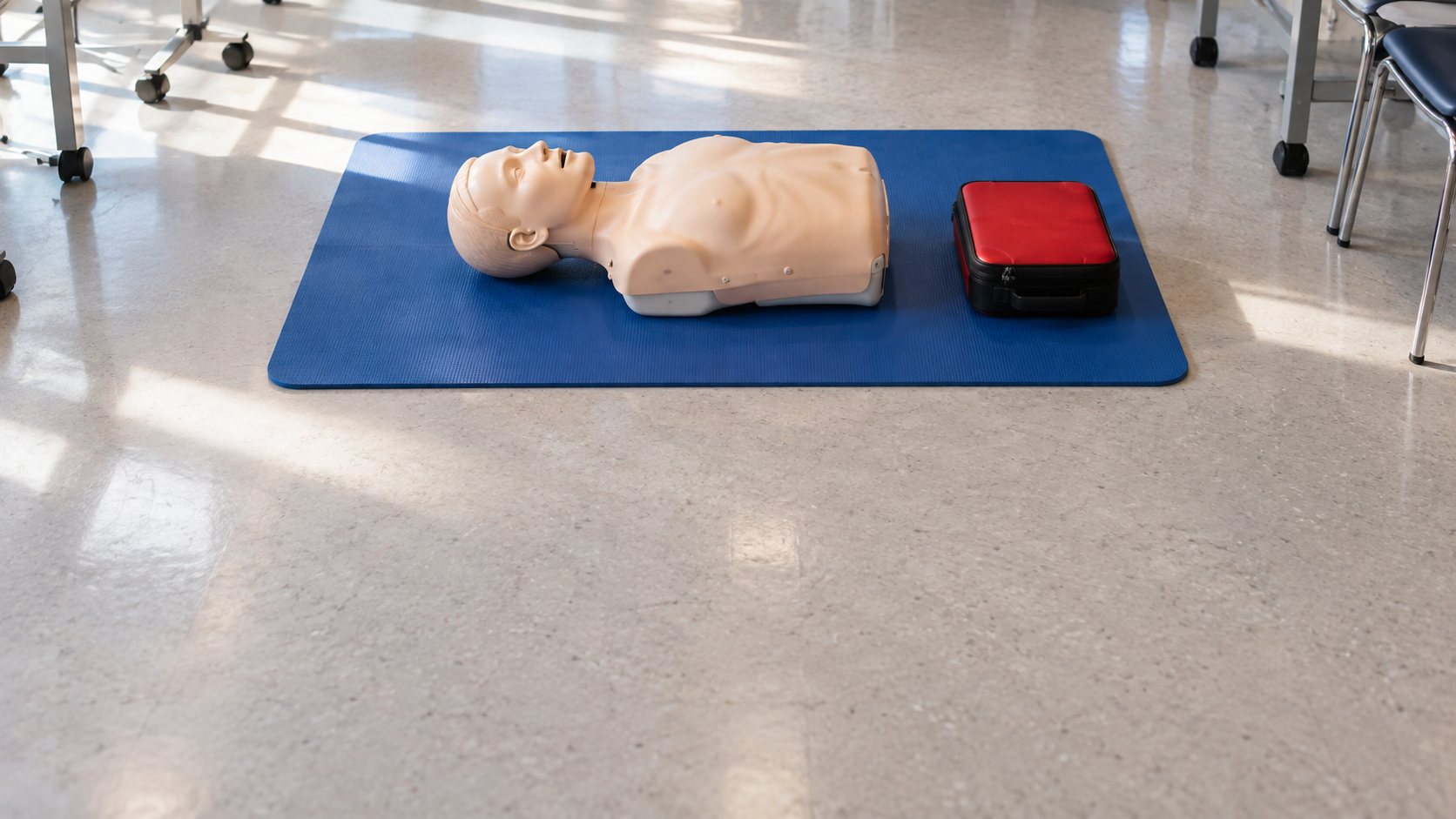
CPR Explainer
Cardiopulmonary resuscitation, usually called CPR, is an emergency response intended to keep blood circulating when a person’s heart is no longer pumping effectively. Chest compressions provide a temporary substitute for some of the heart’s mechanical work. Depending on the situation and responder’s training, CPR can also include breaths. Its purpose is to support vital organs while emergency care arrives. It is not a guarantee that the heart will restart, and it works within a wider response that includes recognizing the emergency and calling for help.
Cardiac arrest is different from a heart attack. In cardiac arrest, effective circulation stops; a heart attack involves an interruption of blood supply to part of the heart muscle and can sometimes lead to arrest. Someone in cardiac arrest becomes unresponsive and may have abnormal gasping rather than normal breathing. These distinctions matter because the emergency response depends on what is happening now. For an actual emergency, calling local emergency services and following the dispatcher’s instructions is more useful than trying to work through an article.
An automated external defibrillator, or AED, complements CPR by checking the heart’s rhythm and delivering a shock when an appropriate shockable rhythm is detected. The device gives prompts and does not advise a shock for every arrest. Compressions support circulation; defibrillation addresses certain electrical rhythm problems. One does not replace the other. A coordinated response can involve one person calling emergency services, another starting CPR, and another retrieving an AED, when enough people are available to share those tasks.
The appropriate technique depends on factors such as age, whether breathing failure contributed to the arrest, and the responder’s training. Hands-only CPR is promoted for particular situations involving adult sudden collapse, while breaths remain important in other circumstances. Reading a description does not build all the practical skills needed under stress. Training lets participants practice recognition, compressions, equipment use, and teamwork. Understanding what CPR is meant to accomplish explains why prompt action matters while keeping its limitations and the need for professional emergency care clear.
The brain and other organs depend on a continuing supply of oxygenated blood. When effective circulation stops, waiting for certainty can consume time that the person does not have. CPR is designed to provide immediate support during that gap. It is a temporary emergency intervention, and its value depends partly on how quickly the larger response is organized.
Abnormal gasping can create confusion because it may be mistaken for ordinary breathing. Training addresses this recognition problem alongside checking responsiveness and activating emergency services. A person does not need to diagnose the precise rhythm before seeking help. Dispatchers can guide callers through the response, adapting instructions to the situation and the information the caller can provide.
Chest compressions move blood through pressure on the chest and the resulting changes inside it. Effective technique includes suitable positioning and allowing the chest to return between compressions. Training provides feedback on these skills. Differences between adult, child, and infant procedures mean that a general explanation should not be treated as a substitute for instruction appropriate to the person involved.
An AED analyzes electrical activity and guides the responder through its prompts. The pads, rhythm analysis, and shock decision are parts of one sequence. Safety instructions include keeping people clear when directed. Familiarity with a training device can reduce hesitation, but responders should follow the actual device’s prompts and emergency dispatcher rather than rely on a remembered diagram.
Outcomes depend on the cause of arrest, the time without effective circulation, and subsequent treatment, among other factors. Successful CPR cannot be promised from a brief checklist. Some emergencies need particular attention to breathing, including circumstances involving drowning. This is why hands-only messaging and full CPR training should be understood in their intended contexts rather than treated as contradictory advice.
Readiness can include knowing the local emergency number, locating available AEDs, and arranging recognized first-aid training. A workplace or community plan is more useful when people know their roles and equipment remains accessible. Refresher practice helps maintain skills. These preparations turn an abstract concept into a practical response without requiring an untrained person to make complex medical judgments.
Explore more "Explainers"
Discover additional explainers across politics, science, business, technology, and other fields. Each explainer breaks down a complex idea into clear, everyday language—helping you better understand how major concepts, systems, and debates shape the world around us.