

Home Energy Audit Explainer
A home energy audit, also called a home energy assessment, is a structured evaluation of how a house uses and loses energy. Its purpose is to replace guesswork with evidence. An auditor examines the building shell, heating and cooling equipment, water heating, lighting, appliances, and patterns in utility use, then identifies improvements that may reduce consumption or improve comfort. A professional audit is more detailed than walking around looking for drafts because it combines observation with measurements. The final product should be a report that explains the important findings, ranks possible upgrades, and distinguishes urgent safety or maintenance issues from optional efficiency work.
The assessment often begins with questions about the house and its occupants. The auditor may review energy bills, learn which rooms feel uncomfortable, ask how thermostats are used, and note renovations or known moisture problems. A visual inspection then follows the path energy takes through the building. The auditor looks at insulation, windows, doors, attic access, foundations, exterior penetrations, ductwork, and mechanical equipment. Gaps where different materials meet can leak air even when they are too small to notice casually. The auditor also records equipment age and condition rather than assuming a newer-looking appliance is automatically the largest source of waste.
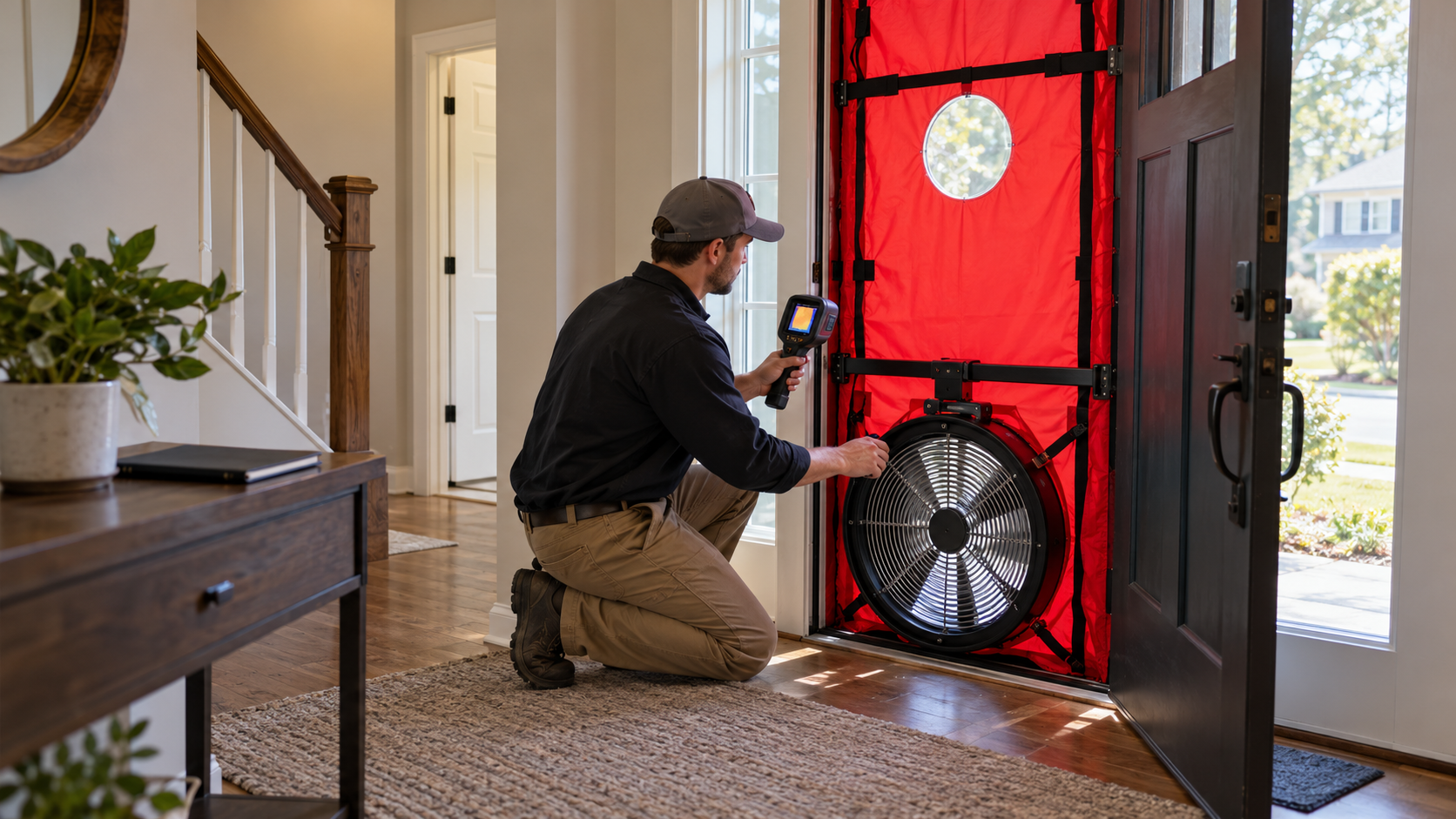
One common diagnostic tool is a blower door: a calibrated fan mounted temporarily in an exterior doorway. With exterior openings closed and interior doors positioned for the test, the fan changes the pressure inside the house. Instruments measure how much air must move to maintain that pressure difference, providing an estimate of overall air leakage. While the fan operates, an auditor can trace incoming air around windows, attic hatches, baseboards, plumbing penetrations, and other openings. The test must be performed with attention to fireplaces and fuel-burning equipment, because pressure changes can affect combustion gases and reveal conditions that need safety review.
Infrared cameras can add another layer of evidence. They display surface-temperature differences that may indicate missing insulation, thermal bridging, moisture, or air leakage when indoor and outdoor conditions make those patterns visible. A thermographic image is not a picture of air itself and does not prove the cause on its own; the auditor interprets it alongside construction details and other tests. Duct leakage testing may also be appropriate, especially when ducts run through attics, crawlspaces, or garages. Because each tool answers a different question, a credible audit does not reduce the house to one colorful image or one score.
The report turns observations into priorities. Air sealing and insulation may rank highly in one house, while another needs duct repair, equipment maintenance, or a control adjustment first. Recommendations should consider expected savings, installation cost, durability, comfort, indoor-air quality, and interactions among systems. Tightening a house without checking ventilation and combustion safety can create new problems, so the sequence matters. Some programs also provide a standardized Home Energy Score that estimates a home’s energy performance under common assumptions, but that score complements rather than replaces the detailed findings and local judgment in the audit.
An audit is a decision tool, not a guarantee of a particular bill reduction. Weather, utility prices, household size, thermostat settings, and daily behavior all affect actual consumption. Contractors may also differ in scope, credentials, and the depth of their testing, so homeowners should understand what is included before hiring one. The practical benefit is a defensible order of operations: measure first, correct safety and building problems, then invest in upgrades supported by the evidence. That approach helps avoid replacing an expensive system when the dominant problem is uncontrolled air leakage—or sealing leaks while overlooking equipment that needs safe repair.
A home energy audit uses inspection and measurement to show how a house consumes and loses energy. Key terms include building envelope, air leakage, blower door, pressure difference, thermography, duct leakage, combustion safety, and prioritized recommendations.
A calibrated fan changes indoor pressure while instruments measure the airflow needed to maintain that difference. The result helps estimate whole-house leakage and makes individual leaks easier to locate.
No. An infrared camera shows surface-temperature patterns. Those patterns can guide an investigation, but construction details, weather conditions, moisture, and other tests are needed to identify the cause.
Explore more "Explainers"
Discover additional explainers across politics, science, business, technology, and other fields. Each explainer breaks down a complex idea into clear, everyday language—helping you better understand how major concepts, systems, and debates shape the world around us.