

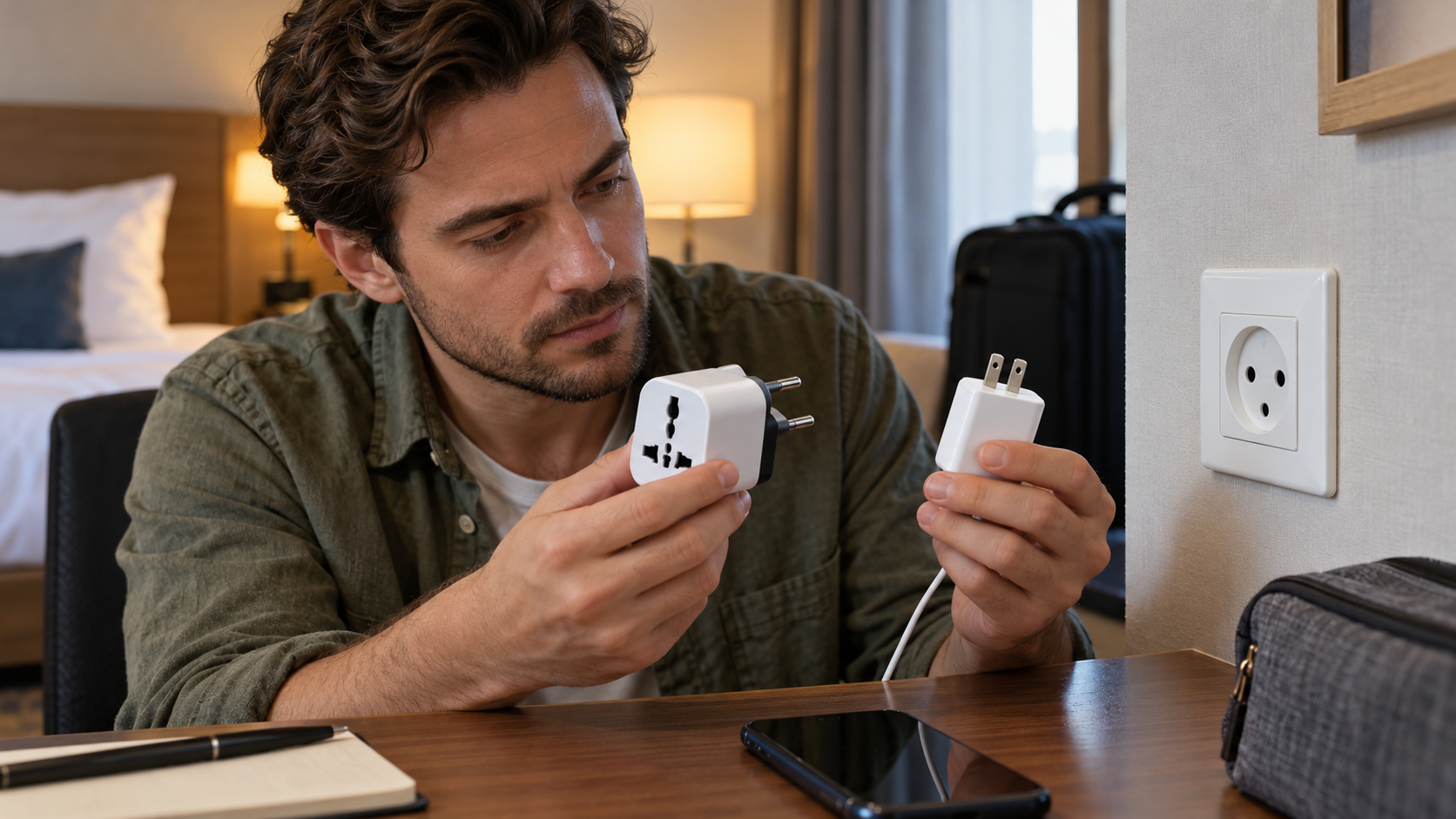
Travel Adapter Explainer
A travel adapter changes the mechanical connection between a device plug and a foreign wall outlet. Countries use several plug shapes, pin arrangements, voltages, and frequencies. The adapter presents pins that fit the destination receptacle and a socket that accepts the traveler’s plug, routing live, neutral, and—when supported—earth connections to the correct contacts. Most simple adapters do not alter the electricity. If 230-volt, 50-hertz power enters the adapter, that is normally what reaches the plugged-in device. The adapter is therefore a fit-and-contact tool, not automatically a transformer or frequency converter.
The device label determines whether an adapter is enough. Many phone and laptop chargers accept a wide input such as 100–240 volts at 50/60 hertz; paired with the correct adapter, they can operate in common systems worldwide. A device marked only for 120 volts may be damaged or become hazardous on a 230-volt supply. A dual-voltage appliance may have a switch that must be set before connection. Frequency matters most for equipment with timing circuits, some motors, and certain transformers, even when the voltage is acceptable.
A voltage converter or transformer changes voltage, but it must be designed for the device type and power. Small electronic converters do not necessarily support heating appliances, motors, medical equipment, or long continuous use. Hair dryers and kettles demand high wattage, making a correctly rated local appliance or genuine dual-voltage model safer than a tiny travel converter. A transformer usually does not change frequency. The device maker’s instructions and rating plate should be checked rather than relying on the adapter package’s list of countries.
Grounding must not be improvised. A three-contact device that requires protective earth should use an adapter that maintains a real earth path in a properly grounded destination outlet. An adapter that accepts a ground pin but has only two output pins cannot provide that protection. Polarized plugs and fused plugs also have safety functions that may not carry through every travel product. Never defeat a shutter, force pins, stack loose adapters, or use a device if the assembly sags, sparks, heats, or exposes metal.
Power strips create additional limits. A domestic strip may have surge components, switches, indicator lamps, or insulation rated only for its home voltage even if every plugged-in charger is universal. Plugging it into a higher-voltage outlet can fail dangerously. An approved destination-rated USB charger or travel power unit with suitable input and certifications can reduce connections. The total current through an adapter must remain below both the adapter’s rating and the outlet’s capability, with high-load appliances used one at a time if permitted at all.
Before departure, list the destinations, identify their official plug and supply standards, read each device’s input line, and choose a reputable adapter with the needed earth connection and ratings. Inspect it for loose parts and carry no assumption that a socket shape proves electrical compatibility. The practical decision tree is simple: match the plug, confirm voltage, confirm frequency where relevant, verify power and grounding, then connect. A travel adapter safely solves only the first of those questions unless the product explicitly provides additional certified functions.
A travel adapter changes plug shape and contact arrangement but usually passes the destination’s voltage and frequency unchanged. Key terms include plug type, receptacle, voltage, frequency, dual voltage, converter, transformer, wattage, and protective earth.
Read the device input rating. Equipment marked for the destination voltage and frequency—often 100–240 V, 50/60 Hz for chargers—usually needs only the correct physical adapter.
Not if the device requires protective earth. Use an adapter and outlet that maintain the earth path, and never force, stack, heat, or modify a loose connection.
Explore more "Explainers"
Discover additional explainers across politics, science, business, technology, and other fields. Each explainer breaks down a complex idea into clear, everyday language—helping you better understand how major concepts, systems, and debates shape the world around us.