

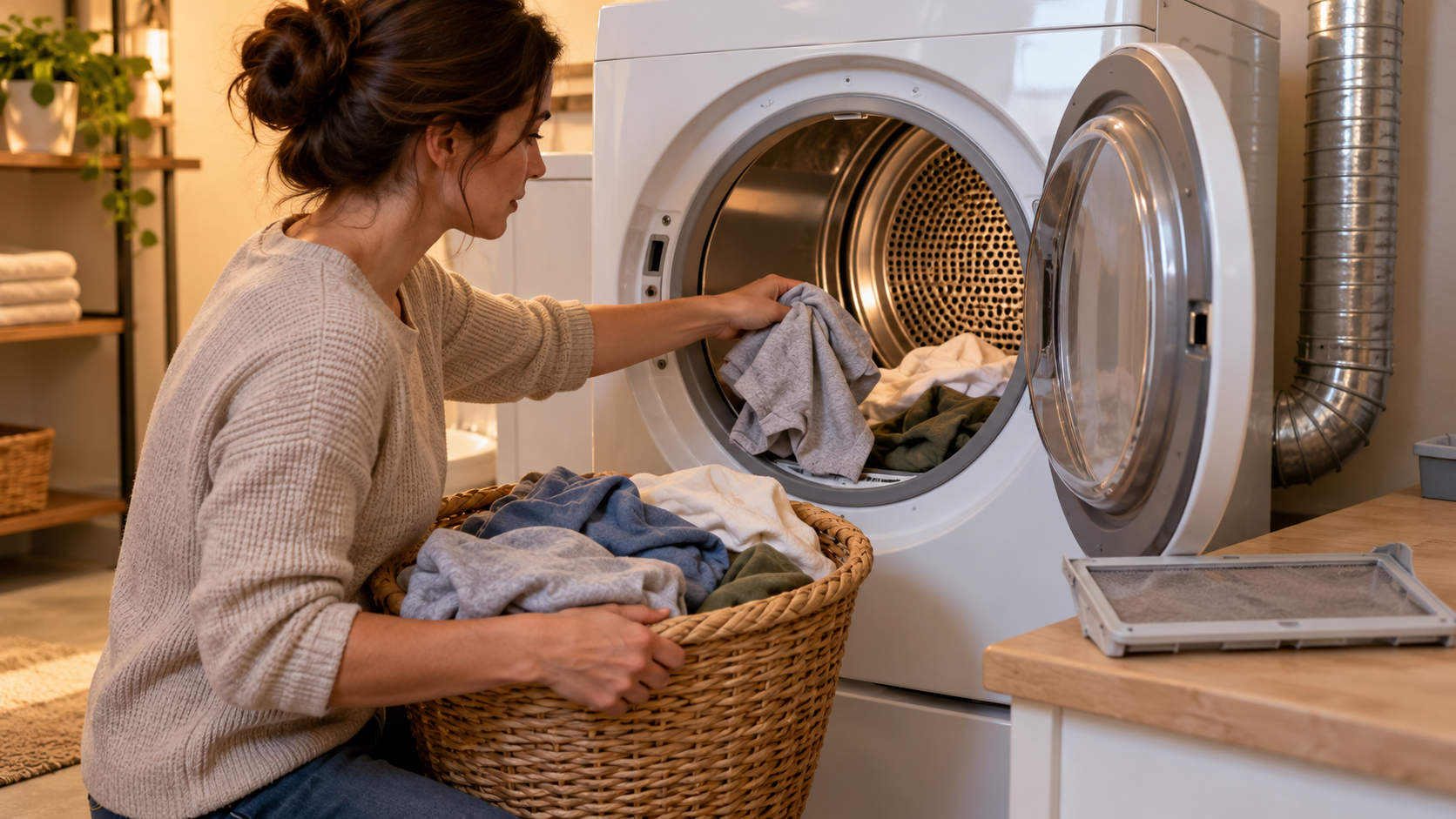
Clothes Dryer Explainer
A clothes dryer removes moisture by combining heat, moving air, and tumbling. A motor turns the drum so wet fabric repeatedly lifts and falls, exposing new surface area. A fan draws air across an electric element, gas burner heat exchanger, or heat-pump coil and sends the warmed air through the load. Water in the fabric absorbs energy and evaporates. The now humid air must then leave the system or be cooled so its water condenses. Drying slows when fabric remains clumped, airflow is blocked, or the surrounding air cannot accept more moisture.
A vented dryer exhausts warm humid air outdoors through a duct. The duct should be short, smooth, properly sized, and free of crushing or buildup so the fan can move the designed airflow. It must not terminate in an attic, crawlspace, wall cavity, or indoor room, where moisture and lint can damage the building. Condenser dryers cool the humid process air so water collects in a tank or drain while much of the air recirculates. Heat-pump dryers add a refrigeration loop that recovers heat, using less energy but often taking longer at lower temperatures.
The lint screen catches fibers released as fabrics flex and rub. Cleaning it before or after every load preserves airflow and reduces combustible buildup, but the screen does not collect everything. The vent path and exterior hood need periodic inspection and cleaning. Long drying times, a very hot cabinet, weak exhaust, a burning smell, or lint around connections are warnings to stop and investigate. Foil or plastic accordion ducts can trap lint or fail under heat; dryer instructions and local code specify acceptable transition and permanent duct materials.
Automatic cycles use moisture sensors, temperature sensors, or both. Conductive bars inside the drum detect damp fabric touching them, while controls estimate remaining time and cool the load near the end. Mixed loads can confuse the decision: thin garments dry first while towels remain wet, or one damp item stops touching the sensor. Sorting by weight and drying behavior improves results. Overdrying wastes energy, shrinks or wears fabrics, and creates more static. Dryer balls can separate some items mechanically, but they do not replace airflow or a suitable cycle.
Preparation matters. Washer spin speed removes water far more efficiently than a dryer evaporates it, so a strong permitted spin reduces drying time. Shake out twisted items, fasten covers as directed, and check pockets. Items contaminated with gasoline, cooking oil, solvents, or other flammable substances can ignite even after washing and require special handling. Foam rubber, rubber-backed pieces, and heat-sensitive fabrics may be damaged. Clean loads should not remain tightly packed while still hot, because some oily materials can self-heat.
Gas dryers add combustion and carbon-monoxide concerns, requiring correct fuel connection, venting, and service. Electric dryers need the specified high-power circuit and intact cord. Neither type should be operated with a bypassed safety switch or disconnected vent. The everyday mechanism is straightforward: remove as much water as possible in the washer, allow tumbling space, heat the air appropriately, carry vapor out or condense it, and keep lint paths clear. When a dryer suddenly needs extra cycles, the right response is airflow and equipment diagnosis, not simply more heat.
A dryer tumbles fabric through warm moving air so water evaporates, then vents the humid air or condenses its moisture. Key terms include drum, heater, airflow, lint screen, exhaust duct, condenser dryer, heat-pump dryer, moisture sensor, and cooldown.
Humid air cannot leave efficiently, so the air around the fabric holds more moisture and evaporation slows. Restricted airflow also raises temperatures and fire risk.
No. Oil- or solvent-contaminated items, foam, rubber-backed goods, and heat-sensitive fabrics can be hazardous or damaged. Check care labels and dryer instructions before applying heat.
Explore more "Explainers"
Discover additional explainers across politics, science, business, technology, and other fields. Each explainer breaks down a complex idea into clear, everyday language—helping you better understand how major concepts, systems, and debates shape the world around us.