

Microwave Oven Heating Explainer
A microwave oven heats food by turning electrical energy into electromagnetic waves and directing them into a metal cooking cavity. An electron tube called a magnetron produces the microwaves. Metal walls reflect the waves, while many glass, paper, ceramic, and microwave-safe plastic containers let them pass. Components in food absorb part of that energy and convert it into molecular motion, which appears as heat. The radiation is non-ionizing: it does not have enough energy to remove electrons from atoms, and it does not make food radioactive.
Water molecules respond strongly to the rapidly changing electric field, but the familiar claim that microwaves simply make each water molecule spin is incomplete. Dissolved salts, sugars, fats, and the structure of the food also affect how energy is absorbed. The field penetrates only a limited distance, so a thick portion is not cooked from the inside out. Its outer region absorbs microwave energy, and ordinary conduction then carries heat farther toward the center. That is one reason density, shape, moisture, and portion size change cooking time.
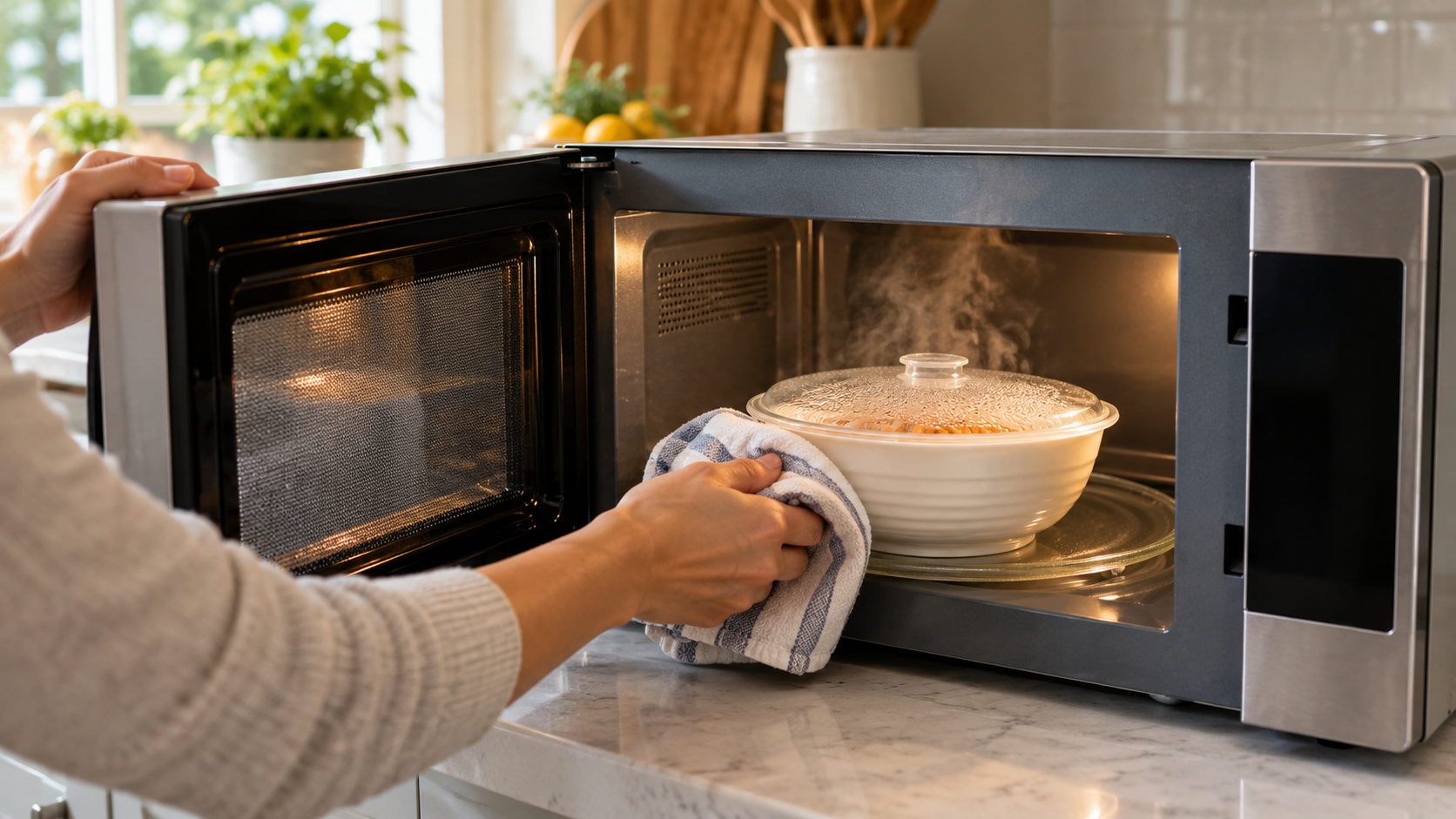
The wave pattern inside the cavity is not perfectly uniform. Reflections can create regions where the electric field is stronger or weaker, producing hot and cool spots. A turntable moves the dish through different parts of that pattern, while some ovens use a rotating metal mode stirrer instead. Covering suitable foods holds moisture, and pausing to stir or rotate redistributes hot material. Standing time matters because heat continues spreading after the magnetron stops, allowing temperature differences to become smaller before the food is served or checked.
The cooking level on many conventional microwave ovens is controlled by cycling the magnetron on and off rather than reducing its output continuously. At fifty percent power, for example, the magnetron may run for part of each interval and remain off for the rest. Inverter-equipped models can supply a steadier range of power. Lower settings give conduction more time to catch up with microwave absorption, which can help thaw frozen food, soften ingredients, or warm delicate mixtures without repeatedly overheating their edges.
A conductive metal enclosure and a fine metal screen in the door help keep microwave energy inside while still allowing a person to see the food. Door interlocks stop the magnetron when the latch is released, and federal safety requirements limit permitted leakage. A damaged hinge, latch, seal, or door is a reason to stop using the appliance and consult the manufacturer. Burns from hot food, steam, containers, and superheated liquids are more common practical hazards than radiation from an oven that is intact and operated correctly.
Safe results still depend on food handling. Package directions may specify covering, stirring, standing time, and a particular power level because those steps reduce uneven heating. A food thermometer should check the thickest areas of foods that require a safe minimum internal temperature. Only cookware identified as microwave-safe should be used, and metal should be avoided unless the appliance instructions specifically allow a limited application. The microwave is fast because energy is deposited in food rather than first heating a large oven cavity, but heat distribution still requires time and attention.
A magnetron produces non-ionizing microwaves that reflect inside a metal cavity and transfer energy to food. Key terms include magnetron, electromagnetic field, dielectric heating, conduction, hot spot, turntable, inverter, standing time, and interlock.
No. Microwave energy penetrates only a limited distance. Outer regions absorb energy directly, while heat reaches deeper portions mainly by conduction, so thick food can remain cool in the center.
Standing time lets heat continue moving from hotter areas into cooler ones. That improves temperature uniformity and helps a thermometer give a more meaningful safety check.
Explore more "Explainers"
Discover additional explainers across politics, science, business, technology, and other fields. Each explainer breaks down a complex idea into clear, everyday language—helping you better understand how major concepts, systems, and debates shape the world around us.