

Retail Barcode Identification Explainer
A retail barcode identifies a product by representing a standardized number as a machine-readable pattern. In a familiar UPC or EAN symbol, dark bars and light spaces of different widths encode digits, along with start, middle, and end patterns that help a scanner find and orient the symbol. The number is usually a Global Trade Item Number, or GTIN, assigned under GS1 rules. The barcode does not normally contain the product’s price or complete description. It supplies a key that the retailer’s computer uses to retrieve those details from a database.
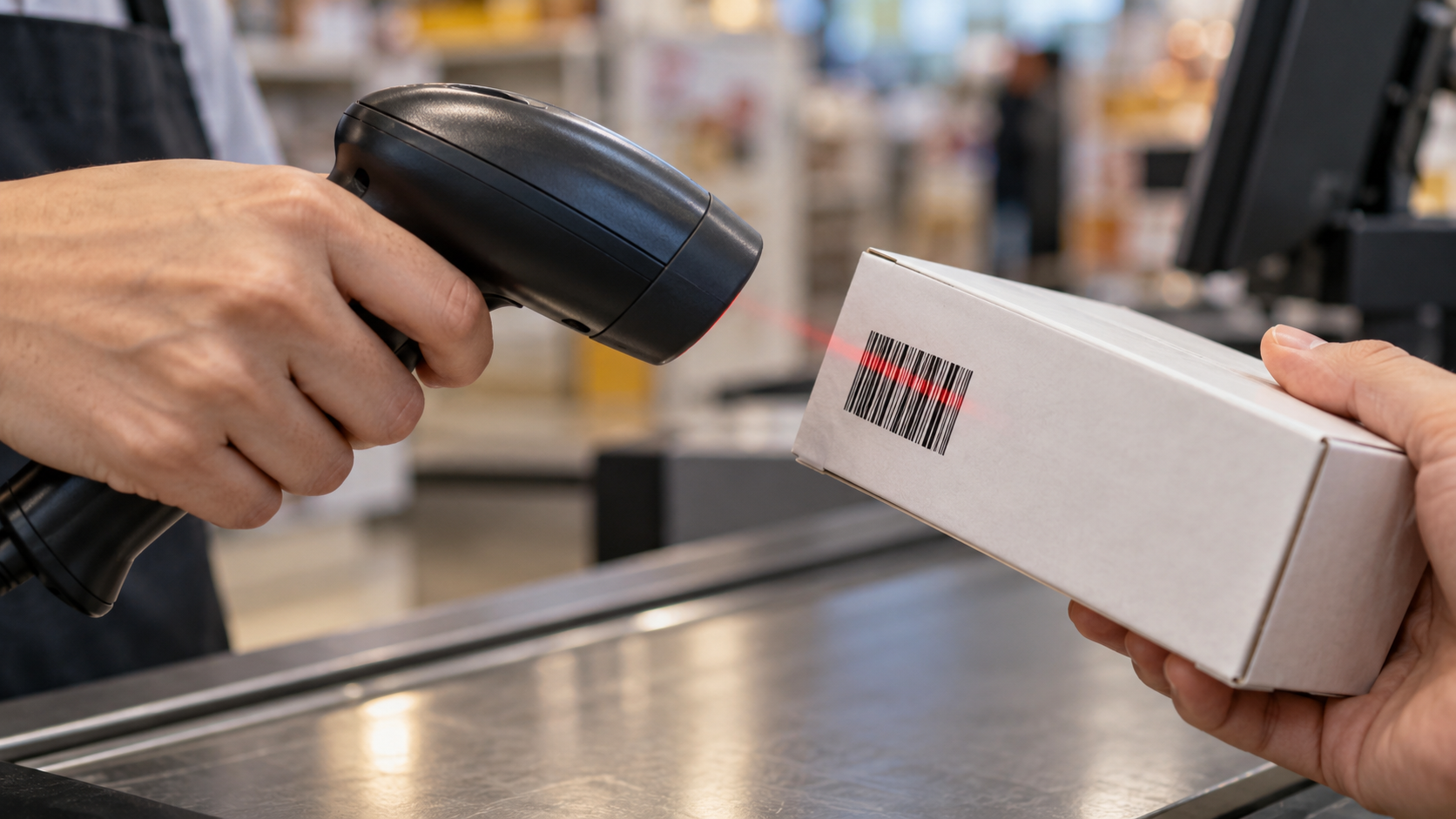
A laser scanner sweeps light across the symbol and measures reflected intensity. Light spaces return more light, while dark bars absorb more, producing a changing electrical signal as the beam moves. Image-based scanners photograph the pattern and analyze many rows or angles at once. Software converts sequences of measured widths into the encoded digits. Quiet zones—blank margins at both sides—help separate the symbol from nearby graphics. Sufficient contrast, correct size, sharp printing, and an undamaged surface make that measurement more reliable.
The GTIN distinguishes a particular trade item configuration, such as one flavor and package size, from another. A company receives an assignment basis from a GS1 member organization and allocates item references according to the applicable rules. The same identifier can appear on millions of identical packages, but a materially different product or pack may need another number. A scanner does not infer what the item looks like. It reads the identifier, and the connected system decides which product record, price, tax rule, inventory count, or restriction belongs to it.
The last digit is commonly a check digit calculated from the preceding digits using a weighting rule. After scanning, the software repeats the calculation. If the result does not match, the read is rejected rather than accepted as a different product. A check digit detects many common errors, but it is not encryption and does not prove that packaging is authentic. Guard bars and parity patterns also help the scanner establish direction and structure. Human-readable digits provide a fallback when the printed symbol cannot be scanned.
Point-of-sale systems use the result within a larger transaction. The register sends the GTIN to a product file, receives the current price and description, records the sale, and may reduce inventory. A price change normally updates the database without requiring a new barcode on every package. Weighed produce, coupons, logistics labels, and two-dimensional GS1 symbols can encode other identifiers or attributes under different standards. A QR code is therefore not simply a square version of a UPC; the formats, capacities, error correction, and intended workflows differ.
A barcode can fail because of wrinkles, glare, low contrast, ink spread, missing quiet zones, incorrect scaling, or a curve that distorts the bars. The operator may rotate the item, use another scanner angle, or type the digits. Verification equipment checks print quality more rigorously than an ordinary successful scan. The system works because identifier assignment, symbol design, printing, scanning, and databases share rules. The black-and-white pattern is the visible bridge between a physical package and a digital product record, not the record itself.
A barcode encodes a standardized identifier in measured bar and space widths; a scanner reads it and a database supplies the product details. Key terms include GTIN, UPC, EAN, quiet zone, guard pattern, scanner, check digit, product file, and verification.
Usually no. The code identifies the trade item. The register looks up the current price and description in the retailer’s database, allowing prices to change without reprinting the package.
It is calculated from the other digits. A scanner recalculates it and rejects many mistyped or misread numbers when the expected and scanned results do not match.
Explore more "Explainers"
Discover additional explainers across politics, science, business, technology, and other fields. Each explainer breaks down a complex idea into clear, everyday language—helping you better understand how major concepts, systems, and debates shape the world around us.