

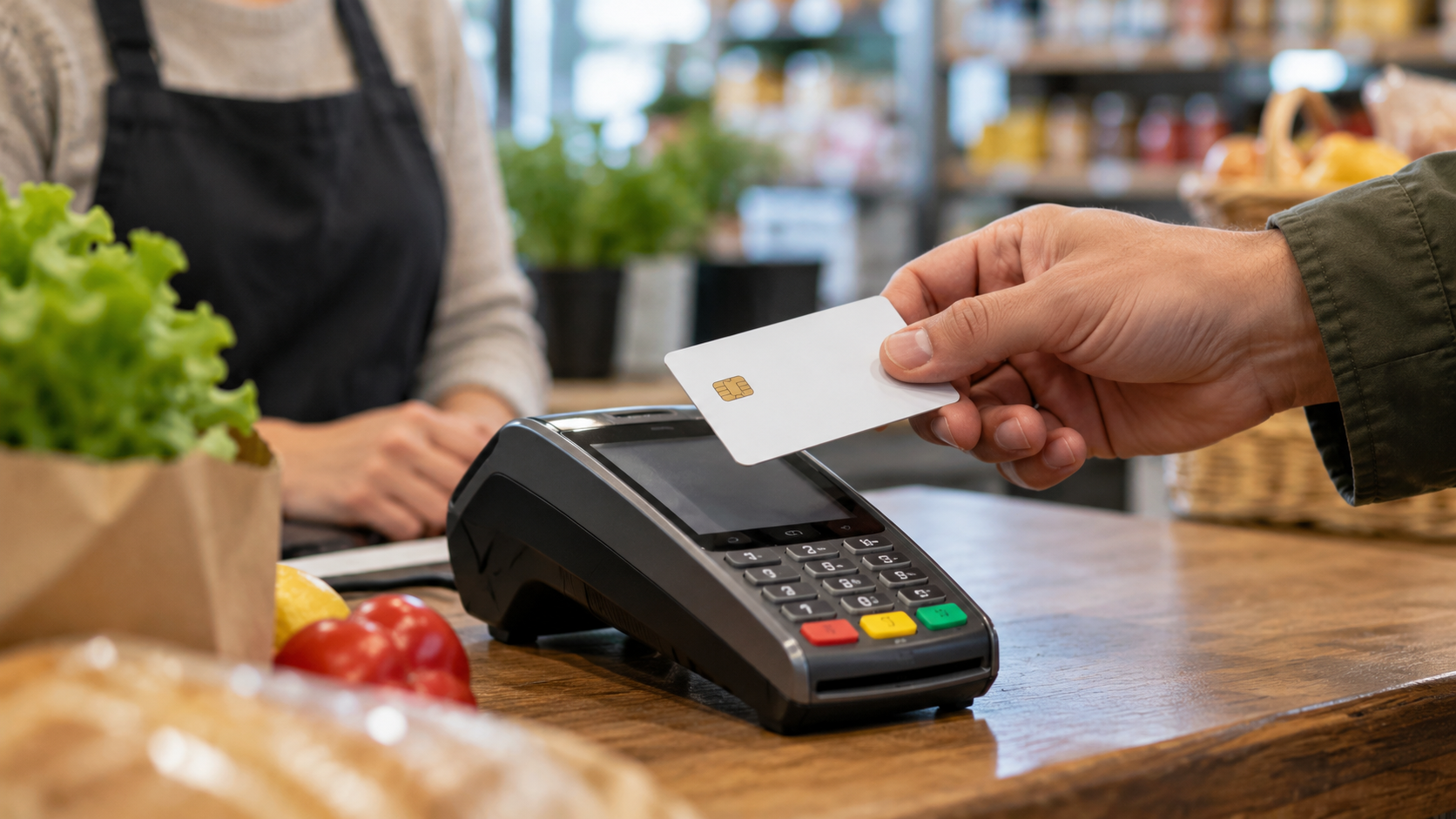
Contactless Card Payment Explainer
A contactless payment begins when a chip card, phone, or wearable is brought within a few centimeters of a compatible terminal. The devices communicate through near-field radio technology. A passive card draws enough energy from the terminal’s field to power its chip briefly, while a phone uses its own power and secure wallet functions. They exchange payment application data under EMV contactless rules. The tap does not spray a card number across a room; the useful range is short, and the interaction follows a structured request-and-response sequence.
The terminal first detects a supported payment credential and selects an application that both sides understand. The chip provides information needed for the purchase and performs a calculation using secret values that are not exposed as ordinary readable data. A transaction-specific cryptogram helps the issuer or payment system determine whether the message is fresh and valid. Replaying a captured exchange is therefore not equivalent to copying an old magnetic stripe. The exact fields and security steps vary by card, network, country, device, and transaction path.
The merchant terminal sends an authorization message through its payment processor and network to the card issuer. That message includes the amount, merchant context, credential data, and the chip-generated security result. The issuer checks account status, available funds or credit, fraud indicators, authentication results, and other rules, then returns an approval or decline. The quick tone or check mark at the register represents that larger exchange. Settlement—the later movement and reconciliation of money—occurs after authorization through additional network processes.
A mobile wallet adds tokenization. Instead of giving the terminal the underlying account number, the wallet can present a payment token associated with a device or wallet account. The payment system maps that token to the funded account in protected infrastructure. The phone may also require a fingerprint, face check, passcode, or unlocked state before releasing the credential. Tokenization limits the value of stolen transaction data, but it does not mean the phone stores unlimited money or that every merchant receives the same identifier in every context.
Contactless does not mean authentication is always absent. Depending on the amount, risk, local rules, and terminal, a purchase may require a PIN, signature, device verification, or insertion of the physical card. Offline and transit transactions can use specialized limits and later processing. A terminal may ask for the card to be inserted when contactless communication fails or when the chip’s counters and issuer rules require another method. The contactless symbol identifies compatible equipment, but acceptance also depends on the merchant and the payment application.
Practical security still includes reviewing statements, protecting a phone with a strong unlock method, reporting a lost card or device promptly, and avoiding terminals that appear altered. Radio shielding is not a substitute for account monitoring, and a payment tap should never be confused with an ordinary NFC tag that opens a web link. The system works by combining very short-range communication, chip computation, transaction-specific data, network authorization, and sometimes tokenization. Convenience comes from replacing physical electrical contacts, not from skipping the financial controls behind the purchase.
Contactless payment uses short-range NFC communication, an EMV chip, transaction-specific security data, and issuer authorization. Key terms include NFC, EMV, terminal, cryptogram, authorization, issuer, processor, network, tokenization, and wallet.
No. Most purchases still send an authorization request through the processor and payment network to the issuer, which applies account and fraud rules before responding.
The token stands in for the underlying account number. If transaction data is exposed, the token has controlled use and is less valuable than the original credential.
Explore more "Explainers"
Discover additional explainers across politics, science, business, technology, and other fields. Each explainer breaks down a complex idea into clear, everyday language—helping you better understand how major concepts, systems, and debates shape the world around us.