

Hotel Key Card Access Explainer
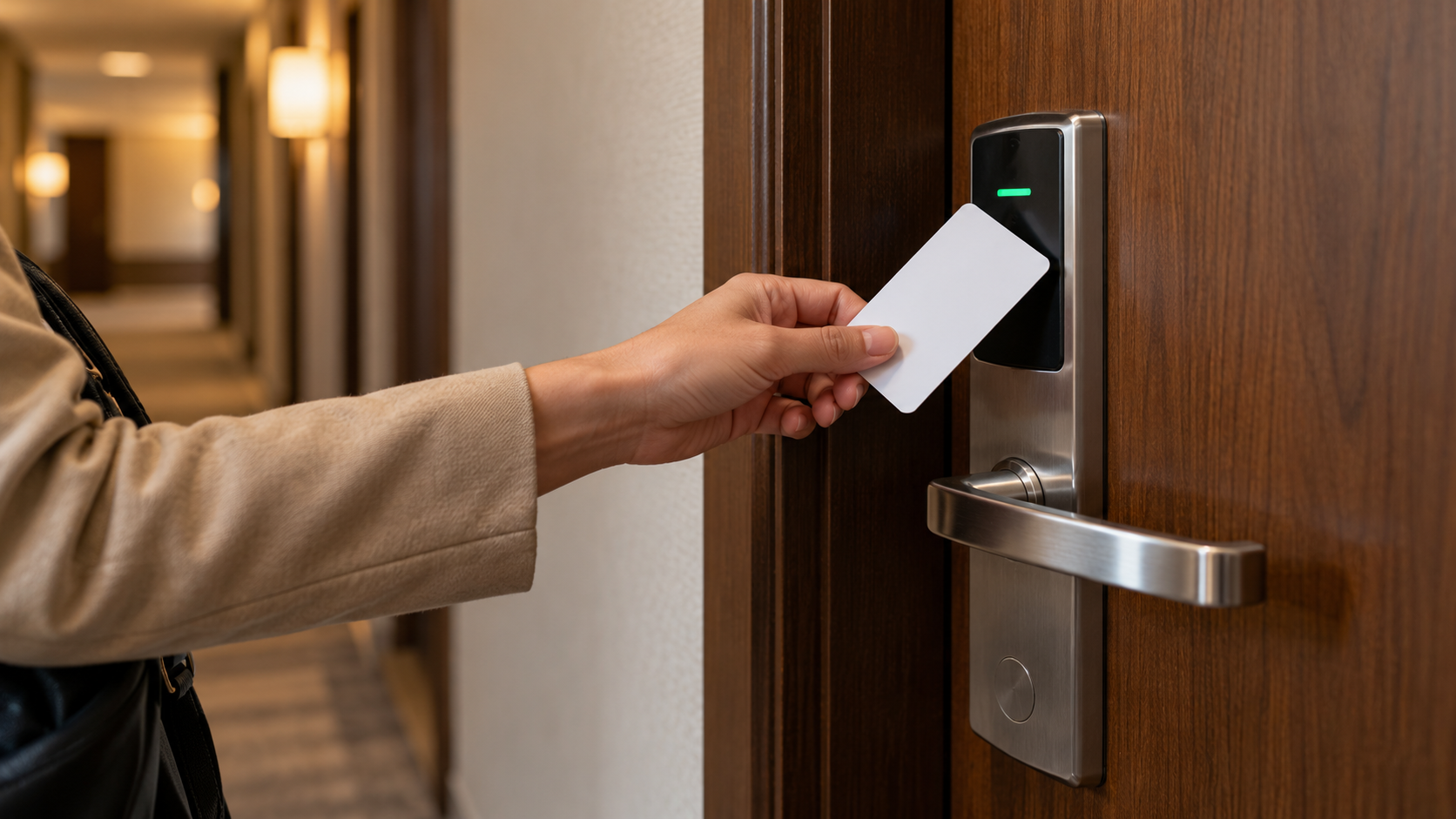
A hotel key card unlocks a door by presenting a temporary digital credential to an electronic lock. At check-in, the property’s access system encodes information associated with the assigned room, permitted time period, and credential sequence onto a magnetic stripe card or an RFID chip. When the guest inserts, swipes, or taps the card, the lock reads that data and checks it against rules stored in the lock or a connected system. A valid result powers a small motor or solenoid that lets the outside handle retract the latch for a few seconds.
RFID cards communicate without physical contact. A reader coil in the lock creates a short-range radio field that powers a passive chip in the card. The card and reader exchange an identifier and protected data according to the system’s design. Magnetic stripe cards instead store a pattern of magnetized regions that a read head senses as the card moves. Contactless locks can seal the reader behind the door trim, reducing wear from slots and moving cards, while magstripe systems remain in use and require clean, correctly oriented contact with the reader.
The lock usually runs on internal batteries and can make an access decision even if a network connection is unavailable. It has a clock, access rules, and a history or audit record. Some hotels update locks over a wireless network; others transfer new information through cards or staff devices. The green or red light is a simplified response to several checks: correct room or access group, valid start and end time, acceptable credential sequence, functioning battery, and no privacy or deadbolt condition that blocks ordinary guest entry.
A replacement card can invalidate an older card through sequence or issue information. Depending on the system, the new credential may update the lock the first time it is used, or a connected server may change the authorized list. Expiration at checkout is based on the lock’s time and the access data, not on the plastic wearing out at a precise moment. Because implementations differ, it is inaccurate to say every hotel card contains the guest’s name or that a desk employee is continuously sending an unlock command to each door.
Staff credentials are structured differently from guest access. Housekeeping, maintenance, management, and emergency roles may have defined areas and schedules, and the system can record which credential was presented and when. Audit information supports operations and investigations but must be handled under the property’s privacy and security practices. The mechanical side remains important: the electronic decision releases or couples a handle, yet the latch, strike, door alignment, closer, privacy bolt, and emergency key override still determine whether the physical door operates correctly.
A failed card does not always mean it was erased by a phone. It may be expired, encoded for another room, damaged, held incorrectly, superseded, or presented to a lock with a low battery or mechanical problem. The safe response is to return to the front desk with identification rather than trying to manipulate the lock. Hotel key systems combine temporary credentials, local electronic validation, battery-powered actuation, and ordinary door hardware. Their central advantage is that access can be changed without replacing a metal key or rekeying every lock after each guest.
A hotel lock reads a temporary RFID or magnetic credential, checks room and time permissions, and briefly couples the outside handle to the latch. Key terms include encoder, credential, RFID, magnetic stripe, reader, lock controller, solenoid, audit trail, expiration, and override.
Many systems use issue or sequence data. The lock accepts the newer credential and can reject an older sequence, though the exact update method differs among hotel systems.
Not necessarily. Many battery-powered locks validate cards locally using stored rules and a clock, then synchronize records or updates through the property’s chosen system.
Explore more "Explainers"
Discover additional explainers across politics, science, business, technology, and other fields. Each explainer breaks down a complex idea into clear, everyday language—helping you better understand how major concepts, systems, and debates shape the world around us.