

Water-Resistant Jacket Explainer
A water-resistant jacket sheds rain by making it difficult for liquid water to move from the outside surface to the wearer. A typical shell combines several defenses: a tightly woven face fabric, a durable water-repellent finish that makes droplets bead, and sometimes a continuous waterproof membrane or coating underneath. The face fabric provides strength and abrasion resistance. The hidden layer blocks wind and water under pressure. A lining or printed protective layer keeps body oils and friction from damaging that barrier. Performance depends on the whole garment, including seams, zippers, cuffs, hood, and fit.
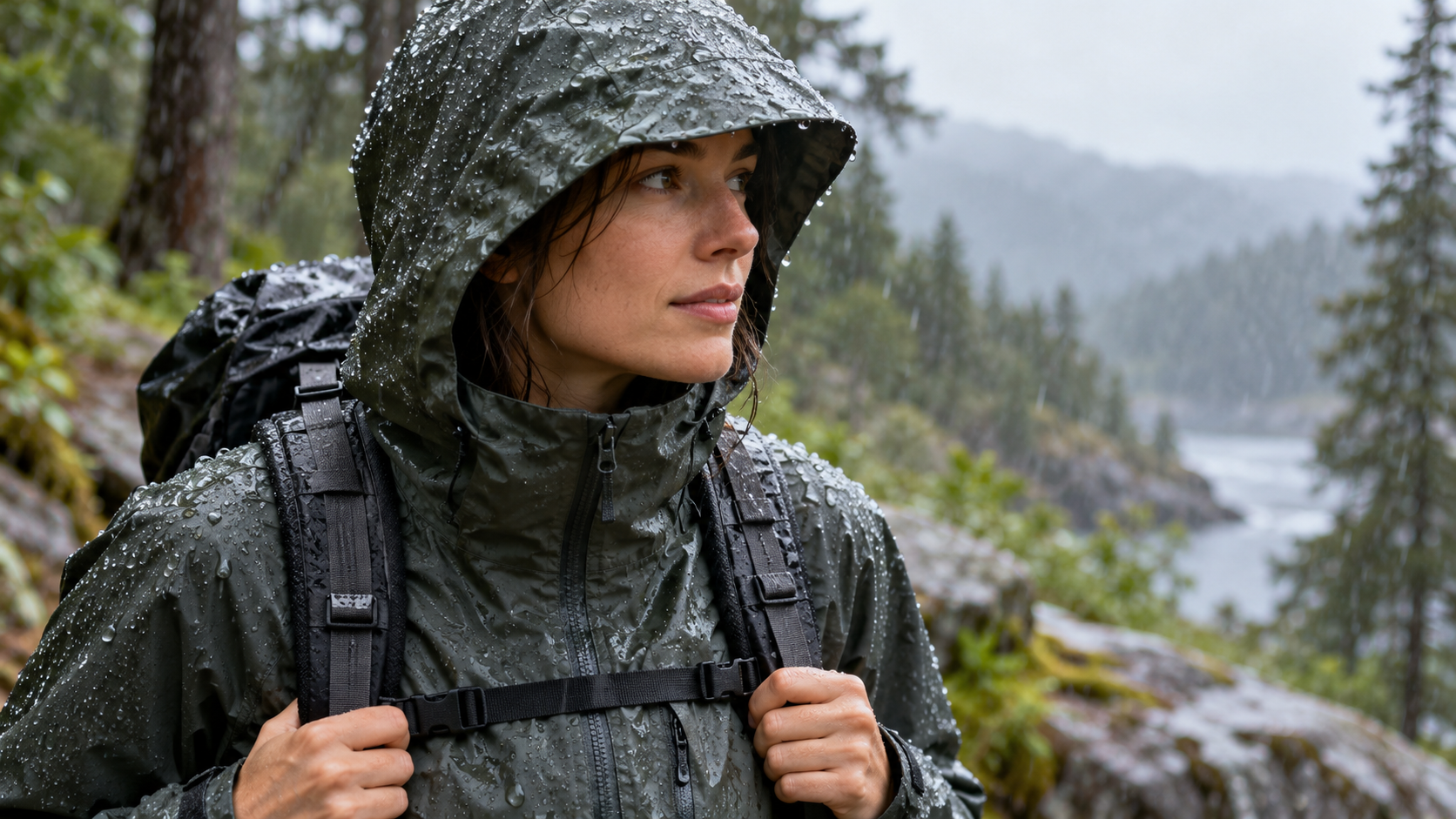
The surface treatment changes how water interacts with the textile. On an untreated fabric, droplets can spread into the spaces between fibers and darken the material. A durable water-repellent treatment lowers the surface attraction, so a droplet forms a rounded bead and rolls away more readily. The finish is not usually the main waterproof barrier, and it can wear down or become masked by dirt, oil, smoke, and detergent residue. When the face fabric stops beading and becomes saturated, the jacket may feel cold and clammy even if the membrane beneath is still preventing leakage.
In a waterproof breathable shell, the membrane contains microscopic structures or materials that resist bulk liquid water while permitting some water vapor to move through. The pressure of raindrops and contact with wet surfaces is different from the diffusion of individual vapor molecules. Manufacturers describe resistance with laboratory measures such as hydrostatic head, but a rating does not predict every real trip. Backpack straps, kneeling, wind-driven rain, contamination, stretching, and manufacturing quality can concentrate pressure or stress at particular points. Water-resistant garments without a continuous barrier are meant for lighter or shorter exposure.
Breathability is also conditional. Moisture moves most readily when the air inside the jacket is warmer and more humid than the air outside. During hard activity in warm, humid rain, that gradient can be small, and sweat production can exceed the fabric’s ability to pass vapor. Condensation then forms inside and can be mistaken for leakage. Pit zips, front openings, mesh pockets, and looser layers provide direct ventilation that often moves much more moisture than diffusion alone. Breathability reduces accumulation; it does not guarantee a dry interior during every level of exertion.
Construction details close the routes that fabric technology cannot address. Needle holes at stitched seams can admit water, so waterproof shells use seam-sealing tape or liquid sealant. Water-resistant zippers use coated tapes, close-fitting teeth, storm flaps, or combinations of them. A shaped hood, brim, high collar, adjustable cuffs, and drawcord hem direct runoff away from openings. If water travels down a sleeve or enters at the neck, the membrane has not necessarily failed. Pocket placement and flap orientation matter because every opening interrupts the continuous protective envelope.
Care restores performance more often than adding an improvised coating. The maker’s washing directions remove contaminants without leaving residues that attract water, and specified heat may reactivate some surface finishes. When cleaning and approved reactivation no longer restore beading, a compatible renewal treatment can be applied as directed. Fabric softener, harsh chemicals, excessive heat, and household waterproofing products can impair the membrane or create hazards. A rain jacket therefore works as a managed system: surface beading preserves comfort, the barrier resists penetration, garment details divert runoff, and ventilation handles the moisture produced from within.
Rain shells combine a face fabric, water-repellent finish, and sometimes a waterproof breathable membrane or coating. Key terms include beading, wetting out, hydrostatic pressure, membrane, seam tape, vapor diffusion, condensation, storm flap, and ventilation.
Sweat and condensation can accumulate when exertion is high or outside air is humid. A saturated face fabric also feels cold and slows vapor transfer even while the inner barrier still blocks rain.
Not by itself. Beading comes mainly from the surface finish. Lasting rain protection depends on the underlying barrier, seams, closures, openings, condition, and intended performance level.
Explore more "Explainers"
Discover additional explainers across politics, science, business, technology, and other fields. Each explainer breaks down a complex idea into clear, everyday language—helping you better understand how major concepts, systems, and debates shape the world around us.