

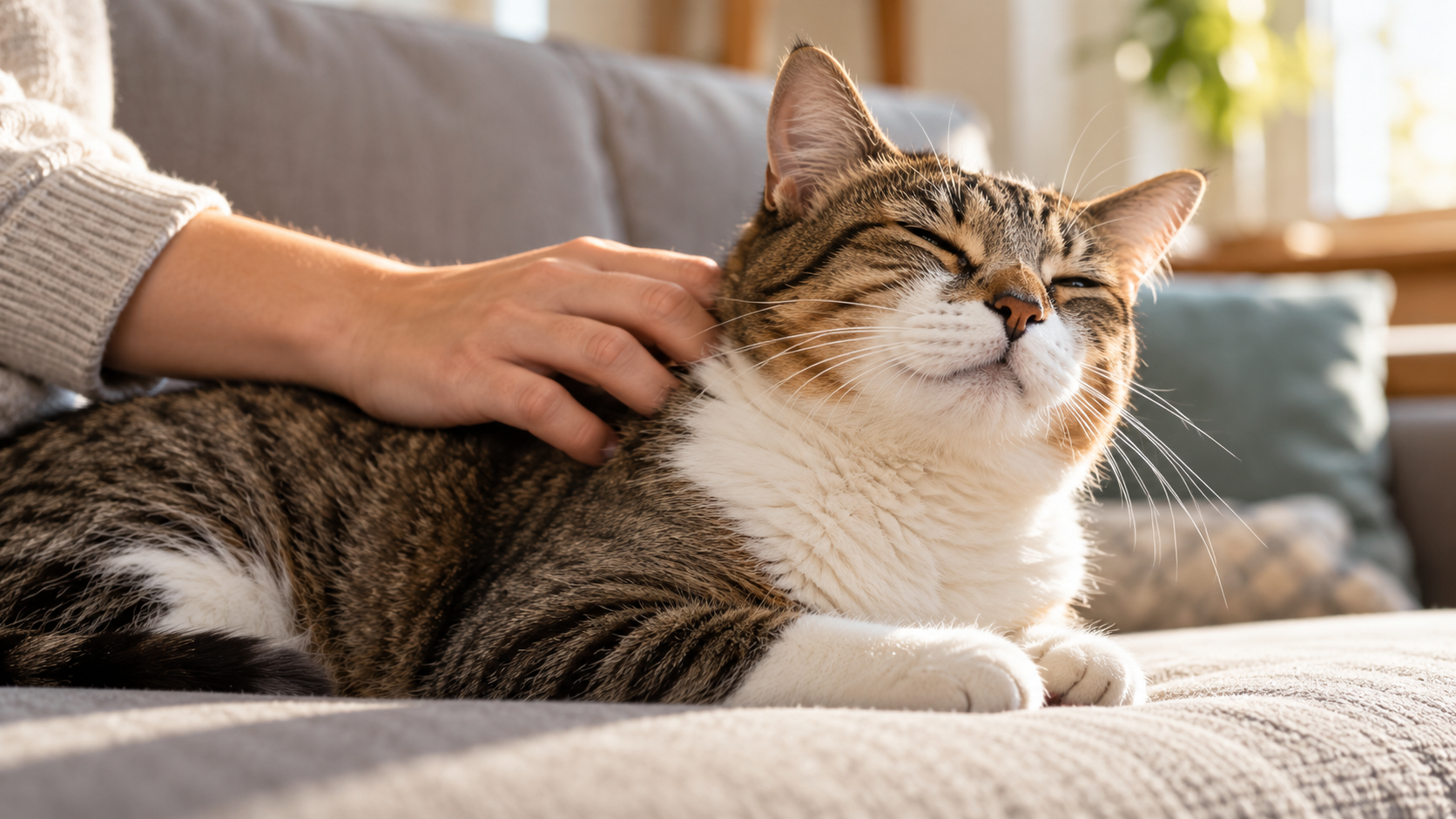
Cat Purring Explainer
A domestic cat produces a purr through low-frequency vibrations generated in the larynx as air moves in and out. Unlike a meow, which is usually shaped mainly during exhalation, a purr can continue through both phases of breathing and sound almost continuous. Muscles, nerves, vocal folds, air pressure, and flexible tissues all contribute. The familiar rumble is then transmitted through the throat and body, so it can be heard and felt. Scientists agree on the laryngeal source but continue to investigate exactly how active muscle control and the mechanical properties of the tissues divide the vibration.
The process begins with neural signals that regulate the muscles around the larynx, often called the voice box. Earlier explanations proposed that these muscles rapidly open and narrow the glottis—the gap between the vocal folds—at the rhythm of the purr. Each pressure change would interrupt airflow and create a pulse. Measurements show repeating electrical activity in laryngeal muscles, supporting an important role for nervous control. The brain region that initiates the pattern has not been mapped as simply as an on-off switch, and emotion, social context, and arousal appear to influence when the pattern begins.
Recent laboratory work adds a passive mechanical component. Researchers examining excised cat larynges found that air moving through the tissues could produce purr-like low frequencies without repeated nerve impulses. Small connective-tissue pads embedded in the vocal folds may increase their mass and allow them to oscillate more slowly than expected for a small animal. That result does not show that a living cat purrs with no muscular involvement. It suggests that neural control may position and tension the larynx while airflow and tissue dynamics sustain part of the vibration.
A purr usually lies in a low audible range and includes a fundamental rhythm plus harmonics. Inhalation and exhalation can have slightly different acoustic patterns because airflow direction, pressure, and tissue position change. The chest and skull act as resonant structures, while contact with the cat makes the vibration especially noticeable. Individual cats differ in pitch, loudness, and regularity. Body size, anatomy, health, posture, and breathing all affect the sound, so a quiet purr is not evidence that a cat lacks the underlying mechanism.
Cats purr in more than one emotional state. Kittens and mothers use purring in close contact, and adult cats often purr during friendly interaction or rest. Cats may also purr when injured, frightened, giving birth, or seeking care. The behavior therefore cannot be translated simply as happiness. It may serve communication, self-regulation, or solicitation depending on context. Claims that purr frequencies directly heal human or feline tissue remain speculative; low-frequency vibration can be studied biologically, but an ordinary purr is not a demonstrated medical treatment.
A change in purring should be interpreted alongside breathing, appetite, posture, activity, vocalization, and other signs. Labored respiration, open-mouth breathing, blue or pale gums, collapse, or sudden distress requires urgent veterinary attention regardless of whether the cat is purring. A clinician may listen to distinguish a normal laryngeal purr from airway noise, wheezing, or chest sounds. The best current explanation is a partnership: the nervous system sets the conditions, air passes through specialized laryngeal tissues, and those tissues vibrate at a remarkably low rate during both halves of the breath.
Cat purring arises in the larynx as controlled airflow interacts with vocal folds and specialized tissue during inhalation and exhalation. Key terms include larynx, glottis, vocal fold, neural signal, airflow, oscillation, fundamental frequency, harmonic, resonance, and context.
No. Cats can purr during friendly rest, nursing, stress, pain, illness, or solicitation. Body language, breathing, appetite, and the surrounding situation provide the meaning.
Probably not. Muscle and nerve activity helps control the larynx, while recent evidence indicates that airflow and the passive properties of vocal-fold tissue can sustain low-frequency vibration.
Explore more "Explainers"
Discover additional explainers across politics, science, business, technology, and other fields. Each explainer breaks down a complex idea into clear, everyday language—helping you better understand how major concepts, systems, and debates shape the world around us.