

Corkscrew Leverage Explainer
A corkscrew pulls a cork by joining two simple mechanical actions. First, a pointed helical “worm” is rotated into the cork so that several turns of metal engage the resilient material. Second, a handle, lever, or threaded frame applies an upward force while another part of the tool bears against the bottle. The helix distributes the load along a longer path than a hook would, while the reaction point lets the user lift without relying only on finger strength. Different corkscrew designs package the same basic job in different arrangements.
The worm acts as both a screw and an anchor. Turning converts rotational motion into axial movement, so each revolution advances the tip by approximately the helix pitch. The cork presses elastically against the metal and into the spaces between turns. Friction and mechanical engagement then allow an upward pull to travel from the tool into the cork. A wide, sharp, open helix usually enters with less damage than a blunt solid auger. If the worm is driven off-center, it can cut through the side or emerge against the glass instead of carrying a balanced load.
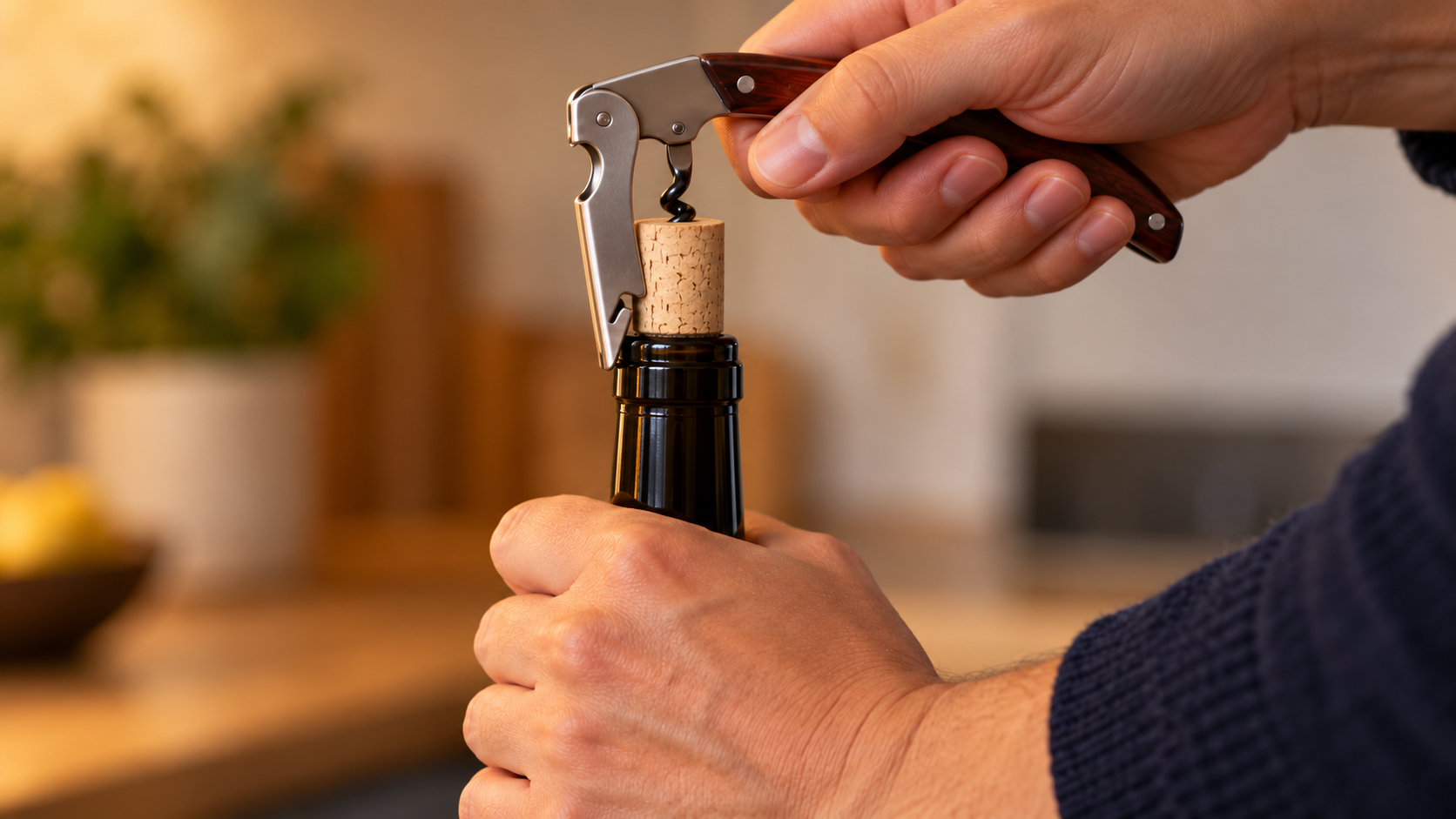
A waiter’s corkscrew uses a hinged fulcrum that rests on the bottle lip. The handle becomes a lever: the user applies force at a relatively long distance from the pivot, while the worm and cork move nearer the pivot. That geometry trades a longer hand movement for a larger lifting force. Two-step versions change the contact point partway through the pull, keeping the handle in a useful range and lifting the cork more vertically. The bottle, lip, and tool carry equal and opposite forces, which is why the support must sit securely rather than on fragile glass edges.
Wing corkscrews add a nut-and-rack mechanism. As the central worm turns down, gears or linkages raise the two arms. Pushing the arms down reverses the motion and pulls the central shaft upward. Lever or rabbit-style tools constrain the worm and bottle neck in a frame, using compound links to insert and withdraw it with a broad handle stroke. A simple T-handle lacks a fulcrum; the user must supply the entire pulling force directly, though twisting during extraction can reduce static friction. None of these tools removes the need for sound alignment.
Cork resists removal for several reasons. It is compressed into a neck slightly smaller than its original diameter, so it presses outward on the glass. Surface friction, adhesion from stored liquid, and the seal at the sides add resistance. Natural cork also changes with age, moisture, and storage. A dry or degraded cork may crumble before it transfers enough force, while a synthetic closure can be more elastic and require a longer steady pull. Driving the worm too shallow concentrates stress near the top; driving it completely through can shed fragments into the wine.
Safe technique begins by removing the capsule below the lip, wiping the neck, placing the bottle on a stable surface, and centering the worm. The bottle should not be clamped by the user’s knees or pointed toward a face. Apply smooth axial force and stop if the glass chips or the cork disintegrates. Specialized two-prong pullers or pressure devices work differently and may suit fragile corks, but they introduce their own risks. The ordinary corkscrew succeeds because a helix forms a distributed grip and a lever or screw mechanism multiplies a controlled upward pull.
A corkscrew embeds a helical worm in cork and uses a lever, thread, or linkage to pull upward against the bottle. Key terms include worm, helix, pitch, friction, axial force, fulcrum, lever arm, mechanical advantage, reaction force, and compression.
Centering keeps the load distributed and the pull aligned with the bottle neck. An angled worm can tear the cork, scrape the glass, or emerge through the side.
Its two fulcrum positions keep the handle geometry favorable during different parts of the lift, reducing sideways force and the effort needed for a long cork.
Explore more "Explainers"
Discover additional explainers across politics, science, business, technology, and other fields. Each explainer breaks down a complex idea into clear, everyday language—helping you better understand how major concepts, systems, and debates shape the world around us.